
19. Allen Iverson
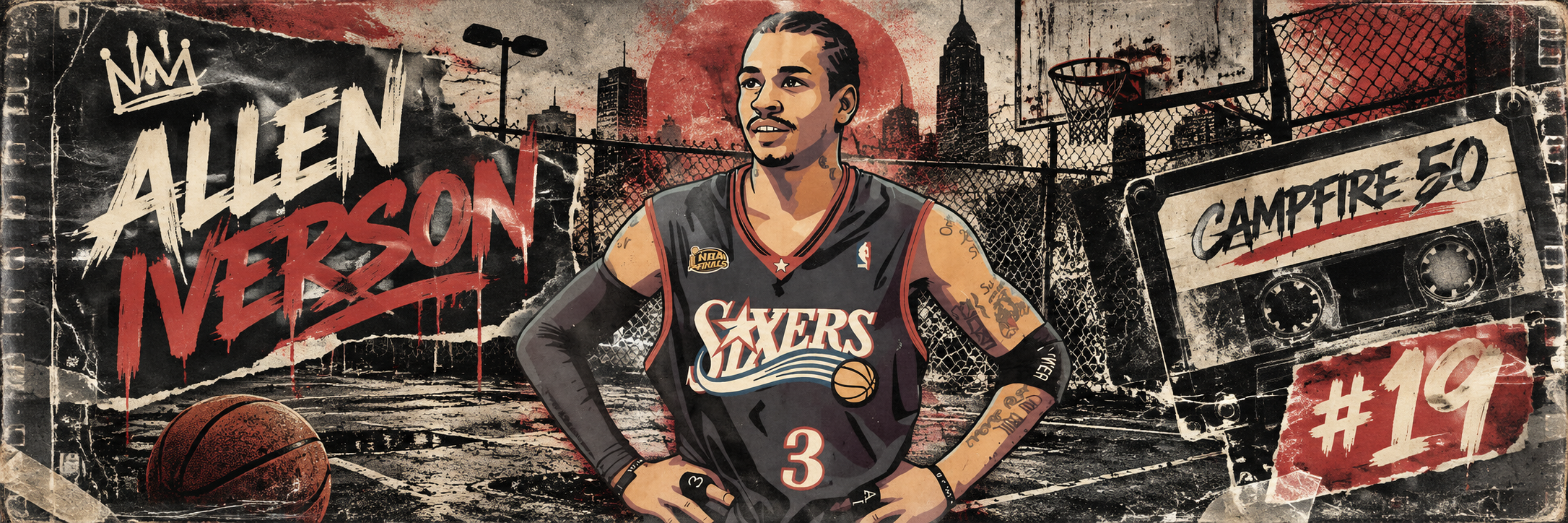
50 WORDS ON ALLEN IVERSON
Allen Iverson made defiance look absurdly athletic. He was too small, too fearless, too stubborn, too culturally loud for the league’s preferred template. Every crossover felt personal; every collision looked survivable only because he decided it was. He changed clothes, language, and attitude. Basketball never looked quite as obedient afterward.
CAMPFIRE ERA STATS
Main line: 27.5 PPG / 3.6 RPG / 6.1 APG / 2.2 SPG / 0.2 BPG
Longevity: 710 regular season games / 63 postseason games
Era Ranks: 1st in steals per game / 1st in minutes per game / 3rd in points per game
CAMPFIRE ERA ACCOLADES
2000-01 Regular Season MVP, 11-time All-Star, 6-time All-NBA, 2 top-five finishes in MVP Vote
THE PEAK
2000-01 - Iverson averaged 31.1 points, 4.6 assists and an NBA-leading 2.5 steals, won the scoring title and MVP, and carried Philadelphia to 56 wins and the NBA Finals. He also led the league in minutes at 42.0 per game.
Then he somehow carried an even heavier load in the playoffs: 32.9 points and 46.2 minutes per game across 22 games, culminating in the famous Game 1 victory over the previously undefeated-in-the-postseason Lakers.
There were slightly more efficient versions later. There was never a more definitive or dominant version of Allen Iverson.
WTF STAT
One of just two players in NBA history to lead the NBA in scoring and steals in the same season twice.
NON-BASKETBALL COMPARISON
DMX - Proof that you don't need to be physically enormous to have an enormous presence. Instead, all you need is rawness, urgency, defiance and some swagger. Just like his hip-hop counterpart, Allen Iverson was such a powerhouse that eventually the mainstream had to adjust to him instead of the other way around.
THE RIPPLE
Iverson changed both who could look like an NBA superstar and what an NBA superstar could look like.
Basketball-wise, he became definitive proof that a small guard could carry enormous scoring responsibility without being a conventional pass-first point guard. His speed, handle, crossover, relentless rim attacks and willingness to absorb contact gave generations of smaller guards a different model of offensive stardom.
Culturally, his influence extended well beyond on-court tactics. The cornrows, tattoos, sleeves, clothes, hip-hop connection and refusal to sand down his personality made him one of the league’s defining cultural figures. Some of those choices generated significant criticism at the time, but later generations of players operated in an NBA where individual style and self-expression were considerably more normalized.
He didn’t single-handedly cause that evolution. But it is difficult to tell the story of how NBA player culture changed around the turn of the century without Iverson near its center.
WHAT HIS PEERS SAY
“I can put it in its simplest terms - pound for pound, the best player to ever play the game.” - (Alonzo Mourning, 2016)
IN HIS OWN WORDS
“I’d rather have more heart than physical ability and talent because I think heart gets you a long way. A lot of times people don’t think they can go the extra mile because they’re fatigued, mentally drained, or physically drained. I’m always thinking I can go the extra mile. You can have all the talent in the world. But if you don’t have no heart to back that talent up, somewhere down the line you’re gonna be lost.” - (Allen Iverson, 2001)
ROLL THE TAPE
THE BEGINNING
THE SKILL
THE PERFORMANCE
THE ARTIFACT