The Throwback Tapes: Lakers vs. 76ers, Game 6 of the 1980 NBA Finals
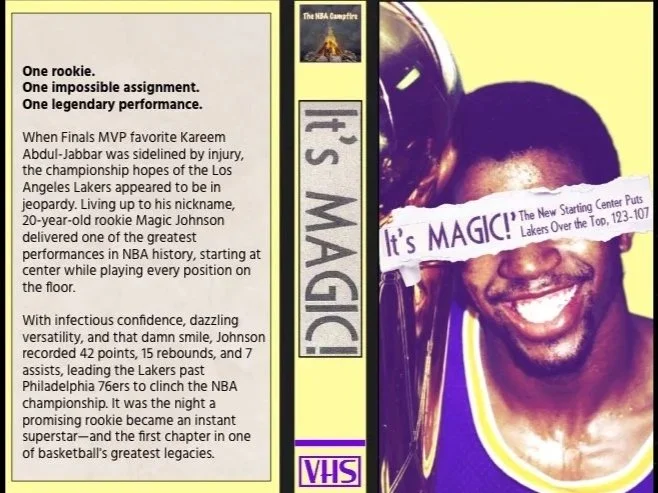
It’s the smile.
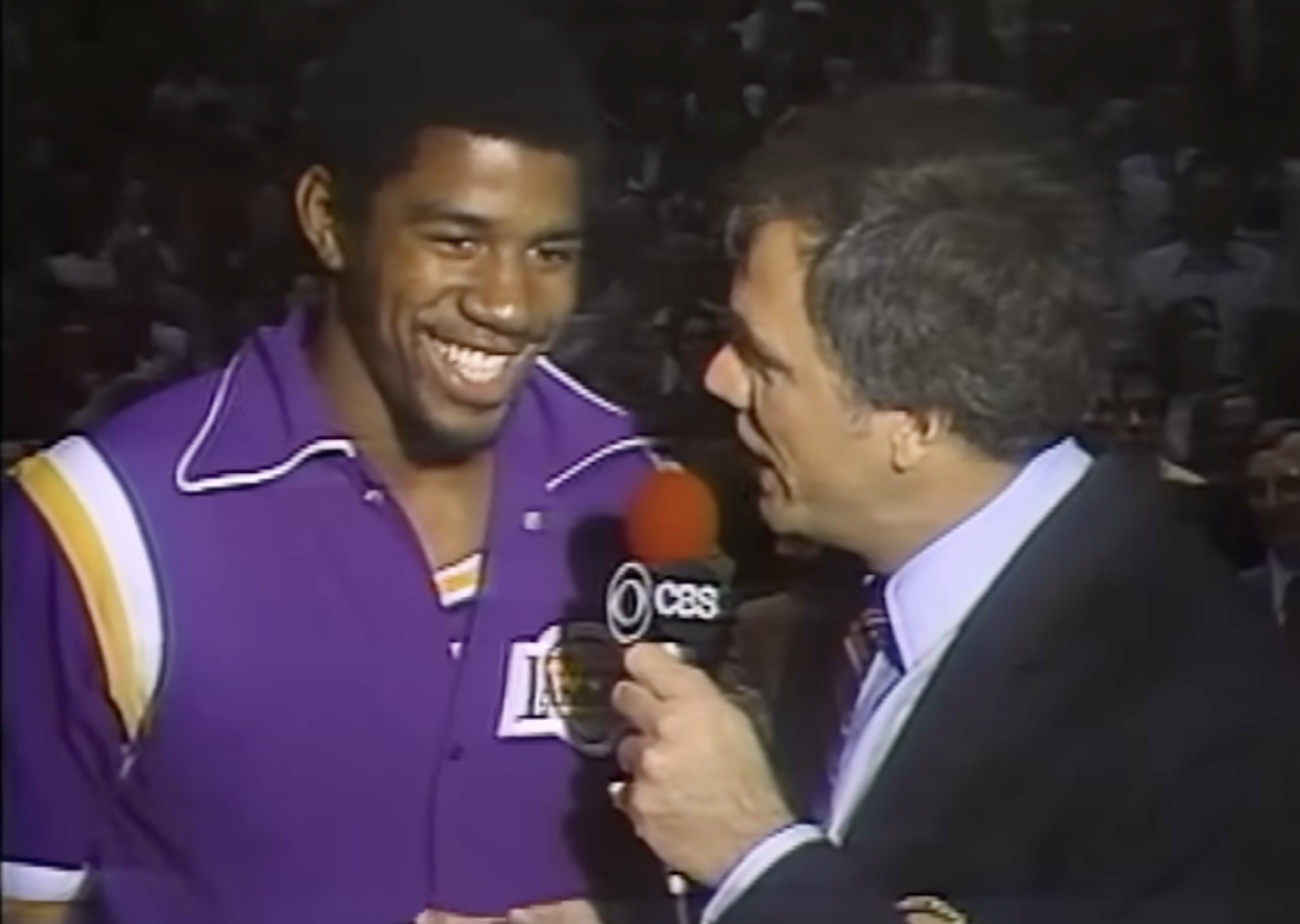
The first time you see Magic Johnson on the screen, during a pre-game on-court interview with Hot Rod Hundley, he’s got a big smile on his face, and that should’ve been the first and most obvious sign that the hometown Philadelphia 76ers were in for a world of hurt inside of The Spectrum on this Friday night in May 1980.
It wasn’t a devious smile like Dexter Morgan’s, one that oozes with, ‘Bet you didn’t expect to end up on my table, did you? It’s going to be an absolute pleasure to carve your body up with an assortment of sharp tools’ energy.
It wasn’t mischievously smug like the one you’ll see plastered across David Blaine’s face in the aftermath of blowing someone’s mind with a sleight of hand card trick that seems impossible.
It wasn’t a shit-eating grin like the one on Kevin James’ face in the viral King of Queens meme from 2023, or explicitly arrogant like the one Conor McGregor flashes on a profanity-fueled press tour promoting one of his fights.
It was joyous. It was genuine. It was completely carefree.
It was the smile of a young man who was perhaps a little naive to the weight of the situation he found himself in.
It was quintessential Magic Johnson.
Of course, in 1980, nobody really knew what that meant just yet. Game 6 of the 1980 NBA Finals was just Magic Johnson’s 93rd career NBA game, and despite the fact that he was the 1979 NCAA Tournament’s Most Outstanding Player, the 1st overall pick in the 1979 NBA Draft, the runner-up for Rookie of the Year — behind Boston Celtics rookie Larry Bird, who earned 63 of the 66 first-place votes for the award — and already an NBA All-Star, everything about Magic Johnson was still more conceptual than fully realized at this point.
Sure, the audience that tuned in to see Magic and Bird go head-to-head for the first time in March 1979 remains to this day the largest to ever watch a college basketball game, and yes, getting drafted to the Los Angeles Lakers put an exceptionally bright spotlight on the league’s youngest star. It’s not as if Magic Johnson was anonymous ahead of the NBA Finals. But he was, for all intents and purposes, still unproven at the professional level. And now, with Los Angeles Lakers center and reigning league MVP Kareem Abdul-Jabbar still back in Los Angeles nursing a badly injured ankle, Magic was tasked with proving himself in both hostile territory and under unenviable circumstances.
This bears the question, Why the hell was Magic Johnson seemingly so legitimately happy ahead of Game 6?
Just one day before Game 6 of the 1980 NBA Finals, head coach Paul Westhead and the rest of the Los Angeles Lakers coaching staff made their decision to leave Kareem Abdul-Jabbar and his badly sprained left ankle behind in Hollywood as LA boarded a plane to fly across the country to attempt to close out the Philadelphia 76ers and win their first NBA Championship in eight years. It was a decision that in retrospect had to feel like the Lakers were admitting defeat, even if nobody within the Lakers organization would’ve publicly admitted as much. The mood on the team plane was, according to Lakers swingman Michael Cooper, “tense and somber,” which is a totally understandable state of mind to find yourself in when you’re faced with the realization that you’re about to enter a gunfight without your biggest and most powerful bazooka.
In the 1979-80 season, the 32-year-old Kareem cruised to his record-extending sixth MVP award, averaging 24.8 points, 10.8 rebounds, 4.5 assists and 3.4 blocks per game for the 60-win Lakers. In Jabbar, the Lakers had a game-changing big man who gave you nearly everything any franchise would want out of its leader, its captain and its marquee superstar… durability, consistency, selflessness, and dominance on both ends of the floor.
So with all of that said, it takes a huge set of nuts for Magic Johnson to do what he did next.
As the last player to board the Lakers team plane for that flight to Philadelphia, Magic Johnson took his place in the front of the plane and sat in the seat that Kareem Abdul-Jabbar had occupied throughout the season, and with gusto, announced to his teammates, “Never fear. Magic Johnson is here.”
The nuts on this guy. Am I right?
The story goes that on this flight, Westhead and Magic put their heads together and concocted an outside of the box game plan that they hoped would flummox the 76ers and prevent the Lakers from having to even think about whether Kareem Abdul-Jabbar could come back for a do-or-die Game 7 less than 48 hours later. That plan involved not only starting Magic Johnson at center, but keeping him there throughout the game, stepping in for his fallen teammate and helping the not-quite-Showtime Lakers to push the tempo more than they ordinarily could with their ultra-talented, but lumbering big man on the floor.
History has told us that Magic Johnson played center against the Philadelphia 76ers in Game 6 of the 1980 NBA Finals. That’s what Hot Rod Hundley and Magic himself talked about in that pre-game interview, the one where Magic was smiling that genuine, joyous and completely carefree smile. It’s what everyone who watched this game as it happened remembers about it 46 years later. It’s what you read in the opening paragraph of any retrospective article written about the career of Magic Johnson.
And I’m here to tell you, with all due respect to those involved in the proliferation of this fable, this is all bullshit, because Magic Johnson DID NOT play center against the Philadelphia 76ers in Game 6 of the 1980 NBA Finals.
Magic Johnson played every fucking position against the Philadelphia 76ers in Game 6 of the 1980 NBA Finals, and he did so majestically, he did so flawlessly, and he did so in dominant fashion.
At every juncture of the game, when the Lakers found themselves in any sort of conundrum, Magic Johnson provided the solution. Need some energy right out of the gate to keep the Philly home crowd subdued? Magic’s got ya covered. Need someone to dominate the boards? Magic will pull down a game-high 15 rebounds. Need a scoring punch to account for the absence of Kareem’s 25 points per game? Magic’s 43 points should suffice. Need a response every time the Sixers surge back into the game to make things interesting? Magic was prepared to respond. He provided the Lakers with so many solutions, it’s a surprise he didn’t lock down the nickname ‘The Answer’ a full decade and a half before Allen Iverson made his debut in the Association.
A quick aside…
If you haven’t heard already, I put together a little project called Hoopertheticals, a card deck with 60 prompts meant to serve as conversation starters and thought experiments for diehard basketball fans, which is available for purchase right now on NBA Campfire.
Within one of the 60 prompts in the deck, I make the statement that Allen Iverson’s nickname — The Answer — is a nearly perfect nickname, and the reason I needed to add the word ‘nearly’ because there is only one truly perfect nickname in the NBA. A nickname so synonymous with the player it’s been attached to, it probably hasn’t even clicked in your head that I’ve already used it two dozen times in this column without even mentioning the player’s birth name.
The first time Earvin Johnson was called ‘Magic’ was in 1974, when after seeing the future three-time NBA MVP stuff the stat sheet with 36 points, 18 rebounds and 16 assists in just the second game of his sophomore season at Everett High School, Lansing State Journal sports writer Fred Stabley Jr. dropped a bar that was so profound that he might as well have filed a petition for a name change and attended the subsequent court hearing for the 15-year-old, because from this point on, ‘Earvin’ was nothing more than a seldom-used pseudonym and a reminder that there was once a time where we didn’t know the magic that Magic Johnson was capable of.
In the Philadelphia 76ers, Magic Johnson faced a challenge far greater than any he would encounter while at Everett High, or at nearby Michigan State University, where Johnson spent two seasons playing under Hall of Fame head coach Jud Heathcote. The Sixers had three Hall of Famers of their own on the roster, one who was arguably the biggest star in professional basketball at the time Magic Johnson entered the NBA in 1979.
Julius Erving was the runner-up to Kareem Abdul-Jabbar in the 1979-80 NBA MVP vote. He would win the very same award one year later, adding it to a collection of trophies he accumulated while in the ABA, winning three straight MVP awards from 1974 to 1976. Dr. J — another nearly perfect basketball nickname, by the way — turned the 76ers into instant contenders upon his arrival in the City of Brotherly Love after spending the first five years of his professional career playing (and dominating) in the NBA’s rival league.
Although Erving was Philadelphia’s only clear-cut superstar, the 76ers were by no means a one-man show. Flanking the Doctor was a solid support staff that included a heady young point guard who already played like a seasoned veteran (Maurice Cheeks), a backcourt running mate who had already won an NBA championship in Portland (Lionel Hollins), an NBA All-Star and All-Defensive Team mainstay at the opposite starting forward spot (Bobby Jones), and a backboard-shattering big who went by the nickname Chocolate Thunder (Darryl Dawkins) which is simultaneously an awesome NBA nickname and a potential name for a delicious Ben and Jerry’s Ice Cream.
But even a Sixers team that was in the middle of a seven season run of excellence that culminated in 1983 with an NBA Title — with a whole lot of help from Moses Malone — wasn’t capable of holding down a player of Magic Johnson’s caliber on the night he would put forth his career’s magnum opus. The night he would lead the Lakers to their first of five NBA Titles in the 1980s.
The greatest trick that Magic Johnson has ever pulled was making folks believe that there wasn't a maniacally competitive basketball virtuoso who was prepared to slit your throat with a box cutter hiding behind the joyous, genuine and completely carefree smile. There clearly was, and this game isn’t the only primary source that informs a statement such as this one.
Across 45 potential postseason close-out games in his illustrious career, Magic’s points, rebounds and assists averages are all higher than both his regular season and postseason career averages in those very same categories. This is the sign of a player who was ready, willing, able and super eager to hammer nails into coffins whenever the opportunity presented itself.
What made Magic somewhat unique compared to some of the sport’s greatest champions is that it never seemed as if he was chasing the high of vanquishing rivals. The snarling fist pumps, the mean-mugging, and the flexing that became common calling-cards of players like Michael Jordan, Kobe Bryant and LeBron James were for the most part absent from Magic’s celebration repertoire. Instead, he basked in the euphoria of victory by hugging teammates, high-fiving fans in the front row, and flashing that fucking smile as he was inching closer and closer to yet another win. In the end, getting that win was all Magic Johnson was concerned with.
After the game, former NBA Finals MVP turned broadcaster Rick Barry interviewed Magic Johnson, and Barry almost seemed salty throughout the interview that Magic had achieved such success so quickly in the NBA. With a tinge of envy and dissatisfaction, Barry asked Magic, “What do you have that makes you perform like this in these championship games?”
Magic, with that trademark smile on his face replied, “I love to win. And I guess that’s the thing. I go in thinking we can win any game I play.”
That’s a fact. And on this night, even without Kareem, there was no way that Magic Johnson and the Lakers were going to lose.
Next Up on Throwback Tapes: ‘No Country For Old Men’ (July 23rd)