
The Throwback Tapes: Bulls vs. Pistons, Game 4 of the 1991 Eastern Conference Finals
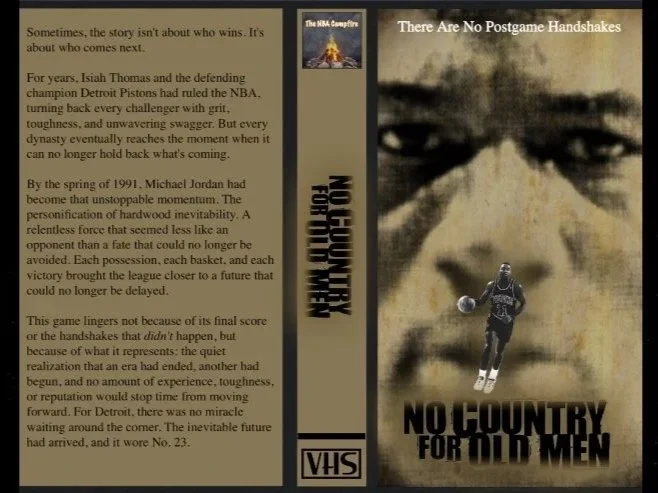
Act I: Reputation
“What’s this guy supposed to be, the ultimate badass?”
-Llewelyn Moss
“If Michael Jordan were 5’6″ instead of 6’6″, he’d be the greatest serial killer in the history of serial killers.”
-David Aldridge, 2024
Over the last 40 years, the mythology of Michael Jordan has been built upon not just the highlights, accolades, and results that we’ve come accustomed to seeing and hearing about, but maybe more importantly, the glowing, first-hand accounts of those who were there to see all of the preposterous things that he was capable of doing on a basketball court. What makes most of these testimonials so unique compared to other great players who have graced the hardwood is how in order to capture what the Michael Jordan experience was actually like, individuals felt compelled to think so far outside of the box that the box was no longer in eyeshot.
The most famous example of this came from three-time NBA MVP and three-time NBA champion Larry Bird, who stated after Michael Jordan’s 63-point game against the Boston Celtics in 1986 that it wasn’t Jordan who was on the parquet floor that afternoon… it was “God disguised as Michael Jordan.” Years later, Reggie Miller recalled an instance in which a trash-talking MJ referred to himself as “Black Jesus” after a Chicago Bulls win over the Indiana Pacers.
Former NBA player, head coach and analyst Doug Collins once stated that Michael Jordan’s level of genius on a basketball court was comparable to that of Albert Einstein or Thomas Edison in their respective fields. Similarly, sociologist and civil rights activist Harry Edwards compared Jordan’s degree of human achievement as being on par with Mahatma Gandhi and Michelangelo before proclaiming that if he were in charge of introducing alien life to humans, he would first introduce them to MJ in order to show them “the epitome of human potential, creativity, perseverance and spirit.”
Albeit slightly hyperbolic, this sort of praise is fairly standard when it comes to our most revered athletes. It’s not at all uncommon to talk about these individuals as if they were real-life superheroes, capable of doing things that normal human beings could only imagine, which is 100 percent true when it relates specifically to their craft. But with Michael Jordan, the praise often transcends the typical boundaries of hero-worship and veers toward something that is just as complimentary, but significantly darker in tone.
In a 2013 profile commemorating MJ’s 50th birthday, award-winning writer Wright Thompson referred to Jordan as, “A breathtaking asshole” and “a killer, in the Darwinian sense of the word.” A reporter once asked Luc Longley to use one word to describe Michael Jordan, and appropriately, “predator” was Longley’s choice. In the critically-acclaimed documentary The Last Dance, Jud Buechler explained that even Jordan’s teammates feared him. Collins, who coached MJ for five seasons total across stints with both the Chicago Bulls and Washington Wizards, once said of his former player, "He wants to cut your heart out and then show it to you."
Without context, these words come off more like the petrified testimonials of the poor souls who crossed paths with a diabolical criminal at some point in their past and somehow lived to tell the story than they do the adoring tributes to a once-in-a-generation basketball icon, but that is what makes Michael Jordan the most uniquely captivating athlete that has ever existed within in our collective consciousness. It also makes him very easy to compare to Anton Chigurh.
For those who have not seen the 2007 Coen Brothers film No Country For Old Men, there are five things you need to know about Anton Chigurh:
Anton Chigurh is played brilliantly by Javier Bardem, who won an Academy Award for Best Supporting Actor for his performance. If someone were to ask me to make a Mount Rushmore of the greatest antagonist performances in film over the last 40 years, it would be Javier Bardem as Anton Chigurh, Heath Ledger as The Joker (The Dark Knight), Anthony Hopkins as Hannibal Lecter (The Silence of the Lambs), and Edward Norton as Roy/Aaron Stampler (Primal Fear). I’ll hear arguments for others, but from what I’ve seen, I’m not prepared to budge off of these four.
In a report for the Journal of Forensic Sciences, an independent group of psychologists named Chigurh the most realistic depiction of a clinically diagnosed psychopath ever put on film.
Cormac McCarthy, who penned the 2005 novel that the Coen Brothers would soon after adapt for film, described his vision of Chigurh as, “pretty much pure evil.”
Although he lacks the traditional type of charisma that characters like The Joker or Hannibal Lecter possess, Chigurh undeniably has an aura about him that’s palpable. Even after multiple viewings, every time he appears on screen his presence still sends a chill down my spine. There is something viscerally uncomfortable about watching him interact with other human beings, and yet you can’t take your eyes off of him.
There’s a line in the movie where Woody Harrelson’s character — Carson Wells, a smarmy southern bounty hunter tasked with stopping Anton Chigurh and retrieving $2 million of drug money — was asked by an associate just how dangerous Anton Chigurh is. With such perfect deadpan timing, Wells responds, “Compared to what, the bubonic plague?” This is my favorite line in the whole movie. Anton Chigurh is so dangerous and destructive that, according to someone within the No Country For Old Men universe who knows him about as well as someone can know a person like him, he can only be compared to a disease that killed half of Europe’s population in the 6th Century, and then again in the 14th Century. And what’s fucked up is, by the end of the movie, you’re kinda like, Yeah, that comparison makes perfect sense. I would rather contract the bubonic plague than ever encounter Anton Chigurh.
Put simply, Anton Chigurh was an unrelenting and unstoppable killing machine who was responsible for at least 13 deaths in the film. Based on both how adept he was at ending people’s lives and the way he carries himself without even a semblance of compassion or remorse for those he murdered, it’s reasonable to believe he could have been one of the most prolific killers to ever walk the earth.
Now do me a favor: read this next paragraph aloud and keep in mind that most of what is said is just a retread of the previous paragraph about Anton Chigurh, a ruthless hitman who murdered multiple people in No Country For Old Men using a cattle gun.
Put simply, Michael Jordan was an unrelenting and unstoppable killing machine who is responsible for at least 13 Hall of Fame players missing out on championship rings throughout the 1990s. Based on both how skilled he was at the game of basketball and the way he carried himself without even a semblance of compassion or remorse for those he vanquished, it’s reasonable to believe he could have been one of the most prolific champions in any era of basketball.
This doesn’t sound totally out of place, right? It’s pretty much in line with the way we normally discuss Michael Jordan’s basketball career, isn’t it? I mean, isn’t it accurate to say that the thing that people love most about Michael Jordan is his killer instinct?
Now it should go without saying, but allow me to state the obvious really quick just to avoid any potential confusion… It’s much more acceptable to have a killer instinct on the hardwood than it is in, you know, everyday life. It’s something that we can appreciate about an athlete, and something we should rightfully fear about any other person who hasn’t pursued a career in athletics.
Fortunately for Michael Jordan — and the rest of us — he channeled all of this toward basketball, and it’s what, above all else, has made him such an iconic figure, even before he won his first NBA Title. MJ’s cutthroat competitiveness has arguably become the defining trait about him as a basketball player, even more so than his above-the-rim style of play, his mid-range mastery, or his capacity for coming through in crunch time. We love when our favorite athletes possess these Chigurh-esque characteristics and knock the guys who don’t. That’s right, Chigurh-esque is how I just described Michael Jordan.
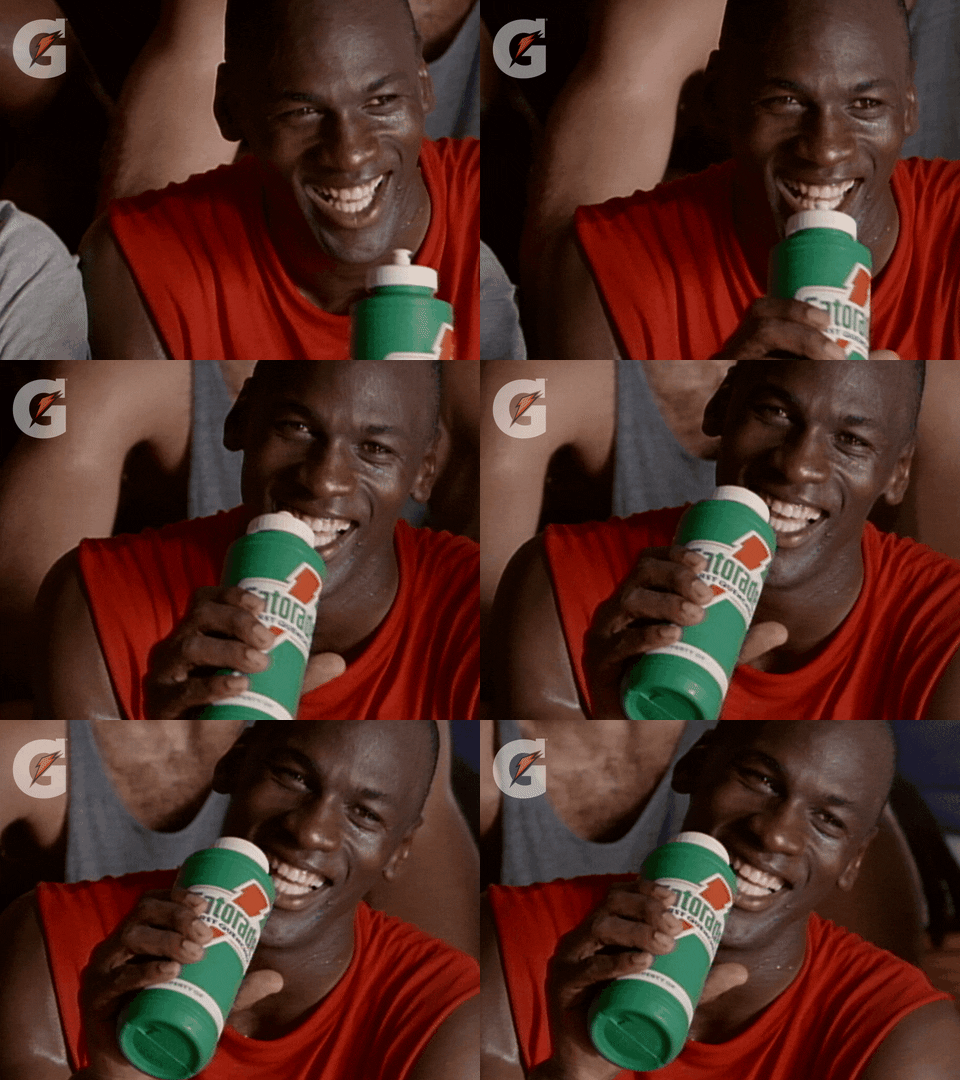
Yet with all of that said, I still find it interesting that the most beloved and marketable athlete to ever live is so regularly talked about in a manner that can easily be mistaken for how we discuss serial killers or hitmen that it has become commonplace within the culture to apply this sort of rhetoric to everyday folks who haven’t literally broken the Sixth Commandment. I guess it helps when you have the face of a man who makes you want to put on Hanes underwear, lace up a pair of Nikes, order a Big Mac and wash that down with a Gatorade.
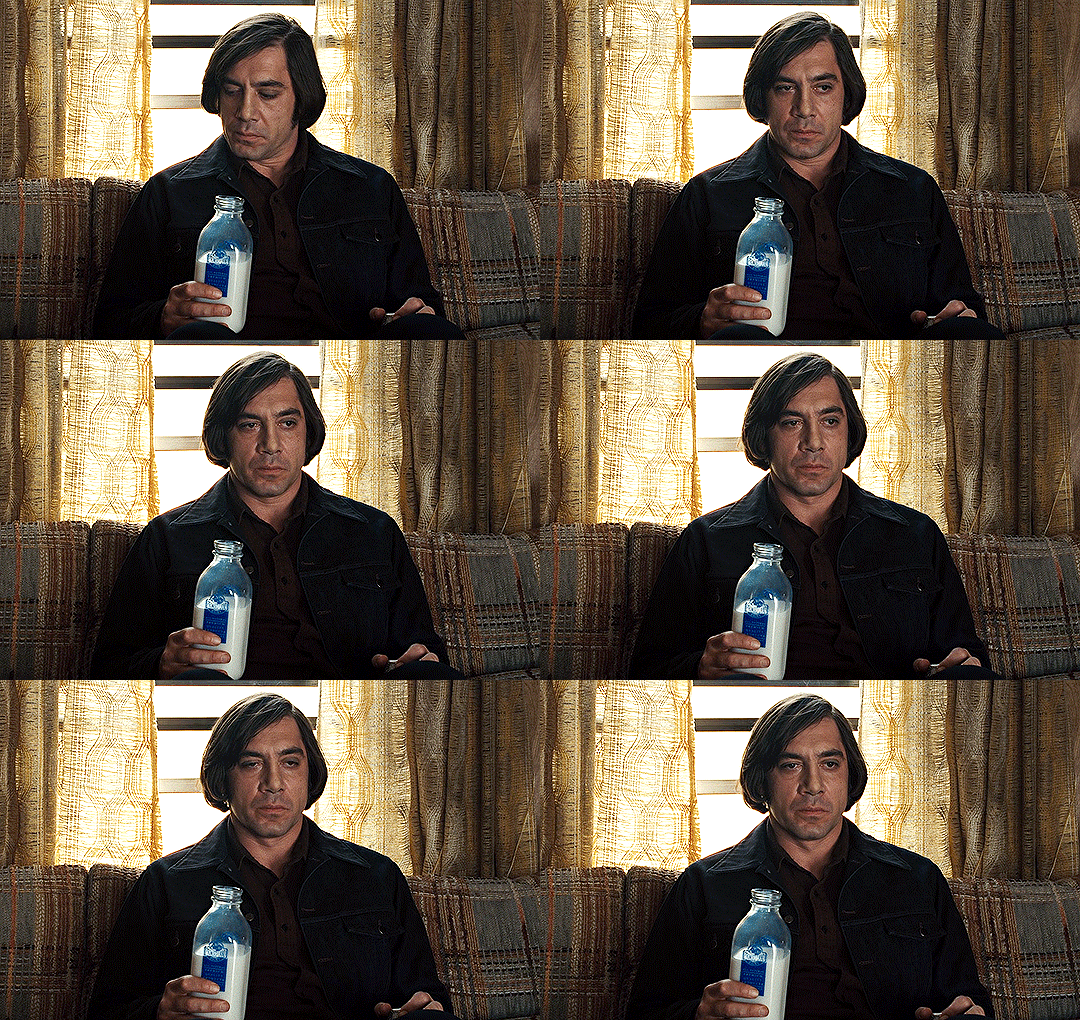
Anton Chigurh’s face makes you reconsider whether you should ever drink milk again.
Act II: Conviction
“You don't understand. You can't make a deal with him. Even if you gave him the money he'd still kill you just for - inconveniencin' him. He's a peculiar man. You might even say that he has principles. Principles that transcend money or drugs or anything like that. He's not like you.”
-Carson Wells“The Game of Basketball has been everything to me. My refuge, my place I’ve always gone when I needed to find comfort and peace. It’s been the source of intense pain, the source of the most intense feelings of joy and satisfaction.”
-Michael Jordan, 2009 Hall of Fame Induction Ceremony
Anton Chigurh lives by an uncompromising set of principles in which fate is sovereign, consequences are unavoidable, and personal emotion has no authority to interfere with either. Chigurh doesn't kill out of anger, revenge, or pleasure. He kills because he believes it's required by the logic of his personal code. If someone stands in his way, all it means is they have become part of the chain of events leading to the conclusion of his mission, and their death now becomes an obligation that he needs to fulfill.
In Chigurh’s mind — and to be clear, this is what makes him a psychopath — he doesn’t believe that he’s the one deciding whether someone lives or dies. He’s the instrument of someone’s fate, not the author. He believes the outcome was written long before he arrived. Even in the instances when he gives someone the opportunity to call a coin flip to determine whether they live or die, Chigurh’s belief is that the outcome is preordained.
People don’t really choose their own destiny… they simply arrive at the consequences of all of the choices they’ve already made. The gas station owner’s destiny was to survive the coin flip, and as a result, the coin becomes something more than just a coin.
Think about communion in Christianity.
The bread is still bread. The wine is still wine. Yet believers understand them to possess a sacred significance because of what they represent — the body and blood of Christ. Anton Chigurh treats the coin almost exactly that way. It has passed through a ritual, it has revealed someone’s destiny, and as a result, it deserves reverence. It’s a sacrament. The entire interaction resembles a liturgy more than a high-stakes, life-or-death gamble.
Hey, speaking of gambling…
Michael Jordan abides by a code as well, and although it seems fairly straight-forward that MJ’s code — his purpose on the hardwood, if you will — is to win at any cost, I actually believe it goes deeper than that. There’s a misunderstanding that MJ was just a psychotic competitor who could never flip that switch off. Hell, even MJ seems to think as much, saying in The Last Dance, “I don’t have a gambling problem, I have a competitiveness problem.” That’s all fine and good, and frankly, it’s accurate. The man clearly has an addiction to competition. But ‘a competitiveness problem’ isn’t the full extent of what we’re talking about here.
Listen closely to the way Michael Jordan talks about basketball, and you’ll find that there’s something reverential about the way he speaks. It’s always framed as, “The Game of Basketball,” in that the ‘T', the ‘G’ and the ‘B’ should all be capitalized because there is something holy about it, the same way that the word Him is capitalized in the Bible when in reference to God. MJ holds The Game of Basketball in the highest regard, to the point that he would dutifully weaponize his competitiveness problem to protect the Game from those who don’t honor it properly, whether they be opponents or even teammates.
“Once you joined the team, you lived at a certain standard that I played The Game. And I wasn’t gonna take anything less. Now if that meant I had to go in there and get in your ass a little bit, then I did that,” Jordan explained during The Last Dance. “I wanted to win, but I wanted them to win and be a part of that as well. That’s how I played The Game. That was my mentality.”
“If you don’t wanna play that way,” Jordan said with tears in his eyes, “don’t play that way.”
Michael Jordan believed there was a proper way to compete on the court. Maximum effort with 100 percent accountability. Never concede psychological ground, and if someone challenges you, even unintentionally, use it as fuel. His ability to find emotional leverage over everyone he crossed paths with felt almost animalistic and instinctual. Perhaps it goes without saying, but nobody was better than MJ at manufacturing slights, disputes, or criticisms. Whether it be because LaBradford Smith had the audacity to say, “Good game, Mike,” or because Clyde Drexler dared to be considered by some as MJ’s equal, or because Charles Barkley or Karl Malone had the audacity to steal his MVP award, Michael Jordan’s code allowed him to raise his game.
But MJ’s response to all of these personal affronts paled in comparison to any perceived attack on The Game of Basketball. For the love of God, don’t fuck with The Game of Basketball, because if you do, Michael Jordan is going to make it his life’s mission to eradicate you forever.
It took four years, but the Bad Boys Pistons eventually learned this the hard way.
Act III: Realization
“I feel overmatched. I always figured when I got older, God would sorta come into my life somehow. And he didn't. I don't blame him. If I was him I would have the same opinion of me that he does.”
-Sheriff Ed Tom Bell“We just didn’t have anything. You could tell because we got beat to every loose ball and rebound. All the things you need to win a ballgame, we lost. The mind says, ‘Go,’ but the body said, ‘I can’t do it.’ They beat us in every phase of the game. They are better. That’s the bottom line.”
-Isiah Thomas, after Game 4
In the minds of most hoops fans, Larry Bird and Magic Johnson are the embodiment of all that is right about professional basketball. Bird’s Celtics and Magic’s Lakers dominated the league from the time they arrived in the Association in 1979 fresh off of the most watched NCAA Tournament Final ever, and for all intents and purposes, they saved the NBA as it stumbled into a new decade out of a troubling ten-year run in the 1970s. These two singular stars were the standard-bearers of the sport, exhibiting what was possible when the most uniquely talented players in the world played perfect team basketball.
By anyone’s calculation, even by Michael Jordan’s lofty standards, Bird and Magic played and approached The Game of Basketball the right way, if not similar stylistically to MJ then at least philosophically aligned, and for the sake of this conversation, that’s a crucial distinction. So accordingly, when the time was right — and by 1988, when Michael Jordan was winning his first MVP Award, it felt like it was time — the torch was supposed to be passed from Magic and Bird to MJ.
The Bad Boys Pistons had other ideas.
Isiah Thomas, Bill Laimbeer, Joe Dumars and the rest of the Detroit Pistons of the mid-to-late 1980s represented the bridge between these two distinct eras of admirable championship dynasties. A blip, if you will, in what many consider to be the Golden Age of professional basketball. The Pistons were biggest bullies on the block and a departure, both stylistically and philosophically, from what Bird, Magic and Jordan all represented.
Larry Bird, Magic Johnson and Michael Jordan could all, in one way or another, be described as beautiful basketball players. Bird made the complex look simple. He was like a novel that was carefully constructed, intellectually rewarding and constantly building toward a satisfying conclusion. Magic Johnson made the impossible look joyful, bringing spontaneity, collaboration and surprise to the court like was a free-styling jazz musician out there with his bandmates just riffing, seeing what they could come up with on the fly. The beauty of Michael Jordan’s game came with how routinely he made human excellence look superhuman, like the conquering hero in a mythological epic blockbuster that demands to be seen on the biggest screen possible.
Contrarily, the Detroit Pistons played basketball like they pulled up to the arena with lead pipes, tire irons, brass knuckles and pocket knives. There was nothing beautiful about it. They wanted games to resemble a street fight, or every so often, those games literally broke down into street fights.
By the time the 1991 NBA Playoffs rolled around, the Detroit Pistons were two-time champions and aiming for a three-peat. They had had already defeated Magic Johnson and the Los Angeles Lakers in the 1989 NBA Finals, they had twice knocked Larry Bird and the Boston Celtics out of the Playoffs, and for three straight years, it was the Bad Boys and their ‘Jordan Rules’ that sent the Chicago Bulls home empty-handed, and sent Michael Jordan home bruised, battered, and without the championship ring that was practically his birthright.
Eliminating Bird and Magic was impressive enough, even if it could at least be argued that Father Time had just as much of a hand in those results as anything the Pistons were doing on the court, but Detroit’s steady dominance over the game’s best young player and the powerhouse he was leading that was rising to the forefront of the league in the Windy City was something entirely different. It wasn’t just impressive… it was an alarming indictment of where the NBA may be headed.
As long as the Bad Boys were sitting on the throne, the sanctity of The Game of Basketball was being put at risk. And whether you believe that to actually be true all these years later, it’s a fact that this is how the Detroit Pistons were being spoken about by non-partisan fans, and covered by the league’s broadcasting partners.
At halftime of Game 4 of the 1991 Eastern Conference Finals, the NBA Showtime halftime show — hosted by Bob Costas, and coincidentally, Pat Riley, who would soon after take over as the head coach of the New York Knicks and bring a lot of the Bad Boys tactics with him to The Big Apple — had kept a ‘Cheap Shot Count’ for the Pistons throughout the first half. Apparently, the Pistons had dished out eight cheap shots in the 1st half alone compared to just one from Chicago. Then, coming out of the halftime break, Pistons head coach Chuck Daly proclaimed that the Bulls were playing more like “Bad Boys” in the 1st half than the Pistons were, which play-by-play commentator Marv Albert responded to by saying that Daly’s line of thinking was coming from, “a distorted point of view.”
For the record, Marv wasn’t necessarily wrong to note the hypocrisy, but his willingness to immediately call this out was a sign that the league itself had grown tired of the Bad Boys schtick and was ready to get things back on track. Fortunately for the NBA, nobody hated the Detroit Pistons more than Michael Jordan, and nobody was more equipped, both mentally and physically, to turn himself into a nuclear weapon designed to exterminate the mini-dynasty that dared to fuck with the purity of The Game of Basketball than MJ was.
“People want to push this kind of basketball out,” Jordan said before Game 4 in Detroit, with Chicago holding a 3-0 series lead. “I don’t feel we’re overconfident, but we want to kill this team.”
And oh boy, the Bulls did indeed kill the Bad Boys. Throughout the entirety of the four-game series, the Pistons led for just 8 minutes and 38 seconds out of a possible 192 minutes, and based on Game 4 alone, it’s a surprise that Detroit led at any point in the Eastern Conference Finals.
The Pistons looked old compared to the Bulls. There were times when the Bulls were pressing full court, or trapping at half-court with Jordan and Scottie Pippen out front where it felt like you were watching one of those videos of a group of Orcas teaming up to hunt a poor baby seal. Only these weren’t baby seals that were being hunted. These were Hall of Fame guards and bonafide tough guys in the frontcourt who looked helpless against Chicago. They were slower, less athletic, and less energetic than their counterparts, and their ‘Bad Boys’ act was less a means of intimidation and more an act of desperation.
In the 4th quarter, with the game already out of hand, Ahmad Rashad interviewed Pistons general manager Jack McCloskey, and he asked McCloskey about the advanced age of his team. McCloskey, perhaps in denial or maybe just fed up with having to partake in the interview in the first place, responded, “Well, we’re still one of the final four in basketball. We won over 50 games. Age, as you know, is just a number.”
Had the Pistons fought valiantly until the final buzzer, a statement like this one wouldn’t seem so ridiculous in retrospect. But with 7.9 seconds left on the clock, led by Isiah Thomas and Bill Laimbeer, the Pistons left their bench, walked past the Bulls without shaking hands, and disappeared into the tunnel. The franchise wouldn’t return to the Conference Finals for another 12 years, long after Isiah, Dumars, Laimbeer, Rodman, and James Edwards’ fu manchu facial hair had retired from the National Basketball Association.
Just like the 1991 Eastern Conference Finals, No Country For Old Men doesn’t end with a climactic showdown. In Old Men, the film concludes with soon-to-be-retired Sheriff Ed Tom Bell realizing that there is a limit to what one man with a badge can accomplish. His job was never to defeat evil forever. His job was hold off evil for as long as he could. It just so happens that Anton Chigurh represented a particularly inevitable sort of evil.
By the end of the Game 4, Isiah Thomas had a similar realization. The Pistons didn't just lose to Michael Jordan. They came face to face with the realization that basketball's future had become inevitable.
Epilogue: Inevitability
“You know what's going to happen now. You should admit your situation. There would be more dignity in it.”
-Anton Chigurh“You don't want to mess with him in the series. Say hello at the beginning of the series. Shake his hand at the end of the series. But during the series, don't let him use anything to motivate himself to be a better player than the greatest player in the game of basketball.”
-Brendan Malone to George Karl, before the 1996 NBA Finals
In No Country for Old Men, Anton Chigurh isn't simply a villain—he's an unstoppable force. The film's central question isn't whether he'll arrive, but when. Once he's on your trail, the old rules no longer apply. What makes him so frightening is that in addition to being absurdly violent, he’s also presented as a force that seems almost detached from ordinary human emotion. He keeps coming. Never distracted, never rattled. Most villains are unpredictable because they're chaotic, but Chigurh is the opposite. He's frightening because he's predictable. Characters spend the film trying to outthink him, outrun him, or simply just survive him, but the movie repeatedly suggests that some things are inevitable.
For three straight years, the Pistons had been the force that dictated the NBA's future. But as the Chicago Bulls were crowned Eastern Conference Champions in 1991, it became clear that Michael Jordan had become basketball's inevitable force. The one that nobody would be able to outplay, outwork or survive.
Before that night, MJ was still the hero fighting to overcome the challenge that the Bad Boys presented and to bring virtue back to The Game of Basketball. After sweeping Detroit, his narrative role within the NBA changed. Michael Jordan became the force of nature that everyone else had to reckon with for the rest of the decade. From then on, teams weren't merely trying to win a championship… they were trying to interrupt what increasingly felt like basketball's natural order.
But so long as Michael Jordan donned the #23 jersey for the Chicago Bulls and played a full season of basketball, nobody could.
Next Up on Throwback Tapes: ‘Holiday Hoops’ (August 6th)