The Throwback Tapes: Heat vs. Celtics, 2010 Debut of The Heatles
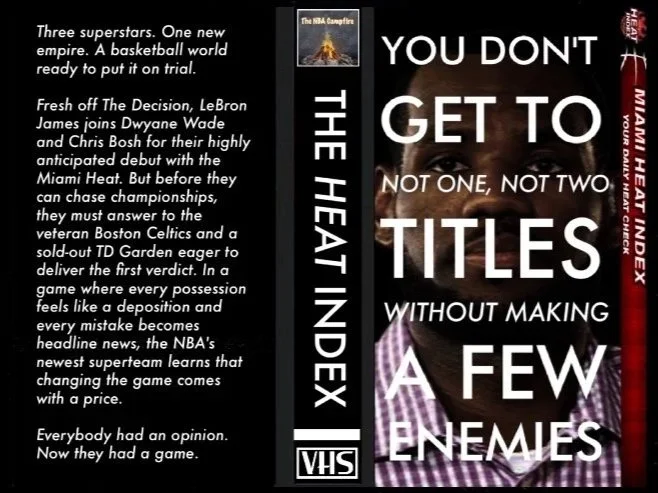
LeBron James had spent the Summer of 2010 being told by others what kind of man he was.
Free agent.
Savior.
Coward.
Villain.
Traitor.
Genius.
Now as he walked off the floor at the TD Garden after his first regular season game as a member of the Miami Heat, the Boston Celtics had given everyone, particularly those predisposed to rooting against LeBron James, another word to use.
Loser.
On October 26, 2010, The Court of Basketball had delivered its verdict: Boston 88, Miami 80.
The crowd roared as LeBron disappeared into the tunnel, a fate eerily similar to how his second-consecutive MVP season with the Cleveland Cavaliers had ended just five months earlier.
It had been three months since LeBron James announced his decision to leave Cleveland, joining Dwyane Wade and Chris Bosh in Miami. Three months since these three All-Stars stood beneath a shower of smoke and promised multiple championships that had not yet been won.
For three months, the basketball world had argued over what the Miami Heat represented.
Was this an example of ambition or cowardice? Player empowerment or superstar arrogance? Were the Miami Heat a stacked team or a flawed team? The exciting future of basketball or the destruction of everything that came before it?
Now, finally, there was a basketball game to use as evidence, and the scoreboard delivered the first verdict in this complex case.
The Court of Public Opinion had already reached its own verdict long before this game was played. The Court of History, with the luxury of patience, would eventually reach another. But the true meaning of a decision is rarely visible at the moment it is made.
This is the story of a decision made in an hour, and a verdict that took four years to arrive.
The Court of Public Opinion
The first witness is Michael Jordan.
Although he hasn’t been nearly as vocal as the National Basketball Association would surely like him to be, Michael Jordan’s voice carries greater weight than almost anyone else’s on all matters related to basketball. With six NBA championships and five MVP’s to his name, he’s considered arguably the greatest competitor AND winner in professional sports.
MICHAEL JORDAN
“There's no way, with hindsight, I would have ever called up Larry or Magic or anybody and said, 'Hey, look, let's get together and play on one team.’”
Michael Jordan’s sentiment was one shared by most former players and many analysts as well, including the most influential voice in basketball media.
The next witness is Bill Simmons.
Bill Simmons saw LeBron’s decision as something more than a troubling basketball decision or an abdication of ambition. He saw it as an example of an athlete whose arrogance would assassinate his own approval rating.
BILL SIMMONS
“I blame us for feeding his narcissism to the point that he referred to himself in the third person five times in 45 minutes. I blame local and national writers (including myself) for apparently not doing a good enough job explaining to athletes like LeBron what sports mean to us, and how it IS a marriage, for better and worse, and that we're much more attached to these players and teams than they realize. For LeBron not to understand what he was doing — or even worse, not to care — made me quickly turn off the television, find my kids, give them their nightly bath and try to forget the sports atrocity that I had just witnessed. He just couldn't have handled it worse. Never in my life can I remember someone swinging from likable to unlikable that quickly.”
Then the case left the basketball court entirely.
The next witness is Dan Gilbert.
Dan Gilbert wasn’t interested in whether or not LeBron James had made the correct basketball decision. He believed that LeBron James had committed an act of betrayal, not just against him personally or the organization he owned, but against an entire city.
DAN GILBERT
“As you now know, our former hero, who grew up in the very region that he deserted this evening, is no longer a Cleveland Cavalier. This was announced with a several day, narcissistic, self-promotional build-up culminating with a national TV special of his ‘decision’ unlike anything ever ‘witnessed’ in the history of sports and probably the history of entertainment. This shocking act of disloyalty from our home grown ‘chosen one’ sends the exact opposite lesson of what we would want our children to learn. And ‘who’ we would want them to grow-up to become.”
Three witnesses, three accusations.
Cowardice.
Arrogance.
Betrayal.
And these accusations came long before LeBron James played a single game in a Miami Heat uniform.
The Court of Basketball
10:53, 1st Quarter
Shot clock winding down. Chris Bosh drives baseline, dishes underneath the basket to Joel Anthony. Anthony bobbles the catch, kicks it out to LeBron James on the right wing. With 1 second on the shot clock, LeBron rises up and drills a contested jumper. His first bucket as a member of the Miami Heat, and the first points scored by any player during the 2010-11 NBA season.
The Court of Public Opinion
The Defense calls Reggie Miller to the stand.
Reggie Miller is a textbook example of a player who prioritized loyalty to a single franchise over anything else. All 18 seasons he played were with the Indiana Pacers, and despite the fact that the Pacers never won an NBA Title during Miller’s tenure, he remains a folk hero in the Hoosier State to this day.
With that said, Reggie Miller was careful not to judge too harshly, and even expressed excitement regarding watching this unique basketball experiment unfold in Miami.
REGGIE MILLER
“You go to Miami and it’s great. I get it. I cannot wait to call games in South Beach and to watch these three players play.”
Perhaps nobody was more excited for the future of Miami Heat basketball than the man who worked behind the scenes to facilitate the greatest free agency coup in league history.
Pat Riley is the next witness to take the stand.
PAT RILEY
"We are looking forward to the opportunity of building something that our fans in Miami will be proud of for a long, long time. The journey is just beginning."
How involved Pat Riley actually was in putting the Miami Heat’s Big Three together can be debated. Many speculate that it was Miami’s star player who planted the idea in the heads of LeBron James and Chris Bosh to join him in South Beach two years earlier when the trio won a Gold Medal together at the 2008 Summer Olympics.
The Defense calls on Dwyane Wade.
DWYANE WADE
"This is surpassing a dream come true. You always want to put yourself in the best position possible. To have an opportunity to team up with arguably the best trio to ever play the game of basketball is amazing. Yeah, it's going to be Hollywood down here.”
Dwyane Wade was not wrong. The Miami Heat became lightning rods for attention in a way that few professional sports teams ever have, becoming celebrities to the degree that the nickname “The Heatles” — a nod to The Beatles — caught on before their first season as teammates had even reached its halfway point.
Instant celebrity, however, did not equate to instant success.
The Court of Basketball
8:33, 1st Quarter
A LeBron James steal leads to a transition opportunity for the Miami Heat. On the break, LeBron throws a pass behind Dwyane Wade. Miami turns it over.
7:48, 1st Quarter
Dwyane Wade dribbles the ball off of his own foot. It’s Miami’s third turnover in the opening four minutes of the game.
6:53, 1st Quarter
LeBron misses mid-range jumper off the back of the rim. Chris Bosh and Dwyane Wade both crash the offensive glass, both have an opportunity for tip-in, but tip the ball away from each other. Rajon Rondo turns the mistake into instant offense, dishing to Shaquille O’Neal on the break for a dunk.
End of 1st Quarter
Celtics lead 16-9 after one quarter of ugly, disjointed basketball. LeBron James, Dwyane Wade and Chris Bosh combine for 7 points and 6 turnovers in the opening frame.
The Court of Public Opinion
In the immediate aftermath of LeBron James’ decision, questions arose not only about how quickly the Miami Heat could gel, but also relating to whether the optics of three star players deciding to play together — rather than compete against each other — was good or bad for the National Basketball Association.
Perhaps nobody was more qualified to speak on this topic than NBA Commissioner David Stern.
DAVID STERN
"Our players, having negotiated for the right to be free agents at some point in their career, are totally within their rights to seek employment with any other team. That's something we agreed to. That's something we embrace. That's our system. They don't collude, they just sort of talk about how nice it is to be able to play together and they're allowed to do that. There's nothing wrong with it. That's just the way it is."
Even though Michael Jordan had made it clear that the decision LeBron James made was not one he would’ve made in his heyday, the majority owner of the Charlotte Bobcats acknowledged that the NBA had changed and that it wasn’t necessarily a change he was opposed to.
MICHAEL JORDAN
"Things are different. I can't say that's a bad thing. It's an opportunity these kids have today.”
Despite the legality of the transaction, it didn’t mean the world was ready to see players start to take power into their own hands. It was a concept still mostly foreign to the NBA’s fanbase in 2010, and of course, since it was the league’s reigning two-time MVP who was the one to buck the status quo, it was naturally going to lead to some exaggerated reactions.
DWYANE WADE
"We knew Bron would take some backlash. I told him he's a strong man for it."
The Court of History
December 2, 2010
Nowhere was the backlash to LeBron’s decision stronger than in Cleveland, Ohio. Understandably, fans of the Cleveland Cavaliers were devastated when The Kid From Akron chose to leave behind Northeast Ohio and take his talents to South Beach, and when it came time for LeBron James to return to the arena he had called home for his first seven NBA seasons, it was a virtual certainty that the crowd inside of Quicken Loans Arena would not just be bonkers… they would be bloodthirsty.
At this point in the season, the Heat were only 11-8, sitting in 4th place in the Eastern Conference standings. Meanwhile, the scrappy Cavaliers were 7-10 with wins already over eventual playoff teams like the Boston Celtics, Philadelphia 76ers and Memphis Grizzlies. Going into a highly-anticipated Friday night National TV matchup, it felt like the Miami Heat were not just beatable, but truly vulnerable.
After the 28-point win over his former team, LeBron James claimed that this was the most complete game the Heat had played all season up to this point. But what he said — and the tone in which he said it — about the Cavaliers organization and the city of Cleveland is what got the most attention after the fact.
“Seven great years. Loved every part. Loved every moment,” James told TNT’s Craig Sager. “From the growth when I was an 18 year old kid to a 25 year old man. And we tried our best. As a team we tried our best to bring a championship to this city and just try to play hard every night. I got the utmost respect for this franchise. The utmost respect for these fans.”
The Court of Basketball
6:25, 2nd Quarter
Celtics lead 31-15, and Marv Albert — on the call for TNT with Steve Kerr and Mike Fratello — notes that the Heat’s newly formed Big Three is shooting 4-for-21 from the field thus far. Steve Kerr astutely points out, “I think what we’re seeing is a team in Boston that has their identity. They know who they are and they’re comfortable with each other. And Miami is just trying to figure it out.”
4:17, 2nd Quarter
LeBron’s pass to Bosh slips through his hands and out of bounds. At the other end, Ray Allen hits a three. Celtics lead 38-20. Erik Spoelstra calls a timeout. The Heat are shooting just 24 percent from the field, and the Celtics home crowd is loving it.
End of 2nd Quarter
Heat trail 45-30 at half. LeBron, Wade and Bosh have combined for 21 of Miami’s 30 points, but they’ve made just 7 made field goals and committed 9 turnovers. Everyone who claimed that the construction of this team — three superstars and a limited supporting cast — would make it impossible for the Heat to win at a high level feels vindicated, as does everyone who believed that chemistry was being overlooked and that even a team with the highest-end talent couldn’t microwave success.
The Court of History
May 11, 2011
Following a 9-8 start to the season, the Miami Heat were able to find another gear. Between November 29 and January 9, Miami won 21 of their next 22 games. They would finish the season with a 58-24 record, good for 2nd place in the Eastern Conference. Perhaps poetically, there were only three teams in the NBA that The Heatles had a losing record against in their first regular season campaign together:
The top-seeded Chicago Bulls, led by league MVP Derrick Rose, who were one win away from clinching their first Conference Finals appearance since Michael Jordan’s final season with the team.
The Dallas Mavericks, who, well, let’s hold that thought.
The Boston Celtics, who were 3-1 against Miami in the regular season and had been tormenting both LeBron James and Dwyane Wade for years.
However, on May 11, 2011, the Heat found themselves one win away from eliminating the Celtics in the 2nd round of the NBA Playoffs. This was two nights after LeBron, Wade and Bosh combined for 85% of Miami’s points (83), 77% of their rebounds (35), and 70% of their assists (7) in an overtime win in Boston in Game 4.
Following a Chris Bosh dunk with just under 3 minutes to play in Game 5, Miami and Boston were deadlocked at 87. Over the remainder of the game, nobody else besides LeBron James would score a point. All 10 of the nails that were left to be hammered into the coffin of the 2010-11 Boston Celtics would be pounded into place by the man that Cleveland Cavaliers color commentator Austin Carr would adoringly and routinely call ‘The Akron Hammer.’
After the game, an elated LeBron James talked about the victory, but even in this moment of hard-earned euphoria, he found a way to bring it back to his decision to leave Cleveland 10 months earlier.
“I knew I had to go through Boston at some point,” James said. “I went through a lot signing to be here. The way it panned out with all the friends and family and fans back home, I apologize for the way it happened. But this was the opportunity of lifetime.”
In this moment, three sentiments suddenly felt overwhelmingly true: The Miami Heat had figured things out, the Boston Celtics reign of terror was over, and the Cleveland Cavaliers still took up a whole lot of real estate in both the heart and the mind of LeBron James.
In time we’d come to find out that only one of those three things was true.
The Court of Public Opinion
BILL SIMMONS
“Can you even make the Finals with LeBron, Bosh, Wade and nine minimum-salary guys? Because that might be next year's team … and if that's what happens, the answer is ‘no effing way.’”
The Court of History
May 31, 2011
After putting the Boston Celtics away in five games, the Heat would go on to do the very same thing to the Chicago Bulls in the Eastern Conference Finals, clinching an NBA Finals berth despite having the exact sort of flawed roster Bill Simmons (and many others) would scoff at over the months that followed The Decision. Now, with a Game 1 NBA Finals victory already in the books against the aforementioned Dallas Mavericks, the Heat found themselves three wins away from an NBA Title that was starting to feel pre-ordained, much to the dismay of everyone who wasn’t a Miami Heat or LeBron James fan.
The level of Schadenfreude that most basketball fans felt in regard to the Miami Heat in 2011 cannot be overstated. It was really only comparable to what the New York Yankees, New England Patriots or Duke Blue Devils have experienced at their respective peaks. It wasn’t just that people hated this Heat team… it’s that they seemed to love hating them. It wasn’t so much that otherwise unbiased fans were fed up with Miami’s success… it’s that they found an almost unhealthy amount of joy in their failures. And when this team started to fail under the brightest of spotlights in the NBA Finals, it became a feeding frenzy.
After losing Game 1, the Dallas Mavericks would win four of the next five games, capturing the first (and so far only) NBA Title in franchise history, which gave Dirk Nowitzki the signature moment that a player of his stature deserved. And while all these years later most basketball fans look back on the 2011 NBA Finals as ‘The Dirk Finals’, in 2011 this was viewed as the NBA Finals where LeBron James had an inexplicable meltdown at the worst possible time.
In the 2011 NBA Finals, LeBron James averaged just 17.8 points per game. The Miami Heat lost this series for a multitude of reasons, but maybe the biggest reason was because LeBron James did not play like LeBron James. And why did LeBron James, in the biggest moment of his NBA career, not play like LeBron James?
December 6, 2011
The short answer: Because after feeling and feeding off of all of the hatred directed toward him following The Decision, LeBron James started approaching the game of basketball with hatred instead of joy, and that, for lack of a more eloquent phrase, broke him.
The Court of Public Opinion
The Prosecution will now call two witnesses to the stand whose nicknames come close to ruining their credibility as speakers on the topic: Harold “Buzz” Bissinger and John “Skip” Bayless.
BUZZ BISSINGER
“He does not have that assassin mentality that defined Jordan and defines Kobe and translates into true greatness. If he wins in Miami, and he should, it won’t be his championship. It will be Dwayne Wade’s. There will forever be a silent asterisk attached to his name.
SKIP BAYLESS
“He came to the realization that he was a Robin in search of a Batman. He not only chose not to go to Chicago and live under Jordan’s shadow, but he went to Dwyane Wade so that he can win at least one ring.”
The Court of Basketball
0:21, 3rd Quarter
LeBron pulls down a defensive rebound, goes coast to coast and finishes at the rim with a right-handed scoop lay-in. Boston’s lead, which had ballooned to 19 points earlier in the 3rd quarter, is now down to 6. LeBron has 15 points in the frame.
“He’s just taking over,” Steve Kerr says of LeBron.
The Court of History
June 7, 2012
You surely know this story, but in case your memory is hazy, allow me to set the scene:
Coming off of a lockout that pushed the start of the 2011-12 season back to Christmas Day, the Miami Heat looked much more comfortable on the court and in their own skin than they did for most of the 2010-11 season. LeBron James, having washed off the stink of the 2011 NBA Finals, won his third regular season MVP Award in four seasons, and despite finishing with the 2nd-best record in the Eastern Conference, the Heat entered the postseason as the betting favorites to win the NBA Title.
Miami cruised to a 4-1 win over the New York Knicks in Round 1, but found themselves in some trouble in the 2nd Round. Facing a 2-1 deficit against the Indiana Pacers, LeBron answered with a 40 point, 18 rebound, 9 assist gem in Game 4, saving Miami’s season for the time being. With little drama the rest of the way, the Heat closed the Pacers out in six, setting up a Conference Finals matchup with the previously-thought-to-be-dead Boston Celtics.
After having knocked out Boston in the 2nd Round of the Playoffs just one season earlier, there was a feeling that the Heat — better this year than they were the previous season — would have no problem dealing with the Celtics — worse (and older) this year than they were the previous season — in the East Finals. After winning the first two games of the series in Miami, the Heat’s place in the 2012 NBA Finals felt like a foregone conclusion.
But those Celtics just wouldn’t die, holding home court in Game’s 3 and 4, and then stunning the Heat back in South Beach in Game 5. Suddenly, the Miami Heat found themselves on the verge of elimination, but this time, no blame could be assigned to LeBron James. Through those first five games, the league’s MVP was averaging 34 points, 11 rebounds and 4 assists per game, shooting 54 percent from the field. But still, as Game 6 approached, it felt like the career of LeBron James was being put on trial.
That makes what happened next all the more impressive.
This was not the LeBron James of one season earlier. Sure, the total lack of expression on his face as he massacred the Boston Celtics with one bucket after another might create the illusion of someone playing with an absence of joy, but at the very least, this was a version of LeBron James who was far removed from suffering a full-blown crisis of confidence in the biggest moment of his career.
In this moment, three sentiments suddenly felt overwhelmingly true: The Miami Heat had figured things out, the Boston Celtics reign of terror was over, and the Cleveland Cavaliers would be lucky to have this version of LeBron James ever consider returning to his hometown team.
This time around, all three of those things were true.
The Court of Public Opinion
DAN GILBERT
"I PERSONALLY GUARANTEE THAT THE CLEVELAND CAVALIERS WILL WIN AN NBA CHAMPIONSHIP BEFORE THE SELF-TITLED FORMER 'KING' WINS ONE."
The Court of History
June 21, 2012
For many reasons, Dan Gilbert’s Comic Sans letter has not aged well. But this is the main reason.
The Court of Basketball
7:24, 4th Quarter
A rusty Dwyane Wade misses another shot at the rim, leading to a Paul Pierce transition three. The Celtics lead is back up to nine, and the Heat call timeout. LeBron is set to sub back in after just 1 minute and 47 seconds of rest.
3:15, 4th Quarter
With the Celtics leading by 11 and the game feeling out of reach for the Heat, the Boston crowd begins chanting “Overrated!”
The Court of History
March 20, 2013
The Miami Heat had won 23 games in a row. The 2nd-longest winning streak in NBA history. And now two nights after escaping Boston with a two-point win to keep this winning streak in tact, the Heat were set to face the short-handed Cavaliers in Cleveland.
The end result, a Heat win, was a predictable outcome. The fact that Miami needed to overcome a 35-minute delay to start the game AND 27-point deficit in the middle of the 3rd quarter was not expected by anyone. But even more unpredictable than the delay or the deficit was the decision by one Cavaliers fan to rush onto the court and approach LeBron James.
Two and a half years earlier, a moment like this one would’ve been the single scariest thing that could’ve happened to LeBron James while playing a game in Cleveland as a visitor. But it was not 2010 anymore. It was 2013, and in 15 months, LeBron James would once again be a free agent with a crucial decision to make.
This Cavaliers fan would be the first one to make a recruiting pitch to the soon-to-be free agent.
This was the first time that, in a very public setting, the notion of Cavaliers fans being ready to welcome LeBron James back to Cleveland was being discussed. It was not, however, the first time that LeBron James floated the idea of returning to the Cavaliers.
February 15, 2012
“It would be fun to play in front of these fans again,” LeBron said two days before a road matchup against the struggling Cavaliers. “I had a lot fun times in my seven years here. You can’t predict the future and hopefully I continue to stay healthy. I’m here as a Miami Heat player, and I’m happy where I am now, but I don’t rule that out in no sense. And if I decide to come back, hopefully the fans will accept me.”
The Court of Public Opinion
Even with the well-established team-building obstacles that the 2010-11 Miami Heat would be forced to overcome, there was still an understanding that the high-level talent at the top of the Heat roster would likely be enough to net this franchise at least one championship in the upcoming seasons. But there was one question being asked by many observers that did not necessarily have a clear answer yet: What would this hypothetical championship mean to LeBron James?
REGGIE MILLER
“Personally, three or four championships in Miami to me is equivalent to one championship in Cleveland, just because they are a starving championship city.”
CHARLES BARKLEY
“I think it would be a lot more important and significant to win a championship in Cleveland than it would be in Miami.”
The Court of Basketball
1:10, 4th Quarter
Just when it looked like Boston had Miami dead to rights, the Heat go on a 10-0 run, punctuated by a LeBron lay-in that closes the gap to 3 points. This is why Miami did what they did in the 2010 offseason, and why despite having not played one meaningful game with each other yet, this team could never be counted out even against the reigning Eastern Conference Champion.
0:49, 4th Quarter
A do-or-die defensive possession for the Heat. Celtics fans on their feet, Rajon Rondo orchestrates the offense like a conductor. The ball pings around the court, all five Celtics touching the ball. Then an off-ball defensive breakdown leads to Ray Allen dagger three-pointer from the left corner. Celtics lead back up to six.
The Court of History
June 20, 2013
No, this is not the game where Ray Allen hit a season-saving triple from the right corner. It’s the next game. It’s the game after The Game. The game that a lot of people forget about when they think about the 2013 NBA Finals even though it was a Game 7. It’s the lost great game in the career of LeBron James. The game that LeBron James proved the well-intentioned doubters — the doubters who were willing to tip their cap and admit defeat — wrong once and for all.
For many years, the book on LeBron James was that he was nearly a perfect player who still had some notable flaws. The belief was that he couldn’t shoot free throws, his jump shot wasn’t to be trusted, and that he would shy away from taking the biggest shots in the biggest games. But in this game — again, a Game 7 with the championship on the line — LeBron James made all eight of his free throws. He made five of his 10 three-point attempts. And with the chance to clinch the a second consecutive NBA Title, LeBron stepped into a mid-range jumper and drilled it, extending Miami’s lead to four with half a minute to play.
With this victory, LeBron James became just the third player in league history to win regular season MVP and NBA Finals MVP in back-to-back seasons, joining only Michael Jordan and Bill Russell in this ultra-exclusive club. The King was officially basketball royalty, and the choice to join the Miami Heat was officially justified.
The Court of Basketball
End of 4th Quarter
The Celtics defeat the Heat by the final score of 88-80 in the opening game of the 2010-11 season. LeBron James leads all scorers with 31 points on 10-for-21 shooting. Dwyane Wade scores 13 points and Chris Bosh chips in 8. It’s the exact kind of one-man-show performance and scoring burden that pushed LeBron out of Cleveland in the first place.
The Court of History
June 15, 2014
The Big Three era in Miami was unquestionably a success. To this point in league history, there were only three other teams that had made at least four straight NBA Finals — the Boston Celtics (1957-1966), the Los Angeles Lakers (1982-1985) and the Boston Celtics again (1984-1987). Of those four teams, the Russell-era Celtics and The Heatles were the only two that won back-to-back NBA Championships in those runs. And in the long history of professional basketball, LeBron James, Dwyane Wade and Chris Bosh are the only trio of teammates who made the NBA All-Star Game in four consecutive seasons.
But by the time Game 5 of the 2014 NBA Finals was coming to an end, the Miami Heat felt like a team that was miles from title contention. The San Antonio Spurs, seeking vengeance from one of the most gut-wrenching defeats imaginable in the 2013 NBA Finals, put the Miami Heat into a wood-chipper in the 2014 Finals, putting forth a masterclass of team basketball while exploiting every single weakness this Heat squad had shown over the previous few seasons. Throughout the series, the Heat felt disjointed. They felt outclassed. They felt, in many ways, like they did at the end of the opening game of the 2010-11 season.
And in what can only be considered a spooky coincidence, the box score of Game 5 looks very familiar to the box score of that first game in Boston.
LeBron James leads all scorers with 31 points on 10-for-21 shooting. Chris Bosh scores 13 points and Dwyane Wade chips in 11. It’s the exact kind of one-man-show performance and scoring burden that pushed LeBron out of Cleveland in the first place. And it’s what many people believe is the primary reason why LeBron James would choose to return to the Cleveland Cavaliers less than one month later.
I’m here to tell you that those people are wrong, and hopefully this exercise has highlighted that. If it hasn’t, let’s return to The Court of Public Opinion one last time to call a final witness to the stand.
The Court of Public Opinion
The Defense calls LeBron James to the stand.
Over the course of three weeks during the summer of 2010, LeBron James sat down for a series of in-depth interviews with J.R. Moehringer of GQ. These interviews took place both before AND after The Decision. The following testimony was recorded less than one week after The Decision, when there may have still been LeBron jerseys being burned in Cleveland.
LEBRON JAMES
“If there was an opportunity for me to return and those fans welcome me back, that'd be a great story.”
Even though LeBron James left the Cavaliers in brutal and public fashion, he never fully slammed the door shut on the idea of returning to Cleveland. He was telling us all along that he wanted to eventually come home.
The Court of LeBron
July 11, 2014
Miami, for me, has been almost like college for other kids. These past four years helped raise me into who I am. I became a better player and a better man. I learned from a franchise that had been where I wanted to go. I will always think of Miami as my second home. Without the experiences I had there, I wouldn’t be able to do what I’m doing today.
When I left Cleveland, I was on a mission. I was seeking championships, and we won two. But Miami already knew that feeling. Our city hasn’t had that feeling in a long, long, long time. My goal is still to win as many titles as possible, no question. But what’s most important for me is bringing one trophy back to Northeast Ohio. I always believed that I’d return to Cleveland and finish my career there. I just didn’t know when. After the season, free agency wasn’t even a thought. But I have two boys and my wife, Savannah, is pregnant with a girl. I started thinking about what it would be like to raise my family in my hometown. I looked at other teams, but I wasn’t going to leave Miami for anywhere except Cleveland. The more time passed, the more it felt right. This is what makes me happy.
In Northeast Ohio, nothing is given. Everything is earned. You work for what you have. I’m ready to accept the challenge. I’m coming home.
The Decision was made in an hour. Understanding why LeBron James made it in the first place took four years. But in the end, the decision mattered far less than the man who made it.
Next Up on Throwback Tapes: ‘Ball in the Bubble’ (August 20th)