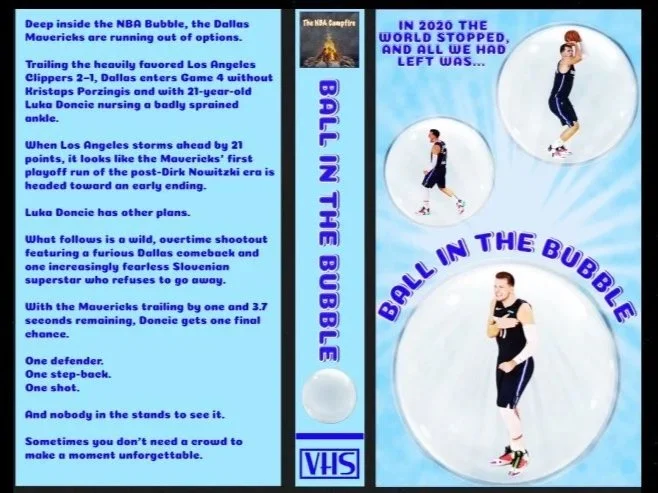
The Throwback Tapes: Clippers vs. Mavericks, Game 4 of the 2020 1st Round
I’ve played thousands of completely meaningless basketball games in my life. Games that, in the grand scheme of things, mattered to absolutely nobody. Most of them have evaporated from my memory, but a handful of them have not, and today I’d like to tell you the stories of three of those games. And I promise, after I tell you these three stories, I’ll get to covering the not meaningless at all basketball game mentioned in the title and then it won’t take long before you understand why I felt compelled to start this column this way.
The Wrong Question
It’s December 2010. The first semester of my freshman year at Florida Gulf Coast University is coming to an end. My whole world feels like it’s falling apart.
Most of my support system is 1,400 miles away. I’m missing my friends and family more with each passing day. There are lot of things in my life I suddenly can’t control, a startling realization for someone who desperately craves control. I miss the version of my life where I knew exactly where I belonged.
A basketball court is the one place where I still do.
It’s a perfect late-fall night in Southwest Florida, and I’m playing two-on-two on FGCU’s outdoor courts with three of my roommates. We’ve been out there for hours already and are getting ready to call it a night when another group of four walks onto the court. They’re all wearing shorts that are a little too short, and they all carry themselves like they come from money. One dude’s wearing a backwards baseball hat. At least two of them show up shirtless. They are, for lack of a more charitable description, four frat bros.
As we’re getting ready to pack up, Backwards Hat approaches me and asks if we want to run one. We’re exhausted, but we agree to one half court game to 15 before calling it a night. I suggest we play our four against their four.
Backwards Hat looks at me, looks at my roommates, chuckles, looks back to me, and and with the douche-baggiest grin imaginable on his face says five words to me that, given my mental and emotional state at the time, probably could not have been more perfectly designed to piss me off:
“Are you sure about that?”
Wow.
WOW.
The gall of this kid. The nerve. The sheer effrontery.
Backwards Hat, you picked the wrong fucking guy during the wrong fucking month and asked him the wrong fucking question.
But Backwards Hat doesn’t learn this immediately.
Backwards Hat and his frat bros get off to a hot start. They are, man for man, better than our foursome, and it certainly doesn’t help that we’re playing with tired bodies. In this game to 15 by 1’s and 2’s, the frat bros take a commanding 13-6 lead, and with every bucket they score comes high-fives, laughs and no shortage of trash talk. One of the shirtless bros and one of my roommates — also shirtless, but that’s beside the point — nearly get into a fist fight after my roommate gets his shit sent back on a baseline jumper. We have to physically separate them.
Thus far, I’ve been playing a similar sort of stylistic game as I played in high school, where I was twice All-League but very much a pass-first point guard. But with the score being what it was, and with those five words — Are you sure about that? — still echoing in my head, my brain chemistry has instantaneously changed, and for the remainder of my college pick-up and intramural career, so has my game.
It’s make-it, take-it, and it’s our ball. Without saying a word to my roommates, I decide that I’m taking every single shot from here on out. They quickly understand the assignment: Check the ball into play, pass it to me on the wing, and let me go to work.
Catch, size-up dribble, blow-by, right-handed finish. 13-7.
Catch, back down into the mid-post, fadeaway. Money. 13-8.
Catch and step right into a jumper from behind the three-point line. Swish. 13-10.
Evidently, this was not a fraternity that placed much emphasis on smarts, because not once did these frat bros send a double team or entertain the idea of trying out a different defender, so I kept working Backwards Hat like he was a fucking speed bag and I was Rocky Balboa.
It’s 14-13 now and we have the opportunity to send these goofballs home with an L. I check the ball into play this time, pass it in to one of my roommates and he immediately gets the ball back to me at the top of the key. I take a few attack dribbles to the left, stop on a dime at the elbow, rise up for a mid-range jumper, and it rattles in.
And with every bit of air I have in my lungs, I scream: “GET THE FUCK OFF OF MY COURT!”
These seven cathartic words echo across an otherwise empty set of courts, and right then, for the first time in a long time, I feel truly happy.
Roommate Warfare
It’s September 2012. My junior year at Florida Gulf Coast University is under way. It feels like I’ve got the whole world in my hands.
I’m living in a four-bedroom, two-bathroom apartment with the two best friends I’ve made during my first two years at college — Weston and Tyler — and a fourth roommate named Josh, who none of us knew prior to our newfound living arrangement.
Josh is not around too often for the first few weeks of the semester, and that would remain the case for the entire academic year. He hangs with a much different crowd than us and never really seems all that interested in associating with or getting to know us… except for during the three days leading up to the first game of the intramural basketball season.
By a stroke of luck, our team — named the Grizzlies, as I am very much in a Grit and Grind Grizzlies phase at this stage of my life — draws Josh’s team in the opening game of the season, and once Josh finds out about this, he’s far more interested in talking to us than he would be at any other point in the year. He is delighted that his team is playing our team. He is positively giddy about the prospect of beating us and claiming both bragging rights and apartment superiority over us.
(In fairness, he never said this explicitly, but based on the fact that he was a 20-year-old college kid who was talking copious amounts of shit for 72 straight hours leading up to this game, I assume this was what was happening in his brain.)
(Also, this game takes place six months before Josh drunkenly stumbled into our apartment one night and pissed all over our kitchen floor, thinking he was in the bathroom. He seemed genuinely embarrassed and apologetic about this bathroom mishap after the fact, so part of me was hesitant to include this anecdote, but hey, who hasn’t pissed somewhere they shouldn’t have when they were drunk? Lord knows I have.)
Anyway, as Josh talks trash to us throughout the week like he’s Larry Bird and we’re the poor souls competing against Larry Bird in the 1988 Three-Point Contest, he has no idea that every sentence he speaks about how he’s going to embarrass us is just another canister of gasoline being poured on the fire that’s burning inside of my lizard brain. It’s no different than hearing ‘Are you sure about that?’ only it’s happening over the course of multiple days.
We get to the gym that Thursday afternoon and I’m hell-bent on humiliating this kid who I still have to live with for the next seven months in front of everybody who’s there to see it.
Nobody is there to see it except the six guys on our team, the seven guys on their team, the two refs and a scorekeeper whose efforts show that at the end of the game we’ve won by 31 points.
DII vs. DIII
It’s January 2015. I’m no longer in college, but I’m playing pick-up basketball at those same outdoor courts I spent way too many hours on during my four years at FGCU. And once again, I have a vendetta to settle.
Now I want to make something very clear: the individual that I have a vendetta with at this time is someone who I actually consider a friend. His name is Zak, and Zak and I were co-workers for two years, and Zak was probably the biggest sports fan that I worked with, so instantly there was something that we could bond over.
For the sake of this story, there are four things you need to know about Zak. Well, really there’s one thing you need to know about Zak, and three things that I find hilarious.
I worked with Zak at a sports retail store called JP Sports, and a crew of workers at this store — myself and Zak included — got in the habit of pranking each other by changing the respective signatures on outgoing emails. The best one I ever came up with was changing my friend (and future co-writer) Dalton Baggett’s signature to Dalton Baguette. Just typing that out again makes me laugh out loud. But the longest running signature switch came when I changed Zak Padfield to Zak Radfield. He didn’t notice it for multiple weeks. It was great.
Zak legitimately didn’t know whether Tracy Chapman was a man or a woman, and one time when I noted that in “Fast Car” there’s a line that says, “I work in the market as a check-out girl” he said, “Well that doesn’t mean a guy couldn’t be singing it,” and I thought that was ridiculous right up until the moment Luke Combs didn’t change that line in his cover of the song that peaked at #2 on the Billboard Hot 100 chart in 2023. Zak was right and I was wrong. I’ll admit that.
One time all of the JP Sports crew gathered for a house party, and this was at the height of the popularity of the Mark Ronson/Bruno Mars mega-hit “Uptown Funk,” which was and still is an iconic jam, and was and still is my favorite song ever. Anyway, “Uptown Funk” was playing at this house party and at the point in the song where Bruno Mars sings…
Stop
Wait a minute
Fill my cup put some liquor in it
Take a sip, sign the check
Julio, get the stretch!… I grabbed a drink right out of Zak’s hand and did as Bruno Mars instructed. I took a big old sip of that drink, a drink I did not realize had tequila in it, and something that you should know about me is that my stomach and taste buds are both rivals with tequila. But in that moment I took the drink out of Zak’s hand, I felt like a baller. Not a basketballer. A straight up baller.
Several hours later I would end up puking all over my parents front yard, which is not a baller move.
Alright, here’s the thing that you actually need to know about Zak… one time Zak and I were putting new apparel out on the racks and we were sharing stories of our respective basketball playing days. I mentioned to him that instead of going to FGCU, I considered staying back in my hometown and going to a nearby college to play Division III basketball.
This prompted Zak to mention that he was scouted to play Division II ball. Upon hearing this, I realized this meant that the first time we played pick-up basketball against each other, I was going to have to run him into the ground. And on the empty courts at Florida Gulf Coast University, that’s exactly what I did.
In that moment, I felt like the other kind of baller, and it was exhilarating.
In retrospect, none of these games mattered.
I did not improve my draft stock. Nobody updated my recruiting profile. There is no grainy YouTube compilation out there titled SONNY GIULIANO WAS A PROBLEM — MUST WATCH!
But somehow, that never mattered.
Put somebody across from me who had said the wrong thing, talked a little too much shit, or simply annoyed me on a deep spiritual level, and I could manufacture enough stakes to convince myself that an otherwise meaningless basketball game had become a referendum on my value not just as a basketball player, but as a human being.
This is, admittedly, not an especially healthy personality trait. It is, however, a pretty useful one if you’re Luka Dončić.
Now, there is an important distinction that needs to be made here:
Me screaming “GET THE FUCK OFF MY COURT!” after winning a pickup game and Luka Dončić screaming “GET THE FUCK OFF MY COURT!” after winning a professional basketball game are two very different things.
When Luka does it, it adds to his aura. It enhances his intimidation factor. It’s the well-earned battle cry of a basketball virtuoso who has spent the previous two hours systematically dismantling the opponents standing across from him.
When it’s someone like me yelling that, it makes people think I’m mentally unstable. You could even argue that it’s more of a cry for help than it is a battle cry. But I would argue that the impulse comes from the very same place.
I’ve wondered occasionally why I remember those three games so vividly, and not some of the ones with bigger crowds and much higher stakes. I think it’s because basketball has never actually needed much to feel consequential. All you need is a hoop, a ball, and somebody on the other side who, for whatever reason, you desperately want to beat. The audience has and always will be optional.
In 2020, the NBA would conduct a rather expensive experiment proving exactly that.
Right in the thick of the COVID-19 Pandemic, the best basketball players in the world were dropped inside an isolated complex at Disney World, removed from their arenas, their cities, their families and their fans, and asked to manufacture playoff intensity largely on their own. Many fans and analysts were concerned that this was not just unprecedented, but impossible.
But what those fans and analysts underestimated was that every NBA player’s basketball origin story began the same way: a hoop, a ball, and somebody on the other side who, for whatever reason, you desperately wanted to beat.
Luka Dončić learned that lesson earlier than most.
Imagine yourself at the age of 13. And if for some reason you’re younger than 13 and reading this, I apologize for the frequency with which I’ve been cursing. Then again, I was probably swearing more at 13 than I do now at 34, so fuck that apology. Let’s keep going.
Imagine yourself at the age of 13, and imagine that at this stage of your life, you possessed such prodigious talent at one particular activity that the best way to harness this talent, and nurture this talent, and accentuate this talent was to travel over 1,200 miles away from your home, leave your friends and your family behind, and focus almost solely on your craft.
Then imagine that at just 16 you have been given the nickname ‘El Chico Maravilla’ — that’s ‘Wonder Boy’ for all of the non-Spanish speakers here — and soon after that you’ll start working alongside full grown adults. And imagine that given the nature of your craft, you can’t expect for any of these adults to cut you any slack or take it easy on you because you are still, in fact, a child. And when you’re a teenager with a nickname like Wonder Boy, you can probably assume the grown men across from you aren’t especially interested in protecting your feelings.
And now imagine that within three years, you’re the very best at what you do compared to all of your professional peers. You’re still only 19 years old but you already carry yourself like a seasoned vet. Your craft is polished and there isn’t an ounce of fear or self-doubt holding you back. And now you’re ready to share your gift with the entire world, and nobody has a clue just how prolific you’re going to be.
At 13, Luka Dončić left Slovenia to join Real Madrid’s academy. By 16, he was sharing a floor with grown professionals. By 19, he was the best player in Europe. Along the way, he learned that age, reputation, hostile crowds and grown men were not reasons to be intimidated. Fearlessness was baked into his development as a basketball player, and audacity was the main ingredient.
Audacity, though, is only interesting if somebody gives you a reason to use it.
Luka never had to wait long.
At 16, his place was supposed to be somewhere near the end of Real Madrid’s bench. Instead, he started treating Europe’s best players like obstacles.
They were older. Stronger. More experienced. They had résumés, reputations, facial hair, and every reason to believe that a teenager would eventually remember he was a teenager.
Luka, still very much baby-faced, rarely did.
If anything, the more someone tried to remind him of the hierarchy, the more interested he seemed in challenging it. Before long, the baby-faced kid who was supposed to be learning from grown professionals was forcing those same grown professionals to deal with an increasingly inconvenient truth: the more they fucked with Luka Dončić, the more fun Luka Dončić seemed to be having.
And then in 2020, the Los Angeles Clippers gave Luka Dončić an entire roster’s worth of reasons to have fun.
The 2019-20 Clippers were not just talented. They were irritating by design.
Kawhi Leonard may be a man of few words, but he doesn’t need to open his mouth to be the most irritating (and destructive) on-ball defender of the century. Paul George, another All-Star wing with legitimate two-way chops, wouldn’t make life easy for Luka, either. The 2019-20 Sixth Man of the Year Montrezl Harrell approached basketball with the general disposition of someone arriving halfway through a fist-fight. Patrick Beverley was the professional agitator who had a track record of knocking talented young guards out of Playoff action with cheap tactics. Marcus Morris was happy to turn any possession into a wrestling match, which felt appropriate considering he and Markieff missed their true calling as a tag team that won every match by switching places while the referee wasn’t looking.
But remember, Luka Dončić plays his happiest basketball when things get personal, so a series against the Clippers, although unquestionably a tremendous challenge for the Dallas Mavericks, was practically an all-inclusive resort for every petty, competitive impulse Luka Dončić possessed.
In the opening game of the series, Luka and Marcus Morris got into a skirmish that ultimately led to Kristaps Porziņģis being ejected. That was your standard postseason dust-up. By Game 3, though, things had gotten considerably uglier, with Montrezl Harrell calling Luka “a bitch-ass white boy” after Luka had accused him of flopping.
The exchange drew immediate attention, particularly given the broader racial tensions in America at the time. After both the league and Clippers head coach Doc Rivers spoke with Harrell before Game 4, he sought Luka out and apologized.
“It was OK. No worries,” Doncic said in response to Harrell’s apology. “A lot of emotions on the court, especially with the playoffs. Sometimes you say things you don’t want to say. He apologized. I respect that. So no problems.”
Luka accepted the apology and insisted there were no problems. And I believe him. But accepting an apology and forgetting what happened are two very different things. Because for a player who seemed to enjoy basketball more once somebody gave him a reason to take things personally, “no problems” did not necessarily translate to “no fuel.”
The apology may have closed the issue, but it didn’t extinguish the fire.
A few hours later, playing on a bad ankle, without Kristaps Porziņģis, and facing the team that had spent three games poking at him, Luka Dončić played the best game of his young life. And there wasn’t a crowd of 20,000 fans to feed off of.
Just two hoops, a ball, and an entire roster that had mistaken irritation for strategy.
Seven Observations from Clippers/Mavericks Game 4
I. Remember how in the Bubble players were permitted to wear jerseys with a social justice message across the back, such as “Black Lives Matter,” “Freedom,” “How Many More,” and “Justice Now”?
Well, Luka Dončić had the Slovenian word “Enakopravnost” on the back of his jersey. Google translate tells me this word means “Equality,” though given Luka’s demeanor and style of play, I would’ve guessed it meant, “Fuck these mother fuckers.”
II. Early on during the game’s broadcast, it’s mentioned that throughout the 2019-20 NBA season, Luka Dončić created 51.6 points per game during the regular season, making him the youngest player in league history to create 50+ points per game in a season. Additionally, the Mavericks finished the season with a 116.7 offensive rating, the highest in NBA history to that point.
Now it’s worth noting that this offensive rating would’ve ranked 13th in the NBA just six seasons later, but what’s really impressive here is how far ahead of the field the Mavericks were as an offense in 2019-20. Since the 1999-00 season, these are the teams that have led the NBA in offensive rating with a mark that was at least 2.5 points better than the team that finished second.
2009-10 Phoenix Suns (3.4)
2019-20 Dallas Mavericks (2.8)
2001-02 Dallas Mavericks (2.8)
2006-07 Phoenix Suns (2.6)
That’s it. That’s the list. Three offenses run by Steve Nash, and one run by Luka Dončić. And mind you, Luka was averaging nearly twice as many points per game as Nash was at his apex. The man is a high-powered offense unto himself.
III. The Clippers come out swinging in Game 4, carrying an eight-point lead into the second quarter and stretching it even further while Luka Dončić sits. By the time he checks back in with 8:12 left in the half, Dallas is buried in a 52–31 hole.
And as he walks onto the court, Luka is smiling.
Not grimacing. Not barking at a teammate. Not bitching at the officials. Not staring at the scoreboard like the Mavericks’ season is slipping away. Smiling. Like a beautiful, baby-faced psychopath.
Over the next 16 minutes and 11 seconds of action, Dallas outscores the Clippers 50–21 and completely flips the game. They start by spamming high screen and roll, and with that very simple play on repeat, Luka picks the Clippers defense apart like it’s a collection of talent you’d find on the courts at FGCU. In that stretch alone, Luka has 16 points, 4 assists and 5 rebounds.
IV. Wanna see three straight possessions where Luka Dončić plays some technically sound Euro bully ball in the paint? Of course you do! Roll the tape!
V. This exchange between Mark Jackson and Jeff Van Gunde made me giggle:
Jackson: “When this dude scores he looks at whoever’s defending him. He’s not scared at all.”
Van Gundy: “And screams ‘And 1’ every time.”
VI. Okay, enough foreplay, let’s get to the good stuff! With 3.7 seconds to play in overtime, Dallas trails 133-132. Marcus Morris has just hit a go-ahead three-pointer from the corner and the Mavericks’ season is on life-support. But there are very few basketball players on the planet better equipped to turn themselves into a pair of defibrillators in a pinch than Luka Dončić is.
I initially typed out the entire 3.7 second sequence, going dribble by dribble, move by move, frame by frame until Luka’s shot drops through the net. But that doesn’t do the moment justice. Just watch and listen, but do your best to ignore the PA announcer yelling “BOOM-SHAKA-LUKA!”
VII. Think about every clutch shot that has taken place in an NBA game both before AND after the Bubble. Obviously you can’t summon ALL of those shots, but a few should arrive immediately:
MJ’s final shot as a Chicago Bull over Russell in ‘98.
Ray Allen from the corner in Game 6 of the 2013 Finals.
Dame’s 37-footer against OKC in 2019.
In every one of those moments, the crowd becomes part of the memory. Sometimes they’re frozen in horror, hands stapled to their heads in full Surrender Cobra. Sometimes they’re exploding, screaming, spilling into aisles, wondering whether security can really stop all of them from storming the floor.
Except in this one.
There is no roar waiting for Luka Dončić’s step-back to fall through the net. No arena shaking around him. No defeated or elated crowd. It’s just Luka, his teammates, two hoops, a ball, and somebody on the other side he desperately wanted to beat.
And somewhere in that moment, I understand a little better why I still remember those three utterly meaningless basketball games I played in my younger days.
There was no crowd to tell me they mattered. No stakes beyond the ones I had created in my own head. Just a hoop, a ball, and somebody across from me who had given me a reason to care far more than I probably should have. Luka’s shot was infinitely bigger. The stage was infinitely grander. The talent involved was not remotely comparable.
But the feeling?
That part I understood, because sometimes basketball doesn’t need an audience.
Next Up on Throwback Tapes: ‘BigFellas’ (August 27th)