
The Throwback Tapes: Suns vs. Bucks, Game 6 of the 2021 NBA Finals
Sixty-five thousand people is too many people to be waiting outside a delivery room.
This is true even if the delivery room is an NBA arena. Even if the waiting room sprawls across several blocks of downtown Milwaukee. Even if many of the people waiting are drunk. Especially, perhaps, if many of the people waiting are drunk.
But on the night of July 20, 2021, approximately 65,000 people packed into the Deer District outside Fiserv Forum, with another 17,397 inside, all of them waiting for the same thing. The Milwaukee Bucks were one victory away from winning the NBA championship. They had not done that since 1971.
Fifty years.
There are people in that crowd whose parents weren't alive the last time the Bucks won a championship. There are people whose parents were children. Entire lives had happened between the last title and this Finals appearance. Births and graduations and marriages and divorces and mortgages and funerals. People had become Bucks fans, raised Bucks fans, grown old as Bucks fans, and never once seen the thing everybody was standing outside waiting for.
Now it was close enough to touch.
ABC kept cutting to the crowd outside of the arena. A sea of green. Bodies jammed together. People climbing onto whatever offered a better view. At one point the broadcast showed a drone shot floating above downtown while thousands of people below chanted the same three words Milwaukee basketball fans had been repeating, sometimes sincerely and sometimes as a joke, for eight years:
Mark Jackson watched the footage from the Deer District and said they'd seen great fans around the NBA during the Playoffs, but “we haven’t seen anything like that.”
And yet, for all the noise, Milwaukee hadn't won anything yet.
There was no trophy. No confetti. No champagne. Just tens of thousands of people packed together outside an arena, close enough to the thing they'd wanted for half a century that they could practically see it, and still completely powerless to make it happen.
Waiting that long does something strange to the thing you're waiting for.
Eventually, you stop knowing exactly what it is supposed to look like. You have an idea. You have imagined versions. You know what you hope it looks like.
But imagination is one thing. Delivery is another.
This is essentially the problem at the center of Rosemary's Baby. Rosemary Woodhouse spends most of the film knowing that something is happening to her without fully understanding what that something is. There is movement. There are symptoms. There are people around her who seem to know more than they're saying. Something is growing. Everybody keeps insisting everything is fine.
And then, eventually, Rosemary gets to see the baby.
Milwaukee had been watching something grow, too. But for far longer than nine months.
It had been eight years.
Giannis Antetokounmpo did not look like this when the Bucks found him.
This is worth remembering because history has a ridiculous habit of retroactively making extraordinary things seem inevitable.
Of course Giannis became Giannis. Of course the 15th pick in the 2013 NBA Draft turned into a two-time MVP. Of course the anonymous teenager playing basketball in Greece became a 6-foot-11 human battering ram capable of crossing half the basketball court in approximately three steps.
Look at him now. Obviously.
Except that wasn't the player that Milwaukee drafted.
Milwaukee drafted a theory. A lanky question mark with a name that looked impossible to pronounce.
There is a graphic ABC shows during Game 6 of the 2021 NBA Finals that might be the single funniest piece of evidence in the entire Giannis Antetokounmpo story.
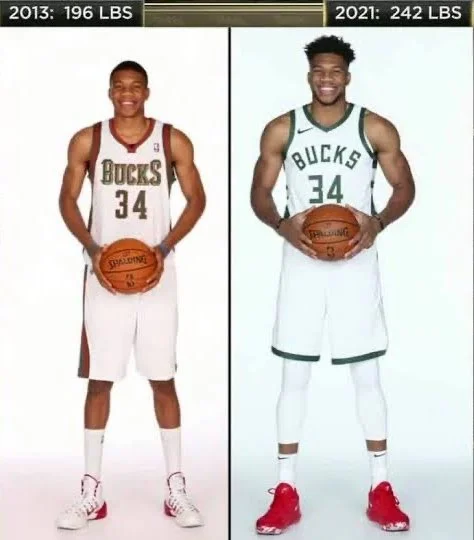
Same person. Same uniform number. Same general collection of arms and legs. But otherwise it looks like the 2013 version wandered into a radioactive weight room and didn’t leave for eight years.
Jeff Van Gundy sees the comparison and reacts with the appropriate amount of disbelief:
“Has he grown seven inches!?”
He had not. Just a couple. It only looked like seven.
The transformation is so dramatic that you can understand why our first instinct is to focus on the body. The shoulders became enormous. The arms somehow started looking even longer. The chest filled out. The skinny teenager who looked as though a particularly aggressive box-out might send him into the third row gradually became the person delivering the aggressive box-outs.
But the body is actually the least interesting part.
Because while everyone was watching Giannis get bigger, Giannis was learning things.
He learned how to handle the ball. He learned how to see the floor. He learned how to defend everywhere.
He learned how to turn a defensive rebound into a fast break without bothering with the antiquated middleman known as the outlet pass, and he learned how to make those enormous strides look less like traveling and more like a loophole in the sport.
He developed touch. And footwork. And patience. And counters.
And every time he added something new to his game, the question Milwaukee had asked in 2013 changed ever-so-slightly.
First: Can this guy play?
Then: Can this guy start?
Then: Can this guy become an All-Star?
Then: Wait. Could this guy be the best player in the league?
Eventually, Giannis won Most Improved Player. Then he became an All-Star. Then an All-NBA player. Then MVP. Then Defensive Player of the Year. Then MVP again.
The question wasn't whether Milwaukee had found something extraordinary anymore. Everybody could see that. Suddenly, the question had become much more interesting.
What, exactly, had Milwaukee created?
Because there was one inconvenient problem with the monster growing on the western shore of Lake Michigan.
Every monster has a weakness. And by the spring of 2019, the rest of the NBA thought it had found Giannis Antetokounmpo's.
Toronto called it a wall.
Not literally, obviously, though at times it looked close enough. Kawhi Leonard took the primary assignment. Marc Gasol and Pascal Siakam waited behind him. Everyone else shaded toward the paint. The idea was simple enough: do not let Giannis get downhill with a runway. Make him see bodies early. Make every drive feel crowded. Make him stop, pass, shoot, think. Nick Nurse had said before the series that slowing Giannis in transition was a “five-person job,” one that required Toronto to “build walls and build them early.”
For two games, it didn’t matter.
Milwaukee went up 2-0 in the Eastern Conference Finals, and Giannis was averaging 27 points per game on 47 percent shooting from the field and 75 percent shooting from the free throw line.
Then, starting in Game 3, the wall started holding a little better. Toronto won four straight, largely because over the course of those four games, Giannis wasn’t nearly as effective as he had been in the first two. His numbers dipped across the board. His scoring down to 20.5 points, his shooting from the field down to 43 percent, and 47 percent from the free throw line.
Suddenly, Giannis’s greatest strength had acquired a blueprint. The league had spent years trying to stop Giannis after he got moving. Toronto’s breakthrough was to stop him from getting moving in the first place. If he wanted to beat you some other way, fine.
Go ahead and shoot. Knock down your free throws. Solve this in the half court.
A year later, Miami unveiled its own version of this riddle in the second round of the NBA Playoffs and sent Milwaukee out of The Bubble in five games. By then, the conversation had hardened. It wasn’t merely that the Bucks had lost. It was that people thought they understood why the Bucks had lost. Milwaukee’s offense had become predictable enough in the postseason that the organization spent the following season reworking it specifically to give Giannis more answers against the wall.
And this is where the story of Giannis gets interesting, because greatness is one thing. Greatness with an instruction manual attached is another.
He was already a two-time MVP. He was already Defensive Player of the Year. He was already one of the most destructive regular-season forces the league had ever seen.
But now every postseason threatened to become the same examination of his limitations.
Can you make the jumper? Can you operate when the runway disappears? Can you make the free throws? Can you win four rounds when everybody knows how to take away what you do best?
The monster had been identified, and so had the weak spot.
And then, in December 2020, Giannis did something that made the whole question much more dangerous.
He stayed in Milwaukee.
For years, Giannis’s eventual free agency had become its own league-wide subplot. Miami. Toronto. Golden State. Every contender with enough cap-space could talk itself into becoming the place where Giannis would finally solve whatever Milwaukee had been unable to solve for him.
Instead, he signed the supermax.
“This is my home, this is my city,” Giannis wrote when he announced the deal.
It was easy to read that as loyalty, and obviously it was. But it was also something more consequential.
Giannis had chosen to make Milwaukee responsible for the ending.
The Bucks had taken a chance on him when nobody knew what he was going to become. Now Giannis was taking a chance on the Bucks after everybody knew exactly what he had become.
There would be no cleaner setup somewhere else. No second act in a warmer market. No version of this story where somebody else got to finish what Milwaukee had started.
If Giannis was going to answer all those postseason questions — the wall, the jumper, the free throws, the half-court offense, the entire growing list of things supposedly standing between him and a championship — he was going to answer them here. With these teammates. With this organization. In this city.
Which made what happened six months later feel especially cruel.
There are injuries you need replay angles to understand, but this was not one of them. This, unfortunately, was disturbingly clear.
Giannis went up to contest Clint Capela at the rim. His left leg came down underneath him. His knee bent backward. And for a few seconds, it looked like the story was over.
The good news came quickly enough.
An MRI showed no structural damage. Giannis had hyperextended the knee, but somehow avoided the kind of catastrophic injury the replay seemed to promise.
Giannis missed the final two games of the Eastern Conference Finals, but then he was back for the start of the NBA Finals.
Seven days later.
Which, honestly, still feels totally fucking ridiculous.
By Game 6 of the Finals, even Mike Breen was still marveling at the recovery. Giannis was averaging nearly 40 minutes a night, putting up staggering numbers less than three weeks after his knee had bent in a direction knees are definitely not supposed to bend.
So when Giannis Antetokounmpo took the floor in Milwaukee on July 20, there were already enough reasons to consider his presence remarkable. What followed was something well beyond remarkable.
He erased Mikal Bridges at the rim on Phoenix’s first possession, then raced the other way and scored Milwaukee’s first basket.
He attacked Deandre Ayton from the perimeter, spun through the paint and finished with touch.
When Phoenix went zone, he found the seam, accelerated through it and finished a twisting scoop at the rim.
When the Suns gave him space, he knocked down a three.
When Jae Crowder held his ground in the paint, Giannis grabbed his own offensive rebound and scored anyway.
When Devin Booker challenged him at the rim in the fourth quarter, Giannis swatted his shot back toward the half court line.
Then, a few possessions later, just for good measure, he did it again.
There was no single version of Giannis that Phoenix was losing to.
They were losing to a player who could run through you, finish around you, recover defensively and erase your shot, make the extra pass, and hit the occasional jumper when you begged him to take it.
For years, the postseason question had been whether Giannis had enough answers once his preferred ones were taken away. But on this night, he had answers for everything.
And somehow, despite all of that, Phoenix had enough answers of its own that the game was still tied entering the fourth quarter.
By then, the performance had stopped feeling explosive and started feeling exhaustive. Giannis had already spent the night absorbing contact, sprinting in transition, challenging shots at the rim, fighting for position, and dragging Milwaukee through possessions that seemed to require more from him every time down. But now the strain was starting to show.
The first signs had shown up before halftime. Late in the second quarter, the broadcast caught Giannis bent over with his hands on his knees, breathing heavily enough that Mark Jackson almost sounded like he was giving him permission to be tired.
“You deserve to be tired,” Jackson said. “You should be winded, with the effort you’re putting forth.”
The remarkable part was that the fatigue never seemed to reduce his influence on the game. Case in point: despite his well-deserved second-quarter fatigue, Giannis came out of the halftime break and scored 20 of Milwaukee’s 35 points in the third quarter.
And in the fourth quarter, he just kept going. He sprinted the floor. Drew fouls. Attacked the paint. Battled for position. Defended every inch he could reach. Kept asking his body for more.
Eventually, the strain became impossible to miss.
With just under five minutes to go in the fourth quarter, Jae Crowder knocked down a mid-range jumper to cut the Bucks lead to four. After the bucket, Giannis didn’t run back down the floor. He didn’t even walk. He stayed behind the play, crouched with his hands on his knees, until Mike Budenholzer called timeout.
For a few seconds, Giannis Antetokounmpo looked completely spent. He looked like any other mortal human being.
Then the fully formed monster returned to the floor.
A few possessions later, Deandre Ayton caught the ball in the paint with Giannis waiting between him and the rim.
Ayton hesitated, then faded away on the shot, and what looked like it could’ve been a gimme turned into a miss.
Milwaukee came back the other direction. Giannis found himself matched against Ayton. He did not hesitate. He attacked. He scored. He pushed his scoring total to 47 points, and he pushed the Bucks lead to eight with 3:37 remaining.
This was what eight years of growth had produced. Not just the longer limbs and broader shoulders from that side-by-side graphic. Not just the downhill force that Toronto and Miami had once convinced themselves could be contained. This Giannis could overpower you, outwork you, recover when you beat him, recognize the second defender, make the pass, finish with touch, protect the rim—and keep doing all of it after his body had started begging him to stop. There was only one thing left to do.
Make the fucking free throws.
For years, that had been one of the easiest places to start if you wanted to explain what Giannis Antetokounmpo could not do.
He could get to the rim almost whenever he wanted. He could overwhelm smaller defenders, outrun bigger ones, swallow up space defensively and turn a rebound into a fast break before most teams had organized themselves.
But put him 15 feet from the basket, completely unguarded, with nothing between him and the rim except time?
That’s when things got weird, and where this otherwise flawless basketball player suddenly had legitimate flaws.
The routine got longer. The misses got uglier. By the 2021 postseason, opposing crowds had turned his trips to the line into public theater, counting the seconds as he prepared to shoot. Every miss reinforced the same idea: if you could not stop Giannis from getting to the rim, maybe you could at least make him finish the possession from somewhere he did not want to be.
Phoenix understood this too.
If Giannis was going to keep attacking, the Suns could live with sending him there.
Or at least they thought they could.
His first two went in. Then two more. He split the next pair. Then he made one. Then two. Then two more.
And somewhere along the way, the free-throw line stopped looking like the place Phoenix wanted to send Giannis and started looking like the place Giannis kept going to finish them off.
By the time Giannis walked to the line in the final minute, the old weakness had become part of the masterpiece.
Seventeen attempts. Sixteen makes. Forty-nine points.
Milwaukee was already going to win. Giannis had already done enough to secure that. But there was still one point left sitting there. So Giannis decided to defy the math one last time.
Fifty points to end a fifty-year wait. The number Milwaukee had been counting since 1971 was now the number Giannis had put on the scoreboard.
A few seconds later, the horn sounded. And almost immediately, the monster disappeared, giving way to the human being. Giannis started crying. He found his family. He embraced his brother. Eventually he made his way toward the Bucks bench, sat down by himself and buried his face in his hands.
No flexing. No screaming. No barreling through defenders. No seven-foot wingspan swallowing up everything within reach.
Just Giannis.
The kid Milwaukee had drafted eight years earlier, sitting alone while an arena celebrated around him.
Eventually, Giannis stood up, and as he did, the monster returned briefly with one primal scream and one flex toward the delirious crowd. Then he found Khris Middleton.
Middleton was traded to Milwaukee just a month after the Bucks drafted Giannis. He had watched the skinny version of his teammate become the enormous version. He had survived the bad teams, the playoff disappointments, Toronto, Miami, all of it. And like Giannis, Middleton too continued to get better and more dangerous.
Giannis wrapped him up.
“We fucking did it.”
Later, holding the Finals MVP trophy, Giannis thanked Milwaukee — his teammates, the organization AND the city — for believing in him.
“I wanted to do it here in the city,” he said. “I wanted to do it with these guys.”
Hours earlier, 65,000 people had gathered outside Fiserv Forum waiting for something they had spent half a century imagining.
They knew what they hoped it would feel like. They knew what they hoped it would look like.
But imagination is one thing. Delivery is something completely different.
Milwaukee had waited 50 years for another championship. It had spent eight years watching Giannis Antetokounmpo become something nobody could have imagined when he arrived.
On July 20, 2021, both things finally arrived at once.
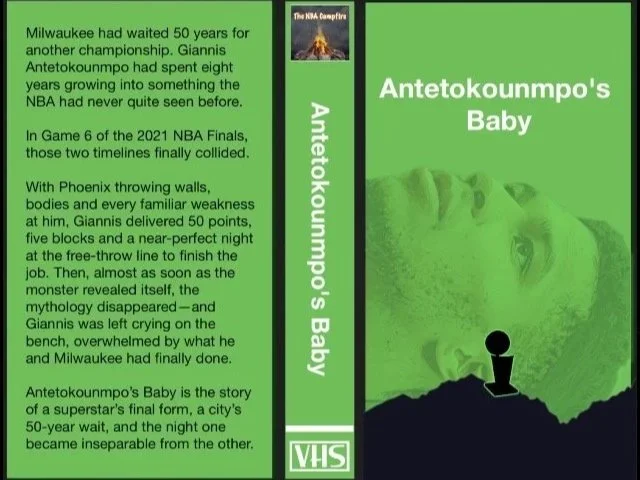
Antetokounmpo’s baby had finally been born. The baby was 6-foot-11, 242 pounds, and had just scored 50 points to close out the NBA Finals.
The monster had become a folk hero.
Next Up on Throwback Tapes: ‘The Greatest Game Ever Played’ (October 15th)