The Throwback Tapes: Lakers vs. Knicks, 2011-12 Regular Season
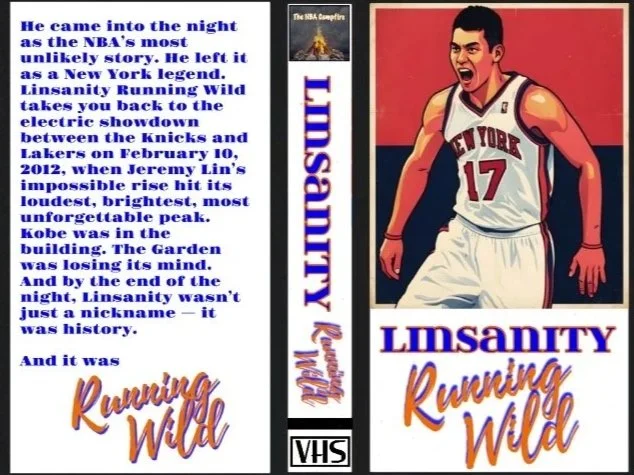
Jeremy Lin touched the ball, and Madison Square Garden barely reacted.
This was awfully surprising, mostly because I had already decided, before rewatching the game, that Madison Square Garden was going to react in a big way.
That is one of the problems with watching famous basketball games nearly fifteen years later. History has already done the editing for you. We remember February 10, 2012 as two-and-a-half uninterrupted hours of Jeremy Lin hysteria, presumably beginning with the opening tip and ending sometime around the invention of the phrase “Madison Square Guard-Lin.” In my memory, everyone in New York had already lost their minds before the Lakers even got off the bus.
The tape disagrees.
Early on in this game, things went something like this… Jeremy Lin gets the ball. Derek Fisher guards him. Lin runs a pick-and-roll. The Lakers go under a screen. People watch basketball.
That’s it.
This is not to say Jeremy Lin was anonymous. Anonymous players generally do not inspire homemade signs reading LIN-POSSIBLE IS EVERYTHING, nor do national television broadcasts spend the first quarter explaining where they went to college with the enthusiasm of a tenured admissions officer. Something was clearly happening. But the strange thing about watching this game now is realizing that Linsanity—the capital-L version, the version that eventually became shorthand for an entire moment in American sports—was not yet fully formed.
In professional wrestling terms, it was still getting over.
Professional wrestling has a wonderfully efficient vocabulary for this sort of thing. A promoter can decide who wins. He can decide who gets television time, who gets the opportunity to use a microphone, who moves up the card and who gets positioned as the next important person you, the fan, are supposed to care deeply about. What he cannot do is force an audience to actually care deeply.
Wrestling calls the moment when they do getting over.
Jeremy Lin had already received the push. Three games earlier, he had barely mattered to the Knicks. Then injuries, desperation, Mike D’Antoni and some sort of beautiful cosmic intervention allowed all of this to happen, and suddenly, the ball was in his hands. Lin responded by winning three straight games and playing well enough that the rest of the country started asking the same question at roughly the same time:
Wait. Is this actually a thing?
But there is a difference between noticing someone and choosing them.
The Knicks could put Jeremy Lin on the card, but Madison Square Garden still had to decide whether he belonged in the main event.
And most importantly, Jeremy Lin still had to prove to the world that he was ready for the push.
The Lakers, to their credit, had a plan. It was not an especially complicated plan.
Derek Fisher would guard Jeremy Lin. He would be physical with him, and considering Fisher was built like an athletic USPS collection box, that was theoretically a problem for the much slighter Knick. When Tyson Chandler came up to set a screen, Fisher would duck underneath it and invite the suddenly famous point guard from Harvard to prove that a few good days had not temporarily broken everyone’s brain, nor turned Jeremy Lin into someone who had definitively solved the league’s stoutest defenses.. Mike Brown confirmed as much between quarters: Los Angeles intended to make Lin beat them from the outside.
This was perfectly reasonable. In a very limited sample size of just 172 minutes during the 2011-12 season, Jeremy Lin had entered this matchup with the Lakers only 1-for-11 from three-point range.
The Lakers were not defending the legend of Linsanity. They were defending the scouting report of Jeremy Lin, a young and inexperienced NBA player, which remained a much less intimidating task.
So Fisher went under.
Lin pulled up from 20 feet.
The shot fell.
A possession later, he fired a half-court hit-ahead pass directly into Tyson Chandler’s path for a dunk. Then came another pull-up jumper. Then a Knicks trap near half court led to a Lakers turnover and Lin racing the other direction for a layup. Less than five minutes into the game, New York led 13–4, and the guy Los Angeles had decided to test had already begun returning the exam with notes in the margins.
There is something funny about how normal Lin looks during all of this.
This is supposed to be the part where the anonymous underdog gets overwhelmed by the moment. Kobe Bryant is in the building. ESPN is televising the game. Half the broadcast appears to have been converted into an emergency Jeremy Lin orientation seminar. And yet Lin spends the opening minutes looking considerably less nervous playing against the Lakers than he does during a prerecorded interview in which he tries desperately to redirect attention toward Tyson Chandler, Iman Shumpert and Landry Fields.
Basketball, apparently, was the easy part for Jeremy Lin.
ESPN was still trying to figure out everything else.
Mike Breen called Lin’s rise “a special story.” Hubie Brown, because Hubie Brown has presumably maintained a scouting report on every basketball player born since the Truman administration, could already explain some of the intricate details of Lin’s game, like how he had good shooting form and that he kept his dribble low. We learned that that he had won a state championship in high school and was an All-Ivy League selection while playing at Harvard.
Nobody quite knew which Jeremy Lin facts were going to matter yet, so ESPN was giving us all of them. All night long.
This is what a star looks like immediately before everyone agrees he is a star. He still requires explanation. Eventually, that explanation becomes a narrative, and in time, the narrative becomes a legacy.
Kobe Bryant did not require explanation.
The first time the Garden truly seemed to notice one of Lin’s otherwise routine touches came midway through the opening quarter. Lin caught the ball near the top of the key, and Kobe was guarding him.
Suddenly, the room changed.
Not dramatically. Not yet. But there was a buzz that had not been there before. For the first time all night, the crowd seemed interested not merely in what Jeremy Lin was doing, but in who he was doing it against.
That visual did something the previous three opponents could not.
Deron Williams, Al Jefferson and John Wall were all real names. In wrestling terms, they were established mid-carders—the sort of opponents who could make a hot newcomer look legitimate.
But Kobe Bryant was the main event.
Jeremy Lin was no longer simply the strange new story helping the Knicks win basketball games. He was standing across from the guy at the top of the poster, and for the first time, Madison Square Garden began to wonder what might happen if he didn’t blink. What is Jeremy Lin is actually built for this moment?
Of course, moving up the card requires surviving the part where somebody tries to knock you back down it.
When Lin returned early in the second quarter, the game briefly began looking much more like the version Los Angeles had probably expected. He drove into traffic and had his shot erased by Andrew Bynum. He reset, attacked again, and had the ball knocked out of bounds. For roughly thirty seconds, Jeremy Lin looked less like the most exciting story in basketball and more like a young point guard learning that the Lakers employed several extremely large men.
Then he attacked again, and this time he absorbed contact, flipped in a floater and drew the foul.
There was something useful about that sequence. Lin did not respond to resistance by becoming cautious. By playing scared. By deciding to take a backseat to one of his teammates. No. He responded by attempting essentially the same thing until the universe produced a more favorable result.
This was becoming a theme.
The Lakers bumped him off the ball. He kept moving. Bynum waited for him at the rim. Lin kept driving. Derek Fisher remained approximately as pleasant to run into as a fire hydrant with lateral quickness. Lin kept coming.
And eventually, the Garden started coming with him.
Late in the second quarter, Lin grabbed a defensive rebound and pushed the ball himself. Fisher picked him up in transition. Lin accelerated toward him, spun around him and finished at the rim.
Then something important happened.
Jeremy Lin smiled.
Not the polite, slightly terrified smile from the pregame interview. Not the smile of somebody trying to convince everyone that Tyson Chandler deserves more credit. This was the smile of someone who had just done something ridiculous, heard 19,000 people lose their minds because of it, and—for perhaps the first time all night—allowed himself to enjoy what was happening.
This was a pop. Not the biggest one Jeremy Lin would receive that night. Not even close. But wrestling crowds have a way of telling you when something is beginning to work. The volume changes. The vigor changes. The anticipation changes. Suddenly the audience is no longer waiting to see whether the new guy fails. They are waiting for an excuse to cheer for him again.
It wasn’t just the crowd adjusting to Jeremy Lin. The Lakers had begun making their own adjustments, too.
By the third quarter, Los Angeles’ big men were showing higher and harder on Lin’s pick-and-rolls. Going underneath screens and waiting for Jeremy Lin to reveal himself as a temporary glitch in the basketball ecosystem had produced insufficient results. Now Andrew Bynum and Pau Gasol were being asked to meet him farther from the rim.
There are more ceremonial ways for an NBA defense to show respect, like sending seven-footers at you. But this was not a deterrent for Jeremy Lin. He just kept coming.
He slipped through Fisher’s pressure for an off-balance floater over Bynum. A few possessions later, he snaked around a screen, got downhill and forced Bynum to foul him hard at the rim to prevent another lay-in. Both free throws fell. 23 points. The Knicks led by eight.
For most of the night, Kobe Bryant had been strangely quiet.
Then the main event arrived and Kobe stepped through the curtain.
After opening 1-for-11 from the field, Kobe made five of his next six shots in the third quarter, including an impossible baseline jumper that reminded everyone why ‘bad shot’ was always a complicated phrase when Kobe Bryant was involved.
For the first time all night, the story had resistance.
Until then, Linsanity had mostly operated according to its own bizarre internal logic. Jeremy Lin did something unlikely, everyone reacted, and then he did something slightly more unlikely. It was less a basketball game than a coincidence slowly becoming a pattern, but Kobe Bryant complicated that.
The Lakers cut into the lead. The Garden tightened. Kobe kept scoring. And now Lin had to answer the guy whose presence had made the entire night feel bigger in the first place.
With a little more than three minutes left in the quarter and New York’s lead down to four, Lin took a handoff, turned the corner along the baseline and finished through Steve Blake at the rim.
A few possessions later, Jason Kapono checked into the game, and Lin immediately went after him.
This was another small but important sign that Jeremy Lin was no longer simply surviving the moment. He was reading it. Kapono had not played all night, typically defended bigger players, and now found himself isolated against a point guard — nicknamed the Harvard Hurricane — who had spent the previous three quarters realizing that nearly every aggressive decision he made was being rewarded.
Lin attacked. Kapono fouled him.
And Jeremy Lin walked to the free-throw line.
That was when Madison Square Garden tried something new.
M-V-P.
The chants were not deafening. Not yet. They sounded less like a declaration than a suggestion—as though a few thousand people had floated the idea into the room just to see if anyone would laugh.
Nobody did.
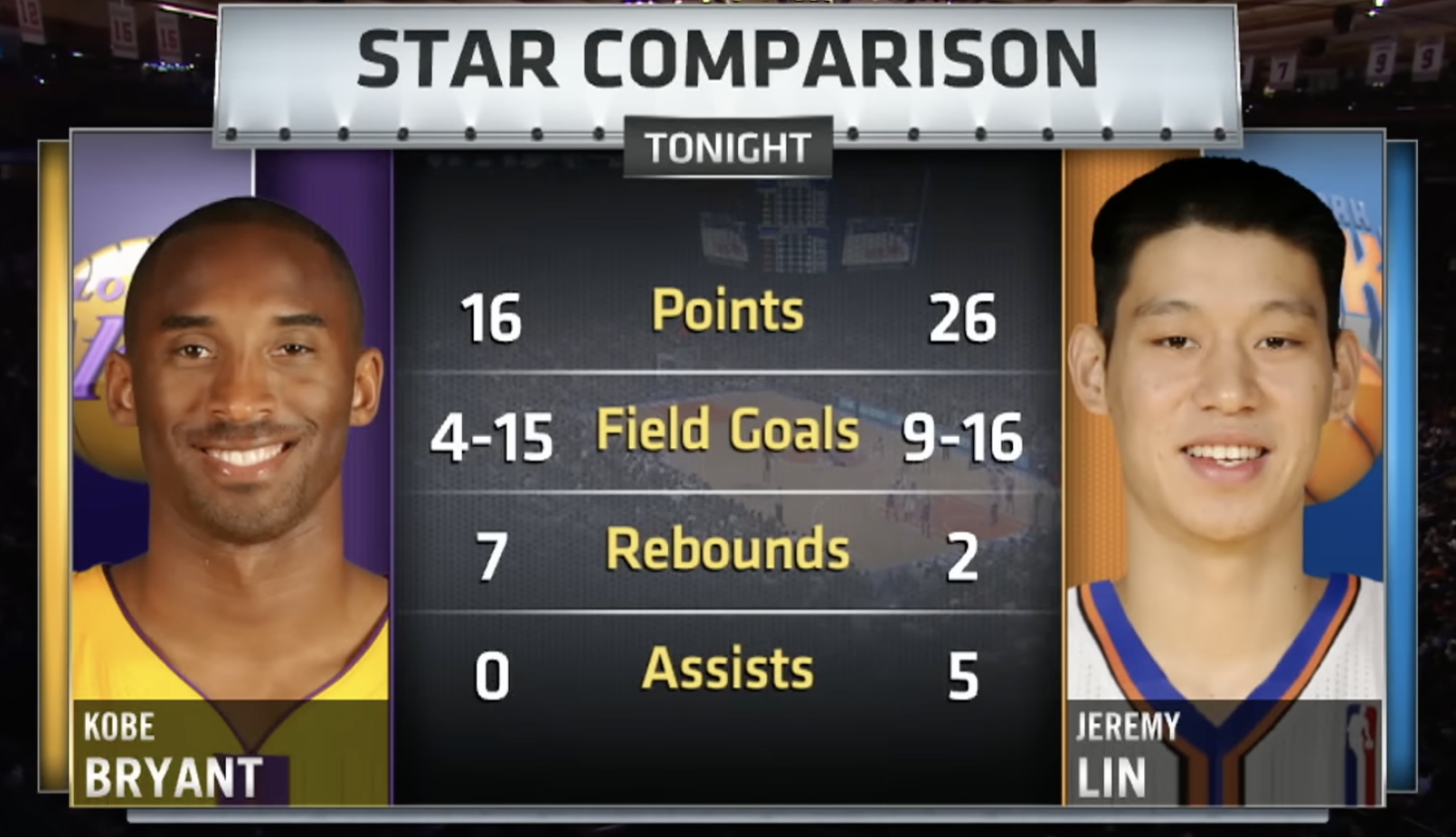
Then ESPN put Jeremy Lin and Kobe Bryant side by side in a “Star Comparison” graphic.
A week earlier, Jeremy Lin required a scouting report, a resume, a highlight package, and several Harvard references. Now he required a comparison to Kobe Bryant.
The fourth quarter began without Jeremy Lin, which by this point felt like a programming error.
He sat on the Knicks bench while Mike Breen noted that New York had guaranteed his contract earlier that week, meaning Lin could presumably stop worrying about whether he might soon be sleeping on his brother’s couch again. This was the sort of biographical detail that had sounded charmingly absurd an hour earlier. Now it already felt outdated.
Jeremy Lin was no longer fighting for a roster spot.
He was fighting off the Los Angeles Lakers.
And for a few minutes, the Lakers made a respectable attempt at ruining the ending everybody in the building had started imagining.
By the time Lin returned, New York’s lead had become uncomfortable. Los Angeles eventually cut it to three, which was close enough to introduce the possibility that this entire night might end with everyone remembering Kobe Bryant instead, as numerous nights at the Garden already had.
Lin responded by doing what he had done every time the story threatened to become less interesting.
He made it interesting again.
With 8:02 remaining, the Knicks finished a 6–0 response with Lin catching the ball in the corner, shot-faking Jason Kapono, stepping inside the arc and knocking down a long jumper just inside the arc.
Timeout, Lakers.
Then, two minutes later, the entire atmosphere of the game changed.
Pau Gasol switched onto Lin at the top of the key, Lin backed away, and Madison Square Garden began to buzz before anything had happened.
Wrestling crowds understand this instinctively. Shawn Michaels starts tuning up the band and the arena rises before Sweet Chin Music ever lands. Kurt Angle pulls the straps down and everyone knows an Angle Slam is coming. Roman Reigns lets out the “Ooooh-Aahhh!” and the spear has already happened in the crowd’s imagination.
Jeremy Lin had reached that point.
He no longer needed to make the shot to get the reaction. The possibility of the shot was enough. But on this night, of course he made the shot.
Gasol gave him space. Lin settled into a long two and buried it. Thirty-one points. And because Linsanity had apparently decided that subtlety was no longer necessary, the broadcast immediately cut to signs in the crowd reading EMPEROR LIN and MADISON SQUARE GUARD-LIN.
Then came the next possession, where Kobe Bryant served as the primary defender.
There are moments in sports when the matchup itself feels like the entire point. This had become one of them. Earlier in the night, Kobe guarding Lin had been enough to make the Garden buzz simply because of the novelty of the image.
Now it felt like an acknowledgment.
The main-event star had come down the card to deal with the guy who had hijacked the show.
Lin drove past him, left his feet and kicked the ball out to Bill Walker. Walker missed. Jared Jeffries kept the possession alive and found Lin again, this time standing alone in the corner.
Lin caught it. Rose. Fired. BANG!
For the first time all night, Mike Breen gave Jeremy Lin the call reserved for shots that deserve their own punctuation.
Lin had 34 points. The reeling Lakers had to take a timeout. And Madison Square Garden had to find a way to catch its breath.
Jeremy Lin was no longer trying to get over. He was over.
And once that happened, the final few minutes began to feel less like suspense and more like an encore.
With 2:28 remaining, Lin waved away a screen and went directly at Matt Barnes. He drove left, twisted his body underneath the basket and somehow finished with his right hand over Pau Gasol from the opposite side of the rim.
Carmelo Anthony jumped off the Knicks bench. The Garden erupted again. And perhaps the strangest part was that none of this felt particularly strange anymore.
That is what Linsanity had accomplished in less than a week. It had taken something objectively absurd—a fringe NBA point guard repeatedly hijacking nationally televised basketball games—and established it as the expected outcome.
Jeremy Lin was supposed to do this now.
With less than a minute remaining, the Lakers fouled him. Lin walked back to the free-throw line, and the chants typically reserved for only the best players in the game started echoing throughout the World’s Most Famous Arena once again.
M-V-P! M-V-P! M-V-P!
Only this time there was nothing tentative about them.
The first MVP chant in the third quarter had sounded almost experimental, as if Madison Square Garden were trying the phrase on to see whether it fit Jeremy Lin. Now the building had made up its mind.
A couple hours earlier, Jeremy Lin could touch the basketball without producing much of a reaction. Now nineteen thousand people were chanting that he was the most valuable player in the league.
Not because anyone in the building had suddenly lost the ability to identify LeBron James or Kevin Durant, or hell, even in defeat, Kobe Bryant.
Because this is how crowds communicate something simpler:
You’re ours now.
The Knicks ended up winning by the final score of 92-85. Lin finished with 38 points, a career-high. And because this was, as Mike Breen so appropriately put, The Jeremy Lin Show, Lin joined Lisa Salters for a post-game interview, and he did exactly what he did in his pre-game interview… credited his teammates and tried like hell to deflect away as much attention as he can.
But when Lisa Salters asked Lin how a moment like this compares to whatever he had imagined for himself, Lin decided not to deflect away the attention. For a moment, he decided to bask in it. To revel in it. And above everything else, to appreciate it.
“This is it right here. This is my dream.”
All these years later, Linsanity still feels a little like a dream.
Not in the inspirational, this is going to end up a movie someday sense. Not in the way Jeremy Lin meant it standing on the Madison Square Garden floor that night. More in the way certain memories become less plausible the farther away you get from them.
Part of that is the speed of it. Part of it is the brevity. And part of it is that Jeremy Lin arrived carrying a collection of identifiers that the basketball world did not quite know what to do with.
He was Asian-American.
He went to Harvard.
Either one of those facts would have made him unusual within the NBA ecosystem of 2012. Together, they became almost impossible for the coverage to stop talking about.
ESPN mentioned Harvard with the frequency of a parent whose child had just been accepted there. We learned that Lin studied economics there. Mike Breen even provided an update on the Harvard-Penn game taking place elsewhere that night, because apparently the Jeremy Lin experience had temporarily expanded ESPN’s responsibilities to include Ivy League scorekeeping.
The cameras found Harvard hats.
They found young Asian fans smiling in Knicks jerseys.
They found Jeremy Lin masks.
And in a prerecorded interview, Lin explained how his father had moved from Taiwan to the United States, discovered basketball on television, and passed the game down to his sons.
None of those details were incidental to what Linsanity became.
For Asian-American fans, Lin represented something that NBA basketball rarely placed at the center of the screen. For everyone else, his background made an already improbable story even harder to categorize. There was no familiar template for this. The league had seen undrafted players become good. It had seen Ivy League players reach the NBA. It had seen unexpected stars emerge.
It had not seen this combination, in this city, this quickly. And that, more than anything, is what made Linsanity feel slightly fictional.
Jeremy Lin did not simply become famous.
He became famous faster than everyone could decide what his fame meant.
He was the undrafted underdog. The Harvard graduate. The Asian-American breakthrough. The couch-sleeping curiosity. The latest evidence that NBA front offices occasionally spend millions of dollars evaluating basketball players and still miss one hiding directly in front of them. The point guard who in just one week’s time had somehow resurrected the Knicks, a team that played basketball in a city that had come to be defined by its point guards.
He was all of those things.
Which meant he was also impossible to reduce to any one of them.
The broadcast itself seemed to understand this only in fragments. It kept returning to Harvard, his economics degree, his Taiwanese family background, the unlikely path through Golden State and Houston—anything that might help explain why this person had suddenly become the center of the basketball universe.
Meanwhile, the Garden was offering a much simpler interpretation. It had masks, Harvard hats, chants, standing ovations, and a whole shit load of signs.
LIN-POSSIBLE IS EVERYTHING.
LEGEND IN NEW YORK.
ALL I DO IS LIN, LIN, LIN.
This is what happens when a sports story becomes a cultural event before anyone has had time to prepare language for it. Analysis gives way to slogans. Context gives way to puns. Everybody understands that something important is happening, but nobody can agree yet on exactly what kind of important it is.
For Asian-American fans especially, there was another layer entirely. Lin was not merely succeeding in the NBA. He was occupying the center of an American sports spectacle that had rarely made someone who looked like them its protagonist.
There is a difference between representation and recognition.
Representation is seeing someone who looks like you on the screen. Recognition is seeing that person allowed to occupy the role usually reserved for somebody else.
Jeremy Lin was not standing in the corner of somebody else’s story. He was not the novelty at the end of the bench, the interesting biography squeezed into a timeout late in the 4th quarter of a blowout, or the player whose presence required the broadcast to explain Harvard for the ninth time.
He was the reason people were watching.
Kobe Bryant had come to Madison Square Garden, and somehow Kobe Bryant had become the supporting character.
That distinction mattered. The significance was not simply that Lin had reached the NBA. It was that, for one impossible stretch of February, the league reorganized its attention around him.
He got the close-ups. He got the graphics. He got the chants. He got the final question in the postgame interview.
He got to be the main event.
The strange thing about Linsanity is that it never really had time to become normal.
Most stars eventually acquire routine. Greatness becomes something scheduled. You know when the game starts. You know who gets introduced last. You know who gets the ball with two minutes left. Eventually, greatness stops feeling like an event and starts feeling like an appointment.
Jeremy Lin never got that far.
Linsanity arrived too suddenly and disappeared too quickly for familiarity to begin to make the improbable feel routine. It remained suspended in that brief period when every game still felt like a question nobody knew how to answer.
That is probably why, all these years later, the whole thing still feels like a dream. Not because it wasn't real, but because reality usually has better pacing.
There should have been more buildup. More warning. A transitional phase between anonymity and folk hero. Somebody should have stopped the story at some point and told it to become more believable.
Nobody did.
Which brings us back to the beginning.
Jeremy Lin touched the basketball on the opening possession of the game, and Madison Square Garden barely reacted. But a couple of hours later, the same building was reacting before he even shot.
That might be the cleanest explanation of Linsanity there is.
The Knicks could give him minutes. Mike D’Antoni could give him the ball. Television could give him an audience.
But nobody could make nineteen thousand people decide, all at once, that Jeremy Lin was the person they had come to see. That part had to happen organically, completely on its own.
In wrestling, you can book the push. You can book the match. You can even book the finish
But you can't book the pop.
And on February 10, 2012, Madison Square Garden gave Jeremy Lin one that we’re still hearing.
Next Up on Throwback Tapes: ‘Antetokounmpo’s Baby’ (October 8th)