The Throwback Tapes: 76ers vs. Celtics, Game 7 of the 1981 Eastern Conference Finals
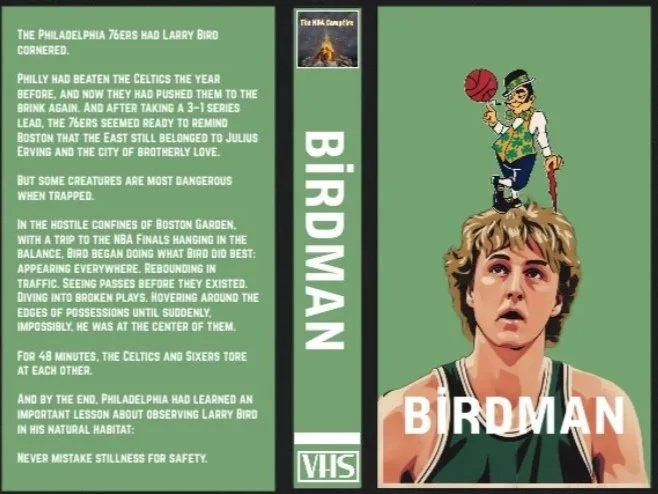
How’s this for irony?
I am deathly afraid of birds, but I fucking love Larry Bird.
Now it’s worth noting that for as far back as I can remember, birds have scared the bejesus out of me, yet there is no singular core memory that I have that suggests I should be so paralyzingly terrified of birds.
I’ve never been attacked by a bird. I’ve never even touched a bird. I’ve never been pooped on by a bird. I haven’t watched the Alfred Hitchcock movie The Birds. I’ve even asked my parents if there was some sort of bird-related incident in my toddler years that imprinted on me in a major and admittedly ridiculous way, but they’ve got nothing.
It is the textbook definition of ‘an irrational fear.’ Unfortunately, it is also very real and, against my will, has become one of the defining characteristics of my personality.
For example: In addition to the handful of ‘Happy Birthday!’ ‘Happy Mother’s Day!’ ‘Happy Thanksgiving!’ and ‘Merry Christmas!’ messages we’ve exchanged over the last few years, I’ve also received not one, not two, but three text messages from Amy Stucko — the mother of my soon-to-be Best Man and NBA Campfire Brand Manager Collin Stucko — related to my fear of birds. She finds it hilarious. Everyone finds it hilarious.
If I’m at the beach and walk out onto a pier, anyone who is with me on this trek delights in the fact that I will unapologetically cower like a child as seagulls fly around us.
If I’m walking down the street and a bird is flying my direction, I will literally crouch to the ground and cover my head and wait for the fly-by to come to its conclusion.
Hell, we have a tree out in our front yard that has a bird feeder hanging from one of its branches, and my fiancee has been asking me for weeks to fill it with bird food. I’ve avoided the task simply because I’m afraid that as soon as I walk outside with that bag of bird food, I’ll be swarmed, attacked, bloodied, and left crying and pissing all over myself.
It’s pathetic, but it’s true. And it’s also true that for most of my life, I’ve believed that there is something fundamentally off about people who enjoy spending their time bird-watching.
And yet, before every high school basketball game I ever played, I watched this specific package of Larry Bird highlights on YouTube.
Despite having to squint to make out what was happening during most of these plays, watching this 6 minute and 4 second video was an integral part of my pre-game routine. It came immediately after a sesame bagel with peanut butter and immediately before I began working my way through the unnecessarily long pregame playlist I had assembled on my iPod mini.
This raises an obvious question: Why Larry Bird?
Of all the players I could’ve chosen to ritualistically watch before every high school game, why was I repeatedly squinting at grainy footage of a retired forward from French Lick, Indiana who announced his retirement from the NBA when I was just 181 days old?
More importantly, how did the only Bird I have ever willingly sought out become the one I trusted to convince me I was ready to play the best basketball of my life?
The truth is, even as a teenager, I wasn’t just watching Larry Bird because he made impossible shots, talked metric tons of shit or was succeeding despite a lack of conventional athleticism.
I was watching the angles. The pass fakes. The way he could move one defender half a step and suddenly create a passing lane that hadn’t existed a second earlier. I was the kind of high school kid who could get genuinely excited about that stuff. A weird kid. A full-blown, unapologetic basketball nerd.
I wasn't watching Larry Bird to appreciate Larry Bird. I was watching Larry Bird to rob him.
I’ll take that shot fake.
Damn, I like that post move. Let me get some of that.
Oooh, that entry-pass angle looks interesting. I’m gonna try that if I have the chance.
I would never have Vince Carter’s vertical, or the combination of strength or speed possessed by LeBron James. I wasn’t quick enough to have the first step of Allen Iverson, nor was I as physically large or dominant as Shaquille O’Neal.
What Larry Bird was doing on the parquet floor felt replicable. It felt attainable. It felt within my reach.
The older I got, though, the more I realized there was a difference between copying what Larry Bird did and understanding why Larry Bird did it.
Half of my life ago, I was looking for any facet of his game that I could pillage and apply to my own.
Present day, I’m more interested in finding all of the things I missed. And while a grainy highlight package provided me a perfect assist when I was just trying to steal moves, I’ve learned over the years that highlights aren’t enough when you’re trying to understand behavior.
And if you want to understand behavior, you have to observe the subject in its natural habitat.
So, against every instinct I possess, today I’m going bird-watching.
Our destination: Boston Garden, May 3, 1981
Before observing any species in the wild, one must first come to understand its habitat.
Okay, that’s probably enough of that.
It is not.
Fine. For the purposes of this exercise, there are apparently going to be two versions of me operating at once: the lifelong basketball obsessive who wants to understand every inch of Larry Bird’s game, and another, much more annoying version who has decided this is a nature documentary. Let’s call that guy Sonny Attenborough. You can even imagine he has a British accent if you’d like.
Basketball Sonny will handle the X’s and O’s, historical context and all of the usual basketball-obsessive stuff you’ve come to expect here around the NBA Campfire.
Sonny Attenborough, meanwhile, has a slightly different assignment: observe the Bird in his natural habitat, document his behavioral patterns and intervene whenever our subject does something particularly instinctive, territorial, predatory or just absurdly Bird-like.
And, ideally, avoid being mauled. Right?
Right, Sonny Attenborough!?
There are, of course, no guarantees in the wild, especially in an environment as hostile as this one. To the uninitiated, it is chaos. To the Bird, it is home.
And to Dick Stockton, it’s fucking deafening.
I’ve watched a whole lot of basketball in my life, and I genuinely cannot remember another game where the play-by-play announcer has been forced to yell the pregame introduction just to keep from being swallowed whole by the crowd. The ball hasn’t even gone up yet, and Dick Stockton is already in a shouting match with the entire Boston Garden.
One year earlier, the Philadelphia 76ers eliminated the Boston Celtics at the Boston Garden to advance to the NBA Finals, and as Dick Stockton noted, it looked like the Celtics were going to suffer a similar fate in 1981.
Down 3-1, just as they were the previous spring, the Celtics found themselves on the brink of elimination. But they managed to force the series back to Philadelphia with a two-point win in Game 5, then they survived Game 6 with another two-point victory.
Now everything — all of the history between these two franchises and all of the baggage from the previous postseason, all of the frustration of nearly being sent home by the same team in the same way — was being compressed into one afternoon in a building that sounded like it was preparing for an exorcism.
The native population understands what is at stake. Their territory has been threatened before. Today, there will be no retreat.
Our subject rises from the bench to a rapturous applause. At first glance, he is not an especially imposing specimen. Tall, yes. But lean. Pale. Curly blond plumage. A thin mustache that does little to suggest danger.
But appearances, particularly in the wild, can be awfully misleading.
In other words, despite looking like a farmer in short shorts, this motherfucker can straight-up hoop.
Larry Bird is 24 years old, in his second NBA season, already the Rookie of the Year, already an All-Star, and already the engine of a Celtics team that had gone from 29 wins before he arrived to immediate contention with him at the center of everything.
And with the subject identified, the observation can begin.
BIRD SIGHTING No. 1 - ROAMING
Our subject rarely remains stationary. Instead, the Bird patrols the baseline, moving quietly through its territory while waiting for opportunity to present itself. Notice how he is searching not necessarily for the ball itself, but for the empty spaces the other inhabitants have failed to protect.
Okay, I’m going to stop Sonny Attenborough right there because the phrase “other inhabitants” makes Julius Erving and Caldwell Jones sound like a pair of water buffalo. But my British alter-ego is onto something.
Even in just his second season in the NBA, it’s clear that Larry Bird has already mastered the art of lurking on the baseline and catching defenses sleeping, creating second-chance opportunities for the Celts.
A few minutes later, there’s a play where Bird is roaming the baseline again. Another shot goes up. Another offensive rebound. Another shot fake. This time he pivots underneath the basket and somehow finishes backward at the front of the rim without even looking at it.
That sort of rim finish — almost like a shot you’d take trying to stick someone with an H in a game of H.O.R.S.E. — is the part that survives in Larry Bird highlight reels. But the highlight only exists because of everything Bird did before it: the patience, the positioning, the quiet little migration toward the one patch of hardwood nobody else realized was about to matter.
Bird almost never moves without purpose. His game is built on a constant stream of split-second decisions—some instinctive, some clearly drilled into him long ago.
Pass the ball? Go screen away.
Defender turns his head? Make a cut.
Shot goes up? Find a body, box out, then find the ball.
Possession changes? Start sprinting in the opposite direction.
What may initially appear to be aimless movement is, in fact, a highly efficient search pattern. The Bird does not chase every opportunity. It simply places itself where opportunity is most likely to appear.
Yeah.
That’s a much more elegant way of saying Larry Bird is always fucking there.
FIELD NOTE - COMMUNICATION
Late in the first quarter, Larry Bird gets his shot blocked underneath the basket and, like any great player who feels even the slightest contact, immediately decides he was fouled. Bird turns toward the official with his hands on his hips. He stares at him for a beat. Keeps staring. Then smiles, shakes his head and jogs back on defense.
No screaming. No arm-flailing. No prolonged negotiation. But Bird certainly got his point across to the official.
The Bird communicates displeasure economically, at least in this instance. A prolonged stare. A subtle change in expression. A brief shake of the head. The message is understood. Occasionally, though, the Bird can be far more combative.
BIRD SIGHTING No. 2 - SCAVENGING
There’s a two-possession sequence in the first half that starts with the Celtics on the defensive end. 76ers point guard Maurice Cheeks blows by Nate ‘Tiny’ Archibald and gets into the paint. With Robert Parish in position under the basket on the strong-side of the floor, Cheeks attempts a lay-up on the opposite side of the rim, but Larry Bird is there to erase the shot.
Boston gets out into transition, and the ball ends up in Tiny’s hands on the baseline. Tiny misses a mid-range jumper from the left side of the floor, but Bird crashes in from the opposite side, snatches the offensive rebound and, as his momentum carries him out of bounds, somehow finds Cedric Maxwell underneath the basket for a lay-in.
The Bird is an opportunistic feeder. Missed shots, loose balls, broken plays — very little within its environment is allowed to go to waste.
Okay, calling an offensive rebound “feeding” is disgusting, but yes, this is the point I’m trying to make. For all the beautiful passes and impossible jumpers we see so often within his highlight packages, Larry Bird spends a lot of this game rooting around in basketball garbage.
Late in the 2nd quarter he hits the floor trying to secure another offensive rebound. He gives Julius Erving the tiniest little shove imaginable just to create a better rebounding angle. He keeps inserting himself into possessions after the first action has already failed.
To Larry Bird, a missed shot does not necessarily signify the end of anything. Sometimes it just means the possession has entered its second phase, and that, I think, is the larger point here.
Most players are most comfortable when the game is clean: the play is called, the spacing is right, the pass hits the intended target, and the shot goes in. Bird seems almost equally comfortable when the whole thing goes to hell.
Precisely. Disorder creates opportunity. And few creatures are better equipped to exploit disorder than one that has learned to anticipate where the remains will fall.
Okay, again, “the remains” is disgusting, but again, he’s not wrong.
FIELD NOTES - OTHER SPECIES
Young Kevin McHale looks more like a vampire than he does Kevin McHale.
At this stage of development, the long-limbed creature is not yet especially productive. But with age will come strength, patience and a considerably more dangerous presence around the basket.
We’re not opening that coffin today, Sonny Attenborough. I was just trying to fire off a joke. Let’s move on.
BIRD SIGHTING No. 3 - AWARENESS
Bird’s defensive positioning might be the thing that surprised me most while watching this game, and frankly, it’s the one thing I wish I saw more of in those highlights I used to watch.
If his man is one pass away, Bird is up in the passing lane. If his man is two passes away, he’s sagged into help. He’s always between the ball and his man. He boxes out, his attention never seems to wander, and he’s always hyper-aware of the personnel on the opposing team.
For example, there’s a defensive possession early in the 3rd quarter where Bird sags so far off Caldwell Jones that Jones can’t even make the entry pass into Dawkins. The entire Sixers set is snuffed out before anything dangerous really develops simply because Bird understands the scouting report.
There’s another play in the 3rd quarter where Dr. J drives middle and spins back toward the baseline once he gets a foot in the paint, leaving Cedric Maxwell in his dust. But instead of conceding an easy finish at the rim, Bird is in proper help position, and the Doctor’s shot ends up being blocked by Robert Parish.
But no play captures Larry Bird’s anticipatory awareness better than this one:
The Bird does not attempt to match its opponent’s superior elevation. Instead, it relies on timing, angle and anticipation — striking before the threat has reached full height.
In basketball terms, Bird doesn’t out-jump Julius Erving. He beats him to the moment. And that’s the one thing I kept noticing throughout this game:
Larry Bird is constantly winning the moment before the moment even arrives.
He doesn’t need to recover defensively because he was already in help position. He doesn’t need to scramble toward a rebound because he already found a body and established position. He doesn’t need to make some spectacular last-second rotation because he already recognized what Philadelphia was trying to do while the play was still developing.
His awareness essentially buys him time, and that’s paramount for a player who doesn’t have overwhelming explosiveness. We talk about Bird’s lack of conventional athleticism so often that his basketball IQ can start to sound like some magical substitute for physical ability. But watching him closely, it feels more mechanical than magical, even if there’s obviously a little Larry Bird Magic sprinkled all over this game.
For most creatures, awareness is reactive: danger appears, and they respond. The Bird operates differently. It positions itself for what is coming, often before the threat has fully revealed itself.
Bird wasn’t waiting for the possession to tell him where he needed to be.
He already knew.
FIELD NOTES - PLUMAGE
Larry Bird buries the first made three-pointer of the entire postseason for Boston, and perhaps predictably, the Garden detonates. He turns and trots back down the floor, curly blond hair bouncing with every step.
The plumage is distinctive. In motion, almost impossible to miss.
The shot is historic. But the hair is somehow more memorable.
BIRD SIGHTING No. 4 - MANIPULATION
Larry Bird’s game is full of tiny lies.
Not big lies. Not elaborate Ocean’s Eleven lies. More like the kind of lie where somebody asks if you’re five minutes away and you say, “Yeah, basically,” even though you haven’t put your shoes on yet.
A shoulder twitch here. A jab step there. A quick glance toward one side of the floor before firing the ball somewhere else entirely.
By my extremely unofficial count, Bird uses 11 shot fakes over the course of this game, which is enough that at some point it stops feeling like a piece of his offensive skillset and starts feeling like a personality trait.
And the thing is, Bird isn’t always trying to get somebody airborne. Sometimes the fake barely gets a defender to move at all. A foot shifts. A shoulder turns. A help defender leans six inches in the wrong direction.
That’s enough. Because Bird isn’t just using fakes to create space. He’s using them to feed defenders bad information, then watching what they do with it.
Deception is among the oldest survival mechanisms in nature. A false movement can cause the observer to reveal its intentions, surrender valuable territory or expose itself entirely.
Every once in a while, Bird doesn’t just manipulate a defender’s balance. He manipulates their expectations. He gets his defender to commit to an entirely different idea of what the possession is about to become.
About halfway through the 4th quarter, Bird catches the ball in semi-transition on the right wing with Julius Erving in front of him. He turns his back to the basket, gives every indication that he’s about to settle into a post-up, and for a brief moment Dr. J seems to accept the premise.
That right there was the exact mistake that Larry Bird was waiting to capitalize on.
Here, the deception becomes considerably more elaborate. The Bird presents one behavior, waits for its opponent to commit to the expected response, then abruptly abandons the entire premise.
Exactly, Sonny Attenborough! Bird doesn’t beat Erving with a quicker first step or some overwhelming burst. He gets Dr. J to defend the wrong kind of possession.
FIELD NOTES - CONFRONTATION
Late in the 3rd quarter, things get a little testy between the two teams near the Celtics bench. Players start jawing, bodies gather, and Bird immediately finds himself engaged in a separate conversation with one of the Sixers.
Except “engaged” might be overselling it. Bird is talking shit while casually wiping sweat from his forehead and wispy mustache, looking less like a man involved in a confrontation and more like a man who has suddenly become much more interested in the proceedings.
When confronted, the Bird does not retreat. Nor does it appear particularly alarmed. If anything, the disturbance seems to produce heightened engagement.
In less scientific terms, Larry Bird is having a fucking blast.
BIRD SIGHTING No. 5 - THE HUNT
With roughly four-and-a-half minutes remaining in Game 7, Larry Bird returns to the floor.
Dick Stockton does not bother dressing up the situation.
“It’s all on his shoulders.”
For most of the afternoon, we’ve been observing Bird in pieces. How he moves. How he scavenges. What he sees. How he deceives. Now there’s no longer any need to separate these behaviors. Because for the final four-and-a-half minutes, Bird compresses an entire afternoon’s worth of behavior into one furious closing stretch.
As daylight fades and the territory becomes increasingly contested, observation grows more difficult. The subject is no longer merely navigating its environment.
It has begun to hunt.
It starts almost immediately.
Erving gets doubled, looks to move the ball, and Bird jumps the passing lane. Before Philadelphia can even process the turnover, Bird has already fired the ball ahead to Tiny Archibald, who attacks the rim and draws a foul.
We’ve seen this already. The preternatural awareness. The uncanny anticipation. The immediate recognition that a defensive play has created an offensive opportunity.
Except now there are four minutes left in Game 7.
A couple possessions later, Erving gets into the paint again, and what happens next is where all of these separate Bird behaviors suddenly crash into the same possession.
The subject is everywhere.
He sure the fuck is, Sonny Attenborough. And he’s doing everything.
Block.
Dive.
Contest.
Rebound.
Larry Bird has somehow affected four different parts of the same possession. This isn’t Roaming anymore. Or Scavenging. Or Awareness. It’s all of it. And before there’s even time to sort out exactly what just happened, Philadelphia comes back at Boston.
Dawkins gets the ball on the left side. Bird helps, the shot comes off, and of course Bird gets the rebound, somehow on the right side of the basket.
He immediately starts up the floor, and by the time he gets to half-court, someone should be stopping the ball.
But as Bird crosses half-court, nobody has stopped the ball. So Bird keeps coming, and then, from about 16 feet out, he stops...
… And he smooches it off the glass.
Boston leads and Bird turns and races back down the floor with both arms raised, making a declaration that is technically premature and, as it turns out, entirely accurate. The game is over.
Sure, Boston has to survive the Sixers for another minute, but eventually the horn sounds and the Boston Garden ceases to function as a basketball arena.
People pour onto the parquet from every direction. Bird jumps in celebration and disappears almost instantly beneath a mass of bodies. Whatever boundary existed between subject, habitat and observer is gone.
At this point, continued observation is no longer advisable.
Yeah, no fucking kidding.
I started this whole exercise trying to understand the only Bird I’ve ever willingly sought out — the guy I used to watch on a grainy YouTube highlight package before high school games because I thought maybe I could steal a pass fake, a shot fake or some impossible angle and make it mine for a night.
What I didn’t understand then was how much of Larry Bird’s greatness lived outside the highlights. In the positioning. The anticipation. The scavenging. The deception. The constant little decisions that made him seem like he was everywhere before everyone else realized where “everywhere” needed to be.
I’ve spent most of my life being afraid of birds for reasons I still can’t explain. But after 48 minutes in Boston Garden, I finally understood how some birds can simultaneously inspire fear and admiration.
Next Up on Throwback Tapes: ‘A Fractured Friendship’ (September 17)