The Throwback Tapes: Lakers vs. Bucks, 1971-72 Regular Season
As far back as I can remember, I always wanted to be a big man.
There was only one problem.
I wasn’t particularly big.
There was a time where I thought I might end up being reasonably big. A time where, as a 5’10” 7th-grader who was already wearing size 14 sneakers, it seemed within the realm of possibility that I could eventually establish myself as the small-town equivalent of a Big Man on the hardwood, especially since my pediatrician told me that it wouldn’t be too surprising if I grew to be 6’5” or 6’6”.
The problem is, my feet stopped growing at size 14, and my body stopped growing at just under 6’1”. Evidently, the growth spurt I was waiting for got whacked somewhere along the way.
This is an unfortunate obstacle to have to overcome when you’re pursuing greatness on a basketball court. Not so much if you're pursuing a life in the family business, though. Henry Hill could work his way into the mob without being 6’10”. Despite being 5’4”, Tommy DeVito could strike fear into grown men with nothing more than a stare, a short fuse, and an alarming inability to take a joke.
But basketball has historically been less flexible with its hiring requirements, because for most of basketball history, the biggest men on the floor were also the ones with the most valuable real estate. Size has never merely been an advantage. For decades, it was jurisdiction.
Sure, Guards could dribble, pass and organize your offense. Wings could soar, shoot, and defend on the perimeter. But the big man lived in the neighborhood everybody else eventually had to visit. The paint was his restaurant, his social club, his back room with the door that stayed closed unless you knew somebody.
And if you wandered in without permission?
Maybe you got your shot blocked.
Maybe you got put on your ass.
Maybe you got turned around at the door and told, in no uncertain terms, to try somewhere else.
That was the arrangement.
Every great gangster movie understands that power is partly about geography. Who controls this neighborhood? Who gets a piece of which racket? Where does one family’s territory end and another’s begin?
For most of basketball history, the most valuable piece of real estate was 16 feet wide and painted a different color than everything around it.
And the BigFellas ran it.
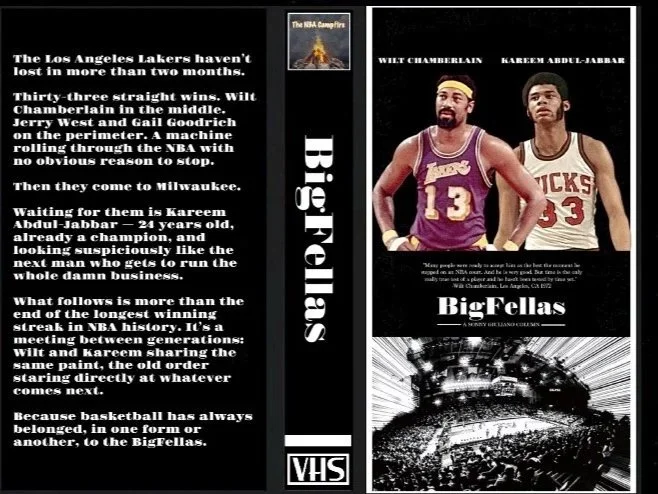
On January 9, 1972, two of the most powerful men to ever control that territory found themselves standing across from one another in Milwaukee. Wilt Chamberlain was 35 years old, and his Los Angeles Lakers had won 33 consecutive games, which to this day remains the longest winning streak in NBA history. Kareem Abdul-Jabbar was 24 years old, and his Milwaukee Bucks were the defending world champions.
One man had spent more than a decade bending basketball to his dimensions, breaking records and obliterating box scores. The other had entered the league just a few years earlier and immediately started doing much the same thing, one skyhook after another.
They weren’t merely two great centers sharing the same court. They were two points on the same bloodline. And on this night, for 48 minutes, the family business had both its past and its future in the same room.
There are nights when basketball history feels less like a timeline and more like a family portrait. This was one of them, and if this were a gangster movie, you’d know the scene:
The old boss is still sitting at the head of the table. Nobody has taken away his chair. Nobody has announced that the business is changing hands. But across the room sits the younger man everyone has started watching. The expected successor.
Maybe the old boss still has a few good years left. Maybe the kid isn’t ready just yet. Maybe everyone in the room is smart enough not to say out loud what they’re already thinking.
But eventually, somebody will inherit the business.
Of course, a scene like this one raises a few important questions:
Who had it before Wilt? Who came after Kareem? And how exactly did basketball’s most valuable territory keep passing from one BigFella to the next?
Once you start tracing the lineage, things get complicated. Names start overlapping. Eras bleed into one another. Some men inherit the operation cleanly. Others have to fight for it. Every once in a while, somebody shows up and takes the whole damn thing by force.
At a certain point, you realize there’s only one reasonable way to sort through the whole damn thing.
You need photographs.
You need a cork board.
And you’re probably going to need some red string.
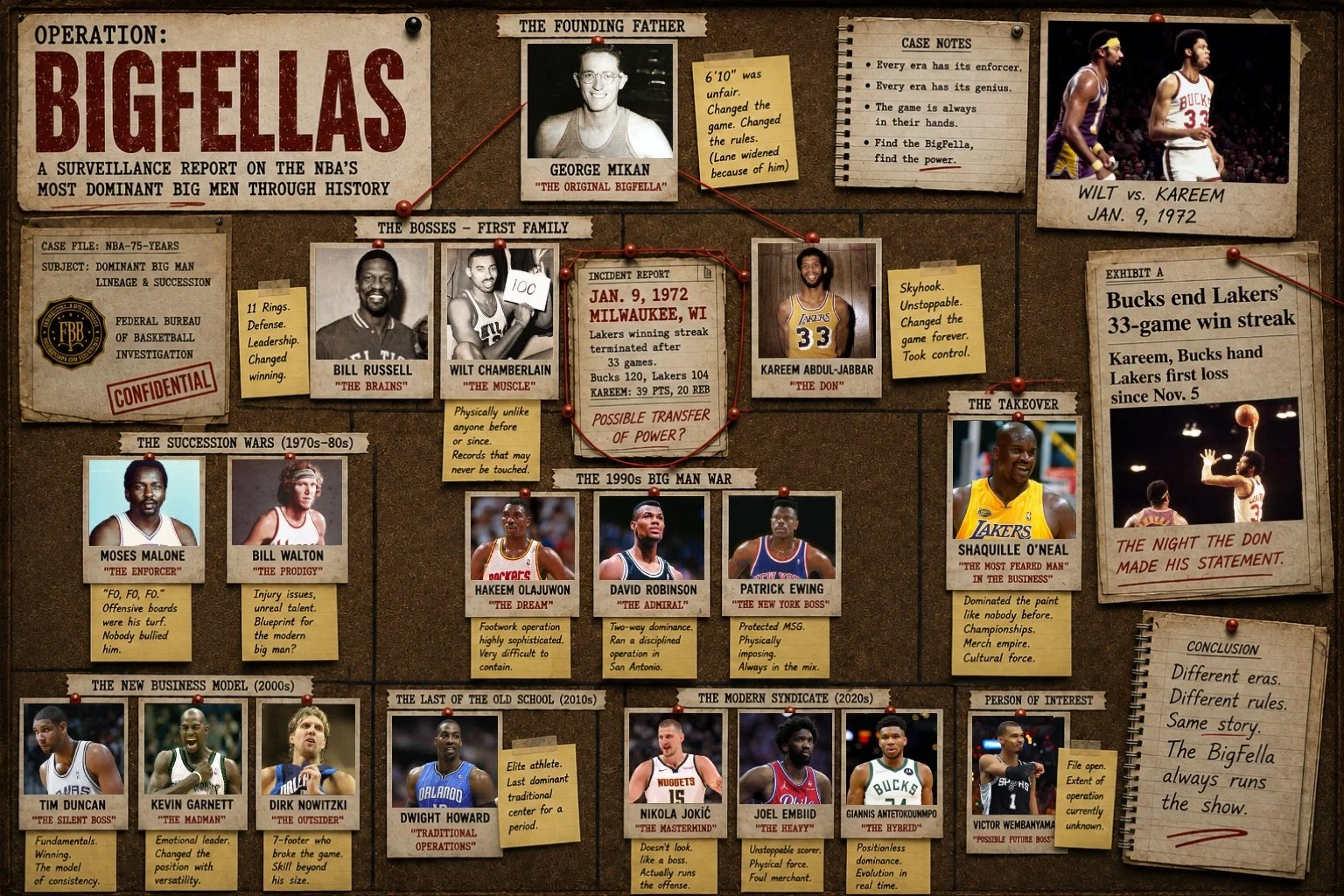
Take a look around.
At the top in the glasses, that’s George. George started the whole thing. By the time everybody else figured out there was money in this racket, George already had established a profitable territory in Minneapolis.
Then there’s Russ. Russ never cared much about scoring. He cared about winning, rebounding, defense and winning. Yes, it’s vital to mention winning twice.
And right next to Russ is Wilt. You’re going to hear some stories about Wilt. Some of them will sound made up. Most of them are not.
Kareem’s in the middle. The one with the skyhook and goggles. Twenty years in the business. He started as the heir apparent, and stayed around long enough to become the old boss himself.
Over on the left is Moses. Moses collected offensive rebounds like protection payments.
Next to Moses is Walton. For a minute, everybody thought the business was going to be his.
Then we’ve got Hakeem, Ewing and Robinson. Houston. New York. San Antonio. Three operations. One piece of territory. Things got competitive.
And that enormous gentleman off to the right? That’s Shaq. Three hundred-plus pounds, several nicknames, absolutely no interest in respecting established property lines.
Bottom left we have Duncan, Garnett and Dirk. Duncan ran a perfectly legitimate operation. Garnett expanded its jurisdiction. Dirk relocated the headquarters outside of the paint.
Next to those three is Dwight, who was built like the future while playing a position that was rapidly being declared part of basketball’s past.
Then there’s the Modern Syndicate that’s run by Jokic, Embiid and Giannis. The family business has gone international.
And that French kid at the edge of that board? That’s Wemby. We’re not totally sure what he is yet, but we’re fairly sure he’s going to be very important.
Every family has an origin story.
This one starts with George Mikan.
George Mikan - The Founding Father
In December 1949, the Minneapolis Lakers were set to visit the New York Knicks, and instead of advertising to the masses that the Lakers were coming to town, the powers that be at Madison Square Garden went a different route to promote this upcoming contest. On the marquee outside of the arena, only three words were needed to tell the entire story:
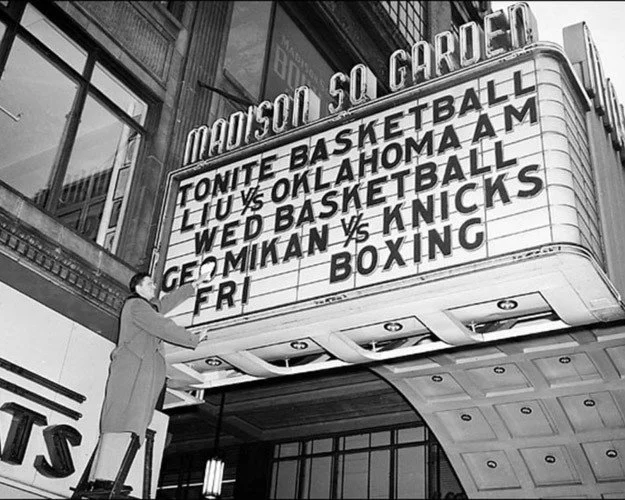
In 1949 — and throughout much of the 1950s — the American public still needed convincing that professional basketball was something worth caring about, and George Mikan had already become big enough, both literally and figuratively, that an entire opposing team could be reduced to the role of supporting cast on a marquee outside of the World’s Most Famous Arena.
Every family business has a version of this guy. The one who got there early. The one who started it all. The one who took control before the operation had rules. Before everybody understood how much money there was to be made. Before the territory had been divided up and people started going to war over who controlled what.
Mikan didn’t inherit the BigFella business.
He incorporated the whole damn thing.
At 6’10” and nearly 250 pounds, George Mikan was enormous by the standards of his time, but describing him as enormous undersells what made Mikan so important as we start to trace the lineage of his position.
Yes, Mikan had superior size compared to his rivals, but he also had touch. He had footwork. He had a go-to hook shot. He had a knack for rebounding the ball and protecting the basket. He would even come to have a drill named after him — the Mikan Drill — that generations of kids would continue doing long after any of them had a clue who George Mikan was.
Most importantly, George Mikan gave basketball one of its earliest demonstrations of a principle that would govern the sport for decades:
If you have the biggest and most skilled man on the floor, everything should revolve around him. And perhaps if you operate this way, you’ll have far more success than any other team trying to carve out its own piece of the territory.
The Minneapolis Lakers certainly did. With Mikan at the center of the operation, they won five championships in six seasons and established professional basketball’s first real dynasty.
Mikan was such a problem for his opponents that the league was forced to change various rules — most famously, widening the lane from 6 to 12 feet in an attempt to keep Mikan from parking himself so close to the basket — in order to combat his dominance.
Is there anything more gangster than forcing the authorities to rewrite the laws specifically because your operation has become so powerful? I don’t think so. The NBA looked at how Mikan was dominating six feet of painted territory around the basket and decided, ‘We need to make this neighborhood bigger.’ So they doubled it, but Mikan and the Lakers still won three more titles after the adjustment had been made.
Mikan proved that the biggest man could become the center of basketball’s universe. And once everyone else saw what that kind of power looked like, the business became considerably more competitive.
Because eventually another organization finds its own guy.
Then another.
And before long, you don’t have one family controlling the territory anymore. You rival families. And rival families go to war.
Bill Russell and Wilt Chamberlain - The War For The Family Business
By the time Wilt Chamberlain arrived in the NBA in 1959, Bill Russell had already been running a highly successful operation in Boston.
Russell was only 25 years old, but the Celtics had already won two championships with him in the middle, including the title the previous spring. Red Auerbach had assembled the crew. Bob Cousy handled the ball and ran the show. Tommy Heinsohn and Bill Sharman handled much of the scoring. Russell controlled everything else.
But then Wilt showed up, and there was nobody else like Wilt.
At 7’1” and somewhere around 275 pounds, Wilt was faster than anyone that size had any reasonable business being, and strong enough that stories about his physical capabilities would eventually begin sounding less like documented history and more like something an old mobster would tell you after he pours himself a fourth Sambuca.
And from practically the moment he entered the league, it became obvious that Boston had a rival family to deal with.
Chamberlain debuted by putting up 43 points, 28 rebounds and 6 blocks against the Knicks in the very same arena that once featured George Mikan’s name on its marquee. As a rookie he averaged 37.6 points and 27 rebounds, won Rookie of the Year and, just for good measure, league MVP.
Wilt was a made man immediately.
His first meeting with Russell came on November 7, 1959, and Chamberlain finished with 30 points and 28 rebounds. It was the beginning of a disagreement that would last the better part of the next decade. And what made the disagreement so fascinating was that Russell and Wilt offered two almost completely opposing theories on how a BigFella should run the family business.
Wilt's argument was impossible to misinterpret: Be bigger than everybody. Be stronger than everybody. Score more than everybody. Rebound more than everybody. And every once in a while, just to make sure future generations suspect the record book contains a series of clerical errors, do something completely fucking ridiculous.
Wilt Chamberlain statistics eventually stop sounding like actual statistics and start sounding like mob folklore.
I knew a guy who saw Wilt score a hundred one night in Hershey, Pennsylvania.
Sure you did.
Guy averaged fifty for an entire year.
Yeah, right.
Played more minutes per game than there are minutes in the game.
Okay, now you're fucking with me.
Except they’re all true.
Russell’s argument was different.
Russell never approached basketball as a competition to determine who could accumulate the most impressive collection of numbers. His influence was harder to capture inside a box score because so much of what he did was preventative. Shots not taken. Drives reconsidered. Possessions turned into Boston fast breaks because Russell either grabbed the rebound and immediately fired an outlet pass in the other direction, or blocked an opponent’s shot in the direction of one of his own teammates.
If Wilt’s version of power was making absolutely certain everyone in the neighborhood knew how powerful you were, Russell’s version was quieter.
You simply controlled the neighborhood.
If you wanted to know who had the most outrageous numbers, the answer was Wilt.
If you wanted to know who kept walking out of the building with the briefcase full of cash, it was Russell.
And that became the defining tension between Russell and Wilt. Philosophically and stylistically, the two operated at opposite ends of the spectrum, so it would be understandable to assume there was genuine animosity between them. It looked like a turf war. It felt like a turf war. But off the court, these rival bosses kept having dinner together. Literally.
For six straight years, when the Celtics played their annual Thanksgiving game in Philadelphia, Wilt would pick Russell up from the team hotel and bring him back to the Chamberlain family home for dinner. Russell would eat with Wilt and his family, enjoy his mother’s cooking, and then ride with Wilt to the arena for the game.
Imagine that sequence for a second.
Pass the potatoes. Compliment the cooking. Ask about the family. Later on, we settle the territory dispute.
Russell knew exactly what Wilt was. Wilt knew exactly what Russell was.
They simply disagreed about which one of them represented the proper way to run the business. And maybe that's why the debate has survived them.
Russell perfected the idea that a center could dominate a basketball game without dominating the scoring column. Wilt expanded the outer limits of what people believed a basketball player could physically do.
Russell collected championships with Michael Corleone efficiency. Wilt approached statistical excess with Tony Montana enthusiasm.
Russell controlled outcomes. Wilt controlled the record books.
Together, they took the operation that George Mikan had built and turned control of the middle into the most important power struggle in professional basketball.
But every war eventually ends, and this one ended in the spring of 1969, when Russell’s Celtics defeated Chamberlain’s Lakers in Game 7 of the NBA Finals. It was Russell’s 11th championship, and his last. Two months later, he retired.
One rival boss had left the business, but Wilt was still standing.
And three years later, now 35 years old and still wearing the purple and gold of the Los Angeles Lakers, Wilt would find himself in Milwaukee staring across the paint at a 24-year-old who looked like he was the next man in line.
Meanwhile, in Milwaukee…
Kareem did not spend much time easing into the territorial dispute.
On Milwaukee’s second possession of the game, Oscar Robertson backed Jerry West into the mid-post and missed a turnaround jumper, only for Kareem to rise over Wilt and clean it up with a tip-in.
And yes, Oscar Robertson and Jerry West are also playing in this game.
That’s Wilt Chamberlain, Kareem Abdul-Jabbar, Oscar Robertson and Jerry West sharing one basketball court. Four of the 20 greatest players in NBA history, if you’re keeping score at home.
And just to make the family portrait even more crowded, Bill Russell was sitting courtside doing color commentary for ABC. The man who had spent a decade fighting Wilt for control of the business was now watching Wilt try to hold off the next guy in line.
Two possessions later, Kareem went directly at Wilt and dropped in a skyhook. Then, on Milwaukee’s very next trip, he did it again.
Same territory. Same defender. Same shot. Another bucket.
If this was supposed to be the young heir patiently waiting for the old boss to vacate the chair, Kareem apparently misunderstood the succession plan.
He attacked Wilt again shortly afterward and caught him with his hand in the cookie jar, drawing a foul.
Wilt responded almost immediately. A few possessions later, Kareem caught the ball in the post. Wilt stripped him clean.
Not long after that, Gail Goodrich penetrated deep enough to force Kareem away from Wilt, then slipped the ball to Chamberlain for a dunk. And slowly, the old man began reminding everybody why the territory had belonged to him for so long.
Bob Dandridge tried a runner. Wilt sent it into the third row. Kareem tried him inside. Wilt altered the shot. Dandridge cut along the baseline for what appeared to be a layup. Wilt erased that one, too.
Then, when Milwaukee tried feeding Kareem on the interior, Chamberlain jumped the passing lane and came away with the ball.
This was 35-year-old Wilt now. The scoring explosions had cooled. The absurd statistical excess had been scaled back. But the size remained. The instincts remained. The ability to make an entire section of the court feel like protected property remained. The ability to take over remained, too.
After one quarter, Los Angeles led 28-26.
Kareem had landed the first punches. Wilt had answered nearly every one of them. And considering one of them was 24 years old, the reigning MVP and seemingly ascending by the week, while the other was 35 and approaching the final chapters of his career, a draw felt a hell of a lot more like a win for Wilt.
The old boss was not ready to surrender the neighborhood just yet.
Kareem Abdul-Jabbar - The Heir Who Became The Don
There was nothing particularly violent about the shot Kareem Abdul-Jabbar employed to take firm control of the family business.
No thunderous collision. No shattered backboard. No defender getting tossed aside like somebody who had missed a payment.
Mostly, Kareem just turned his body sideways, extended his right arm toward the ceiling, and released the basketball from a point in the sky that very few human beings could ever think of accessing.
The skyhook. Everybody knew it was coming, but this information was about as useful as warning Fredo Corleone not to bang cocktail waitresses two at a time.
There is something almost insulting about an unstoppable move that doesn’t look especially unstoppable. Shaq would eventually dunk on people with the subtlety of a home invasion. Wilt could overwhelm an opponent simply by being Wilt Chamberlain. Kareem’s signature move looked comparatively peaceful… until you tried to do something about it.
At 7’2”, with his arm fully extended and his body positioned between the defender and the basketball, Kareem essentially turned every skyhook into a geometry problem that didn’t have a correct answer. Contest the skyhook too aggressively and risk sending him to the foul line, where he shot a respectable 72 percent for his career. Give him space and you may as well start jogging back on defense. Send help and somebody else was about to profit from your panic.
By the time Kareem and Wilt met in Milwaukee on January 9, 1972, this wasn’t merely some promising young player waiting patiently for his chance to inherit the operation.
Kareem was already a made man.
The previous season, he had led Milwaukee to 66 wins, was named regular season MVP, and carried the Bucks to their first championship in franchise history in only their third season of existence. Milwaukee went 12-2 during that postseason run, including a five-game dispatching of Wilt’s Lakers in the Western Conference Finals.
Then he came back the following season and got even better.
By January 1972, Kareem wasn’t really asking whether there was room for him at the table anymore. He was already looking like the guy everyone else needed permission to sit next to. And his version of BigFella dominance added something different to the family lineage.
Mikan had established that basketball could revolve around its largest skilled player.
Russell had demonstrated that a center could control an entire game without dominating the scoring column.
Wilt had taken the physical possibilities of the position and stretched them until the numbers stopped looking real.
Kareem inherited pieces of all of it. The size. The scoring. The rim protection. The rebounding. The gravitational pull of having the largest problem on the floor standing five feet from the basket.
But he added something to his game that the family business hadn’t quite seen before: Inevitability through refinement.
The skyhook wasn’t merely a weapon. It was Kareem’s intellectual property. It was a product that nobody else could replicate, and for two decades he refused to take it off the market.
This is an underrated part of running any successful operation. Eventually, everybody figures out what you do. Competitors study you. The authorities adapt. Younger guys arrive with newer ideas. The trick is having something everybody knows about and nobody can stop anyway.
Kareem had that, and he kept it for nearly two decades.
He arrived. He dominated. He won. And then, most inconveniently for everyone waiting behind him, he stayed on top.
He entered a league still tethered directly to Russell and Wilt, spent years without a true equal at his position, continued to thrive even as Larry Bird and Magic Johnson changed the way the game was played, and eventually left a league that was rapidly becoming Michael Jordan’s.
Twenty seasons is a long time to stay in any business, particularly one that asks seven-footers to run up and down hardwood floors several nights a week. Long enough, in Kareem’s case, for the young heir to become the old boss.
That might be the strangest part of looking back at January 9, 1972. We see Kareem standing across from Wilt and instinctively recognize the younger man as the future. Even with all of the hype and early success, Kareem couldn’t have known that someday he would be the veteran everybody measured themselves against. That younger centers would enter the league looking at his records, his championships, his skyhook and his seat at the head of the table and wonder when, or if, it would become available.
But that’s the problem with becoming the Don. Eventually somebody starts asking who comes next. And for the first time in the history of the BigFella business, the answer wasn’t particularly obvious.
There were two candidates, though, who could offer competing claims.
There was one guy who looked like the natural heir until his body betrayed him, and another who seemed considerably less interested in waiting for anybody’s blessing.
Bill Walton and Moses Malone - The Succession Crisis
The trouble with sitting at the head of the table for as long as Kareem Abdul-Jabbar did is that eventually everyone starts wondering who gets the chair when you’re finished with it. For a little while, the answer appeared obvious.
Bill Walton had already followed Kareem into one of the most intimidating basketball operations in America. Kareem left UCLA after three national titles, and a few years later, Walton took over the middle in Westwood and helped keep John Wooden’s machine rolling toward another two championships. Apparently succession planning was something the Bruins took rather seriously.
If Kareem represented dominance through refinement, Walton seemed like the next logical evolution of the BigFella business. Brilliant passer. Elite rebounder. Defensive anchor. A basketball brain seemingly capable of processing all other nine players on the court at once. Walton didn’t dominate possessions so much as organize them.
The ball moved through him. The defense operated around him. Portland’s entire ecosystem seemed healthier simply because he was standing in the middle of it. And in 1977, everything clicked.
The Trail Blazers won the NBA Title in the first season following the league’s merger with the ABA. Walton was named Finals MVP, and suddenly the family business appeared to have found its next perfectly respectable heir. The succession plan had worked perfectly in college, and it looked like it might work again.
Then Walton’s body had other plans.
During the 1978 NBA Playoffs, Walton suffered a fracture in his left foot. A year and a half later he’d suffer another fracture in his left foot. And then a stress reaction that was followed by another stress fracture. Reconstructive surgery on both his foot and ankle. Then the bone spurs started popping up, and that paved the way for a fracture of his right foot. And that required reconstructive surgery too.
Bill Walton didn’t just have a history of lower-body injuries. He had a full-blown medical dossier. If Walton was supposed to inherit the family business, his feet and ankles kept putting hits out on the succession plan.
Fortunately for the BigFella business, another man had already entered the operation, and while Walton appeared to be the carefully groomed successor, Moses Malone looked like the guy who spent years kicking up, collecting debts and doing the jobs nobody else wanted until somebody finally realized he was running half the operation anyway.
Even his route into professional basketball felt unconventional. In 1974, Malone went directly from high school into the ABA, becoming the first modern player to make that jump. There was no carefully managed collegiate apprenticeship. No waiting around for somebody to tell him he was ready. Moses just went straight to work, and he never stopped working.
There are flashier skills in basketball than offensive rebounding, and there are certainly skills that involve considerably less elbowing, wrestling, sweating and repeatedly crashing into very large men.
Moses was not concerned with aesthetics, nor was he shy about making all of that elbowing, wrestling and body contact part of the business model. Every missed shot turned the paint into Moses Malone’s own personal mosh pit, and he usually looked like the only guy who actually wanted to be in there.
If Walton played basketball like he could see the entire operation from above, then Moses played it like he could outwork everyone inside it, and accordingly, nobody in NBA history accumulated more total offensive rebounds or led the league in offensive rebounds per game more times than Moses did.
Eventually, all of that work started paying considerably better. Moses won his first MVP in 1979 with Houston. Three years later, he won another. By then, he wasn’t the guy waiting around for somebody to recognize how valuable he was anymore. He was one of the most powerful men in the business.
And in the summer of 1982, Philadelphia decided it needed him.
The 76ers already had an established operation. Julius Erving was the face of the franchise. Maurice Cheeks ran the point. Bobby Jones handled the dirty work. They had reached the NBA Finals three times in six years.
They had also lost all three.
Twice, the Lakers — led by Kareem Abdul-Jabbar, still sitting in the big seat at the head of the table — had been the ones standing in the way of the 76ers. So Philadelphia went out and acquired the reigning MVP, proving that sometimes the easiest way to settle a territory dispute is to hire the biggest, baddest motherfucker out there and let him unleash holy hell on all of the other families.
Moses won his second-consecutive MVP Award, the 76ers won 65 games, and in the NBA Finals, Philadelphia swept the Los Angeles Lakers, with Malone earning Finals MVP after overwhelming the glass against the man whose chair everyone had spent the previous decade discussing. Across four games, Moses outscored Kareem 103-94, and out-rebounded him 73-30.
No ceremonial transfer. No announcement from league headquarters. No consigliere standing between them explaining the terms of succession. Just Moses Malone repeatedly grabbing the basketball and putting it back into the basket until the argument became difficult to continue.
And yet even Moses never quite became what Kareem had been.
Walton had the perfect game but not the healthy body. Moses had the MVPs, the championship and one of the most relentless physical identities the position had ever seen, but his reign never became the kind of decade-spanning monopoly Kareem’s had been.
The family business had changed. Power became heavily contested, readily available and increasingly temporary. And once everybody realized the territory was up for grabs, a whole lot of BigFellas started staking claims.
The succession crisis was over, but the territory wars were about to begin.
Back to Milwaukee…
For most of the 1st quarter, Wilt had managed to keep the territorial dispute relatively even.
That arrangement did not survive much longer, and accordingly, neither did the cordiality between the two.
Midway through the 2nd quarter, Kareem caught the ball near the basket with Happy Hairston standing between him and the rim, which proved unfortunate for Happy Hairston.
Abdul-Jabbar exploded through him for the dunk, sending Hairston —no longer happy — crashing to the floor, then stood over him and screamed. And almost immediately, Wilt came charging into the picture.
Chamberlain confronted Kareem. An official hurried between them. And for a few seconds, the whole family-business metaphor stopped being a metaphor.
The old boss had just watched the young guy put one of his people on the floor and looked ready to take matters into his own hands.
Wilt answered on the other end. Kareem tried pulling the chair out from underneath him in the post, but Chamberlain kept his balance and finished the lay-in anyway.
Nice try, kid.
But before halftime, Kareem got the final word.
With less than a minute remaining, Abdul-Jabbar swept across the lane and launched another skyhook. Wilt challenged it and wound up tumbling to the floor as the ball dropped through.
Milwaukee went to halftime ahead by six.
And when the 3rd quarter began, the generational gap started becoming considerably harder to ignore.
Kareem beat Wilt down the floor, caught a pass over the top and finished at the rim before Chamberlain could recover. A little later, Kareem grabbed an offensive rebound and gave Wilt a shot fake. Wilt stayed disciplined and refused to bite, but Kareem knocked down the short baseline jumper anyway.
Then Wilt caught the ball in the post and delivered a beautiful bounce pass to a cutting Hairston. For a moment, it looked like Chamberlain had created an easy basket.
Kareem recovered and blocked Hairston — still not happy — at the rim.
And this is where the game began to feel different.
Kareem suddenly looked like the most energized player on the floor. He was running. Scoring. Rebounding. Protecting the basket. Controlling increasingly large portions of the same territory Wilt had spent more than a decade claiming as his own.
The Lakers, to their credit, refused to go away. They ripped off an 8-0 run and tied the game at 67, prompting ABC to put the two centers’ numbers on the screen.
Kareem: 27 points, 12 rebounds, 4 blocks.
Wilt: 9 points, 11 rebounds, 6 blocks.
Los Angeles had survived everything Kareem had thrown at them and gotten the game back to even.
So what did Milwaukee do?
They went right back to Kareem.
And what did Kareem do?
He went right back to the skyhook.
Then on back to back possessions at the other end, Kareem emphatically erased a pair of Wilt shots at the rim, and by the end of the 3rd quarter, Milwaukee led by 7.
24 minutes earlier, Wilt had still been making a convincing argument that the old operation remained perfectly functional. But now with three frames down, Kareem was looking less like the next man in line and more like the man everybody else was already working for.
Hakeem Olajuwon, Patrick Ewing and David Robinson - The 1990s Territory Wars
For most of the BigFella family history, identifying the man who controlled the territory wasn’t particularly difficult. But by the time the 1990s arrived, there was no single Don sitting comfortably at the head of the table.
There were, instead, three rival families:
New York had Patrick Ewing. San Antonio had David Robinson. Houston had Hakeem Olajuwon. Different cities. Different operations. Different methods of conducting the same business. And all three wanted the same piece of territory.
Patrick Ewing's operation was probably the easiest to understand, but to fully grasp Ewing’s place in the NBA in the 1990s, you first need to consider what was happening in Detroit, where the Bad Boys had already demonstrated that intimidation could be more than an attitude. It could be an entire basketball system.
The Pistons had shown the league that there was competitive value in making opponents miserable. They had the two championships and a whole shit-load of pissed-off contemporaries to prove it. The Knicks took detailed notes, and when Detroit’s run eventually ended, the folks in New York made sure the Bad Boys brand of basketball did not.
By the early ’90s, Pat Riley’s Knicks had inherited a good portion of Chuck Daly’s philosophy. Different personnel. Different city. Same basic idea: defend everything, concede nothing comfortably, and make sure anybody entering the paint understood there would be a price to pay.
And at the center of New York’s operation stood Patrick Ewing, broad-shouldered, drenched in sweat, and perfectly suited to serve as the figurehead of a hard-nosed team in the biggest city in the world.
He protected the rim. He scored in the post. He knocked down the mid-range jumper. He battled on the glass. And if the Knicks were going anywhere meaningful, everybody understood who was going to have to drag them there.
In Game 7 of the 1994 Eastern Conference Finals, with New York trying to reach its first NBA Finals in more than two decades, Ewing finished with 24 points and 22 rebounds and put back a missed John Starks layup in the final minute to help finish off the Indiana Pacers.
That was Patrick Ewing basketball. Nothing came easily. Certainly nothing came quietly. But eventually, somehow, the job got done.
Down in San Antonio, the operation looked very different.
David Robinson looked less like somebody who had grown into a basketball player and more like somebody the United States government had grown in a lab after being asked to design the perfect big man.
Tall. Long. Fast. Absurdly athletic. And a physique that would make statues of Greek gods feel self-conscious.
The Admiral ran the floor and exploded off the ground like a wing. He could face up, put the ball on the floor, finish above the rim and erase mistakes on the other end of the floor. The traditional BigFella had always controlled the territory by being bigger and stronger than everyone else. At his peak, Robinson looked like he’d be given those advantages without being asked to sacrifice any of the speed.
If Patrick Ewing’s power was industrial in nature and David Robinson’s felt aerodynamic, then Hakeem Olajuwon’s was geometric. He didn’t simply overpower defenders or outrun them. He rearranged their relationship to space.
A shoulder fake. A pivot. A hesitation. Another pivot. One step in one direction. The defender commits. Hakeem disappears the other way. The geometry was constantly changing, and the defender was usually solving the problem one step too late.
The Dream Shake wasn’t really a move. It was a collection of possibilities, all of which befuddled opposing defenders.
A baseline spin. A drop step. An up-and-under. A turnaround jumper. A soft hook. A fake that looked exactly like the move he had used two possessions earlier, right up until the moment it wasn’t. Bada Bing! Hakeem scored another bucket.
That was the cruelty of guarding Hakeem. Every answer created another question. Stay grounded and he could simply shoot over you. Leave your feet and you were finished. Shade him toward the baseline and he could spin middle. Take away the middle and suddenly he was gone along the baseline.
There was no correct choice. Only varying degrees of wrong, and by the time the basketball went through the hoop, the poor bastard guarding him usually looked like he needed someone to explain what had just happened.
And somehow, the Dream Shake represented only half the problem.
Hakeem could terrorize you at the other end, too. Hell, you could make a convincing argument that he was a far superior defensive player than he was an offensive one. He protected the rim, moved his feet well enough to survive away from it, generated steals like a player half his size and had the instincts to clean up mistakes that occasionally hadn’t even happened yet.
Most great centers controlled one end of the territory and remained enormously useful on the other, but Hakeem made both ends feel like his property.
Eventually, of course, territory disputes have to be settled in person, and in 1994, Hakeem and Ewing finally got their sit-down.
Ten years earlier, Ewing’s Georgetown Hoyas had beaten Olajuwon’s Houston Cougars for the national championship. Now they were meeting again with control of the professional game on the table.
The series went the full seven. It was ugly, physical, low-scoring basketball that played more to New York’s preferred style, but this time, it was Hakeem who emerged victorious. And for the first time in this entire territory war, somebody had made a convincing claim that the business belonged to him.
David Robinson apparently required further convincing.
The following season, Robinson won MVP, which was perfectly reasonable considering he averaged 27.6 points, 10.8 rebounds and more than three blocks per game while leading San Antonio to 62 wins and the league’s best record.
Unfortunately for Robinson, the trophy presentation occurred with Hakeem standing at the other end of the court, shortly before their Western Conference Finals showdown. And Olajuwon appeared to approach the meeting with roughly the same intentions Michael Corleone had when he sat down with Sollozzo and Captain McCluskey at Louis’ Restaurant.
Years later, Robinson’s explanation for the problem could basically be summarized in four words:
And maybe that's the cleanest way to describe what happened during these territory wars.
Ewing had New York and Robinson had San Antonio. Both were unquestionably made men. Both could build contenders around themselves. Both could control the paint on either end of the court.
But when the three families finally started settling things in May and June, Hakeem kept walking out of the room with everybody else's envelope.
For two consecutive springs, The Dream controlled the territory. Which should have settled things. Except there was a problem: while Ewing, Robinson and Olajuwon had been fighting over the neighborhood, somebody new had already moved in down in Orlando. He was younger than all of them. Louder than all of them. Already one of the most famous basketball players alive.
His name was Shaquille O’Neal. And Shaq was coming for the whole fucking business.
Shaquille O’Neal - The Hostile Takeover
Shaq did not arrive in the NBA looking like somebody prepared to patiently work his way up the organizational chart. He arrived looking like he might accidentally knock the building over.
During his rookie season, O’Neal became famous for doing things to basketball hoops that usually required an insurance adjuster afterward. Backboards shook. Supports buckled. Shot clocks tumbled.
This big fella was a different kind of BigFella. Other great centers mastered the territory. Shaq occasionally made it look like the territory needed to be rebuilt after he stepped foot inside of it.
The first time Shaq made a serious run at control of the territory, though, the sitting boss sent him home. In 1995, Orlando reached the NBA Finals and found Hakeem waiting there. Olajuwon and Houston swept the Magic, which is important, because hostile takeovers don’t always succeed on the first attempt.
Like plenty of ambitious gangsters before him, Shaq eventually realized there was considerably more territory to be claimed out west. In the summer of 1996, Shaq signed with the Los Angeles Lakers, where Hollywood, Jerry West and quite a few boxes of ziti were waiting for him.
By 2000, the takeover was complete. Shaq was the nearly unanimous MVP, and the Lakers — despite a near hiccup in Game 7 of the Western Conference Finals — won the NBA Championship, the franchise’s first since Kareem Abdul-Jabbar was still manning the middle. Unlike the Kareem and Magic-led Lakers, this version of Showtime did manage to three-peat.
Shaq did not reinvent the BigFella business. In some ways, he dragged it violently back toward its oldest principle: Acquire the biggest, most dominant man in basketball. Put him near the basket and make everybody else solve the problem.
George Mikan, the O.G., would have understood the operation immediately. The difference was that Mikan ran his business in black and white. Shaq ran his in HD and with surround sound.
Tim Duncan, Kevin Garnett and Dirk Nowitzki - The New Business Model
Shaq had spent years proving there was still enormous value in doing business the old-fashioned way. But Tim Duncan, Kevin Garnett and Dirk Nowitzki were about to start rewriting the company handbook
Duncan was probably the easiest of the three for George Mikan to understand.
He played inside. He rebounded. He protected the rim. He operated from the post. He banked shots off the glass with such regularity that somewhere along the way it became impossible to determine whether he was just playing fundamentally sound ball or conducting a long-term experiment to see if every arena’s backboards were actually up to code.
Duncan carried himself in a manner that would make any old-school mafioso proud. Just keep your head down, handle the business, and under absolutely no circumstances attract attention. In time, Duncan’s way of carrying himself permeated the entire San Antonio Spurs organization.
Not only was Kevin Garnett not nearly as attention-averse as Duncan was, he seemed interested in expanding the definition of what a BigFella was allowed to do.
Dominate the boards? Of course.
Defend the rim? You know it.
But KG started switching onto guards. Handling the ball. Facilitating the offense. Shooting from the elbows and wings. Talking enough shit to fill several seasons of premium cable television.
If Duncan ran one of the cleanest operations in basketball, Garnett seemed to be running six different departments at once while screaming instructions to everyone in the building. Duncan spoke softly and carried a big stick. Garnett spoke loudly enough that nobody ever bothered checking whether he was carrying one.
And then there was Dirk, who arrived from Europe apparently unaware that seven-footers were supposed to stay in their assigned neighborhood.
For generations, BigFellas had established their power by moving closer to the basket. Dirk looked at all of that valuable painted territory and decided he might prefer doing business eighteen feet away.
Or twenty.
And hell, if we’re all the way out there, why not just push it to twenty-five and get that extra point every time you knock down a jumper?
Dirk did not abandon the family business. He relocated it. And once he did, everybody else started noticing how much unused property existed outside the paint.
The territory was expanding, and soon enough, the old borders would become almost impossible to recognize.
Dwight Howard - The Last of the Old School
But before the old business model disappeared completely, there was one more guy running it almost exactly the way the founding fathers would have recognized.
Whatever happened to the strong, silent center?
For a few years, his name was Dwight Howard. Well. Strong, anyway. Silent, not so much.
At his peak, Howard was a terrifying combination of strength, explosion and vertical reach, and Orlando built an entire operation around the basic understanding that he could control the interior while everybody else spread out around him.
There was almost something defiant about it. The league was beginning to stretch. More shooting. More spacing. More skill away from the basket. More big men being asked to do things that would have seemed foreign to the previous generations. Meanwhile, Dwight kept conducting business the old-fashioned way, and with capable enough floor-spacers around him, the Magic reached the NBA Finals for the first time since Shaq was still making backboards tap out.
But it wasn’t 1995 anymore. Sure, the paint still mattered, but to become a truly dominant BigFella in the modern NBA, you needed to be able to hold down considerably more territory.
Nikola Jokic, Joel Embiid and Giannis Antetokounmpo - The Modern Syndicate
For several years, we kept hearing that the traditional BigFella was dying. As the game got smaller, faster, and more perimeter-oriented, centers were being played off the court.
The family business looked like it was finished, at least domestically. So in response, the family business went international. The old BigFella controlled the paint. The modern version apparently needed the entire fucking floor.
Nikola Jokic, Joel Embiid, and Giannis Antetokounmpo have redefined what it means to be a dominant big man in the NBA. From 2019 through 2024, the MVP trophy became less a league-wide honor than a piece of property passed around within the same three-man syndicate. And hell, even just 20 years earlier, the makeup of this syndicate would’ve sounded completely ridiculous.
A Serbian center who played offense like he’d already seen the next three possessions? A Cameroonian big man who combined the scoring menu of a super-skilled wing with the physical dimensions of an old-school center? A Greek freight train whose position occasionally seemed to depend on which part of the floor he had just destroyed?
Do any of those descriptions make even an iota of sense in 1990?
This was no longer just one operation. It was a multinational conglomerate that controlled the entire 94-by-50 playing surface, until eventually the old positional borders barely meant anything at all.
And just when we’d finally started to accept that the borders were meaningless, France sent us a guy who made even these three look like recognizable basketball archetypes.
Victor Wembanyama may very well be the next BigFella to take his seat at the head of the table. If we’re lucky enough, we’ll get to watch the coronation in real time, just as we did in 1972.
One Last Time, Back to Milwaukee…
We know considerably more now than anybody sitting inside Milwaukee Arena could have known on January 9, 1972, even after the Bucks defeated the Lakers by the final score of 120-104, ending LA’s 33-game winning streak.
We know what Kareem became. We know how long he stayed. We know who eventually came after him, and who came after them. We can trace the entire family tree from Mikan to Russell and Wilt, through Kareem and Moses and Hakeem and Shaq, all the way to Jokić, Embiid, Giannis and whoever comes next.
But sitting courtside that night, Bill Russell didn’t need 50 years of hindsight. After the game, the former boss looked at what had just happened and summarized it rather simply:
“In the 2nd half, Kareem really took over.”
That was it. No ceremony. No crown. No formal transfer of power.
Just one BigFella recognizing the moment another had taken control of the family business.
Next Up on Throwback Tapes: ‘Birdman’ (September 3)