The Throwback Tapes: Suns vs. Bulls, Game 3 of the 1993 NBA Finals
Chicago Stadium. June 13, 1993.
It’s Game 3 of the NBA Finals, and the Phoenix Suns and Chicago Bulls are heading to a third overtime.
As he approaches the center circle for the tip to begin the seventh period of this game, Michael Jordan can’t help but smile.
NBC cuts to Charles Barkley.
He’s smiling too.
There’s no way to prove that Michael Jordan and Charles Barkley are smiling at each other. But take a peek at this video and tell me it doesn’t very much feel like they are.
Now, let’s Rewind.
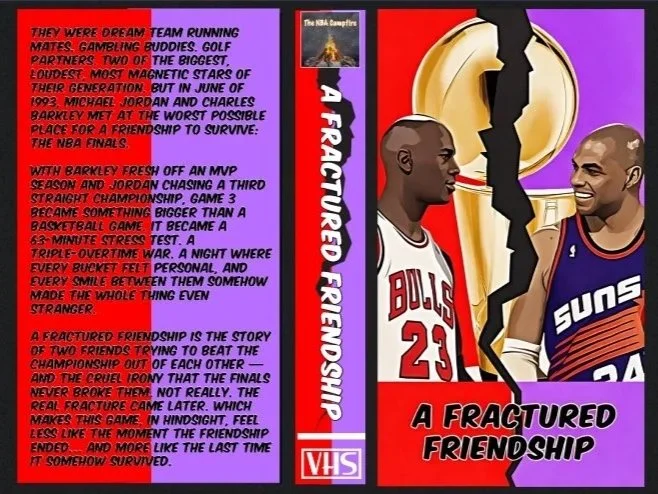
It’s important to remember that a fracture is not always a complete break.
Sometimes it’s just the slightest crack. Something damaged but still intact. A windshield you keep driving with. A phone screen that remains functional. A bone that aches but still holds weight. A fault line sitting quietly beneath the surface, waiting for enough pressure to make itself known.
And sometimes the thing you assume caused the fracture wasn’t actually the thing that broke anything at all.
If you were looking for the moment Michael Jordan and Charles Barkley’s friendship should have broken, the 1993 NBA Finals would seem like a totally logical place to start, because the conditions were almost laboratory-perfect.
Take two close friends. Make them not only two of the best basketball players alive, but also two of the most competitive human beings on Earth. Give one of them the MVP trophy the other guy wanted and felt he deserved. Give the other two consecutive championships. Put the first guy four wins away from the only thing missing from his career. Then inform both of them that the other is standing directly in the way.
See what happens.
Of course, these unique conditions don’t means much unless we first understand what Jordan and Barkley were to each other before there was a championship trophy sitting between them. Two full years before they met in the NBA Finals, Charles Barkley already seemed to believe he understood Michael Jordan better than most opponents did.
During the 1991 Eastern Conference semifinals, the Philadelphia 76ers trailed the Chicago Bulls two games to none when the Sixers found themselves with a chance to steal a must-win Game 3. The late-game play was designed for Barkley to attack the basket, but before the possession Barkley gave Hersey Hawkins, who was being guarded by Jordan, a prediction: Michael was going to leave him in order to double Barkley.
What happened?
The 76ers triggered in to Barkley. Jordan sagged off Hawkins in the corner. Barkley kicked it out to his teammate. Hawkins buried the three, and somehow, Philadelphia survived 46 points from Jordan to steal the game.
Afterward, Barkley explained his clairvoyance about as simply as he possibly could:
“I knew Michael Jordan like the back of my hand.”
At the time, Barkley was only talking about basketball. It wouldn’t be long until he’d get to know MJ this well on a personal level, too.
In May 1992, The Washington Post’s Bill Brubaker, while chronicling Jordan’s increasingly public fascination with gambling, casually dropped one hell of a detail: sometime during one of the previous two postseasons, after a playoff game against Barkley’s 76ers, Jordan and Charles spent “a long afternoon” playing blackjack together.
There is something wonderfully revealing about this particular anecdote.
These were not chummy teammates killing time on a road trip or throwing a couple bucks down on a team plane. They were superstar opponents who poured their blood, sweat and tears into knocking each other out of the Playoffs, only to reconvene hours later and spend a few hours chasing 21 instead of an NBA Championship.
Evidently, MJ and Chuck contain multitudes, because from the sounds of it, this counted as bonding.
If the blackjack table was where this friendship first started to reveal itself, the summer of 1992 gave it room to become something more.
For six weeks, Jordan and Barkley were no longer playoff opponents separated by locker rooms and playoff brackets. They were teammates. They practiced together, traveled together, played cards, played golf, talked shit and spent an absurd amount of time surrounded by what was at the time by far the most star-studded collection of basketball players ever assembled.
The Dream Team turned the usual NBA relationship inside out. The guys you spent eight months trying to beat were suddenly the guys sitting next to you on the bus on the way to the game… a game that the entire world was waiting to watch.
And basketball would never really go back to the way it was before. The Dream Team helped turn the NBA’s biggest stars into global icons, poured gasoline on the sport’s international growth, and showed a generation of players that rivals didn’t necessarily have to remain strangers simply because they wore different uniforms from October through June.
The effects would eventually show up everywhere—from the increasingly international makeup of National Basketball Association to an era in which superstar players became far more comfortable building relationships, sharing power and, eventually, choosing to play together, taking some of the power out of the hands of the individuals who historically facilitated such roster changes.
For Jordan and Barkley, though, the immediate consequence was much simpler: they suddenly had a whole lot of time to hang out. And this arrangement appears to have been particularly productive.
There’s a brief clip from that summer that probably explains the dynamic of this friendship better than I can:
This is an extremely Charles Barkley way of showing affection: give your friend his flowers, then swat the bouquet out of his hands. And this dynamic seemed to suit MJ just fine, because somewhere between the golf, the cards, the practices and Barkley’s apparent inability to let Michael Jordan enjoy his own commercial jingle in peace, the two became genuinely close.
By the time All-Star Weekend rolled around in February 1993, the friendship had become close enough that Barkley was being described as one of Jordan’s best friends by long-time NBA journalist Jan Hubbard. And when Michael was asked about the similarities between the NBA’s impeccably packaged global superstar and its considerably less filtered resident shit-stirrer — fresh off a summer in Barcelona where Barkley had emerged as one of the most popular American athletes at the Olympics — he offered an explanation that, in hindsight, feels almost too perfect.
“We’re like twins. That’s why I like Charles so much. The difference is that I’ve always been a little more controlled.”
There’s a lot hiding inside those three sentences.
Jordan wasn’t saying Barkley was fun to golf with or particularly useful when you needed someone willing to sit at a blackjack table for several hours. He was saying he recognized something of himself in Charles.
The competitiveness. The gambling. The shit talking. The stubbornness. The enormous personality. The apparent belief that almost any mundane activity could be improved dramatically by introducing the possibility that somebody might lose.
They were wired similarly. Michael just believed he kept a tighter grip on the wiring than Chuck did.
At the time, that probably seemed like little more than a funny distinction between two friends.
Keep this in mind, because that distinction will matter a whole lot later on.
A few months later, the post-Barcelona friendship got its first real stress test.
On May 25, 1993, Charles Barkley was named the NBA’s Most Valuable Player, edging out Houston Rockets big man Hakeem Olajuwon and reigning two-time league MVP Michael Jordan in one of the closest votes in league history.
It was hardly some sentimental lifetime-achievement award for the enigmatic star. In his first season in Phoenix, Barkley had transformed a 53-win Suns team into a 62-win juggernaut, averaging 25.6 points, 12.2 rebounds and 5.1 assists while immediately becoming the gravitational center of the best team in basketball. At 29 years old, after eight seasons spent unsuccessfully trying to drag Philadelphia through an increasingly unforgiving Eastern Conference, Charles Barkley was having the best year of his life.
There are probably easier ways to test a friendship with Michael Jordan than being handed an award that essentially says, for this season anyway, you were better at basketball than him.
A few weeks after Charles Barkley was officially named the NBA’s MVP, he would have to defend that distinction against the buddy who still believed it belonged to him.
Through the first two games of the 1993 NBA Finals, Michael Jordan’s claim was not lacking merit. The face of the NBA was not only averaging 36.5 points, 9.5 rebounds, 7.0 assists and 3.5 steals per game, but more importantly, he had led Chicago to a pair of wins in Phoenix, putting the Bulls in a commanding position to capture a third straight championship.
Worse yet for Charles Barkley, the series was already beginning to take on the shape of a familiar Michael Jordan story.
MJ had spent years turning great players into obstacles on the way to something larger — Ewing’s Knicks, Isiah’s Pistons, Drexler’s Blazers — and he would spend years afterward doing the same thing to plenty more. Another star would arrive with a compelling case for his own greatness, and somewhere along the way, the story would gradually stop being about him.
Phoenix had entered the Finals with home-court advantage. Two games later, that advantage was gone, Chicago was heading home up 2–0, and Barkley was suddenly one bad night away from being reduced to a supporting character in his friend’s mythology. Based on how those first two games unfolded, it didn’t feel like Barkley or the Suns had much hope of reversing their fortune with the series shifting to the Windy City.
In the first two games of the series, the Suns led for just 3 minutes and 54 seconds of a combined 96 minutes of play, a clear sign that despite finishing the regular season with a superior record and featuring, at least according to the MVP voters, the best player in basketball, Phoenix had spent most of the series looking like the inferior team.
But just minutes into Game 3, it was clear that the Suns were not content with letting the Bulls off easy, and Charles Barkley — despite playing with a banged-up right elbow that required the MVP to wear a bulky, not-too-flattering pad on his shooting arm — wasn’t going to behave like someone ready to hand his friend the throne back without a fight.
Then again, Barkley had already spent years making it clear that he had little interest in playing whatever role other people wanted to assign him.
And on this night, he had no intention of becoming a supporting character either.
Barkley wasn’t dominating Game 3 in the way you might expect from the newly crowned MVP. You’d expect the response to be loud: a scoring barrage, a rebounding clinic, and a stat line that reminded everyone why the MVP trophy had his name on it. Instead, he was doing something more irritating to Chicago: refusing to let the Bulls establish the rhythm they had controlled for most of the series.
Early on, that meant answering Jordan’s first basket with a three from the top of the key. It meant catching the ball inside and slipping a beautiful pass to Richard Dumas for what looked like an easy layup before Jordan materialized from behind to erase it. Later, Barkley caught the ball near the nail, got Scott Williams leaning with a shot fake, blew past him and finished through contact from Jordan for the and-one.
Nothing about it felt especially theatrical. Barkley was simply involved in everything.
Even when Chicago seemed poised to generate a little momentum — Jordan and Barkley battling for a rebound, only for Horace Grant to eventually clean it up for a dunk — Charles came right back down the floor and calmly buried a short jumper.
Chicago would do something that made a 3-0 series lead feel inevitable. Barkley would answer and keep Phoenix alive.
He was controlling the game without overwhelming it — a surprisingly subtle performance from a player, and personality, rarely accused of subtlety.
Of course, refusing to cooperate with a Michael Jordan story had a tendency to get Michael Jordan’s attention.
And in the first half of Game 3, he started to look less like the reigning back-to-back Finals MVP and more like a predator circling wounded prey.
Phoenix opened with more energy. Jordan responded by crashing the offensive glass for a putback. When Oliver Miller caught the ball with his back turned near the elbow, Michael swooped in from the blind side, ripped it away and immediately converted the theft into a breakaway dunk.
For stretches, he seemed to be everywhere at once.
This was Michael Jordan in full apex-predator mode — hunting loose balls, attacking gaps before they fully existed, turning routine possessions into opportunities for the sort of beautiful basketball violence that became his signature. His jumper didn’t even need to be perfect. He was finding other ways to impose himself on the game.
And watching the 1992-93 version of Michael Jordan move like this, it becomes awfully difficult not to wonder whether this might have been the absolute peak of the species.
The problem for Chicago was that Phoenix seemed strangely unmoved by the wildlife documentary unfolding in front of them.
Jordan could hunt all he wanted, but the Suns were hell-bent on hanging around.
And whenever Chicago appeared ready to restore the natural order of the series, Barkley was there to disrupt it.
Late in the 3rd quarter, Jordan buried a short baseline jumper to put Chicago ahead. On Phoenix’s final possession, Barkley caught the ball at the top of the floor and began sizing up Scott Williams. Jordan immediately abandoned his assignment and came sprinting over to double — because, as Charles had demonstrated two years earlier, Michael Jordan was never particularly good at resisting the opportunity to involve himself in the biggest possession.
The double knocked Barkley to the floor and stopped the play.
Phoenix still had time, and on the ensuing possession, Barkley hit a fading baseline jumper with 0.4 seconds left.
Suns 86. Bulls 85.
Three quarters down, and Phoenix wasn’t just clinging to life. They were clinging to a lead.
And early in the 4th quarter, that lead started to feel less temporary. The Suns kept forcing Chicago to chase, and with just under nine minutes remaining, the game produced one of those tiny moments that suddenly made the larger relationship impossible to ignore.
Jordan attacked the basket, and Barkley met him there.
The interesting part isn’t the foul. It’s what happens immediately after.
Barkley’s swipe at the ball instead caught Jordan across the face, and Michael’s initial reaction suggested he was every bit as annoyed as you’d expect.
Until, apparently, he realized who had done it.
“He didn’t like it, up until he saw it was Charles Barkley,” Magic Johnson observed on the NBC broadcast. “Then he said, ‘Okay, I’m gonna let it go this time.’”
Marv Albert immediately turned the conversation toward the friendship between the two stars.
Magic’s response could have doubled as a mission statement for the entire series:
“They know they can be friends after this series is over, but not right now.”
That is a fascinating arrangement when the guy you’re temporarily not allowed to be friends with is also the guy you apparently allow to hit you in the face without starting an altercation.
Jordan split the free throws, and on the other end, Barkley went right back to work. He caught the ball in the post, drew the double and kicked it out to Kevin Johnson for a mid-range jumper that pushed Phoenix’s lead back to six.
Even Barkley’s most personal moment of the night ended the same way so many of his possessions had: with Charles making the right read.
And for the next few minutes, Phoenix kept tightening its grip. Barkley ripped down a rebound and fired ahead to Danny Ainge, who buried a three and pushed the Suns’ lead to 11. Charles bounced down the floor pumping his fist, briefly appearing to forget about the injured elbow wrapped beneath all that padding.
Phoenix finally had some breathing room. But Michael Jordan still had half a quarter to work with.
With 5:14 remaining, Jordan pushed the ball in transition and drew Kevin Johnson toward him before firing a pass to B.J. Armstrong in the corner. Armstrong buried the three and Chicago Stadium detonated.
NBC headed to commercial, panning through a crowd that suddenly seemed convinced it knew exactly how this was going to end.
Then the camera found a homemade sign.
NOBODY
BEATS
CHICAGO.
How prophetic, and for the majority of the nineties, tremendously accurate. Phoenix still led by seven, but this is the moment Game 3 became something else. Until then, the Suns had been trying to win a basketball game.
From here on out, they were trying to survive a Michael Jordan story.
The Bulls ripped off 10 straight points, the building getting louder with each one. Jordan’s jumper had largely abandoned him in the 2nd half, but that hardly meant he had disappeared from the game. With Chicago trailing by three, he spun baseline, sucked the defense toward him and slipped the ball to Horace Grant underneath the basket for a dunk and the foul.
Tie game.
This was how these things usually happened. The opponent created separation. Jordan started pulling at the thread. Chicago Stadium could smell blood. And eventually the entire thing unraveled.
Barkley, however, was still refusing to play his assigned role.
With a little more than two minutes remaining, he caught the ball in the post, spun quickly and dropped in a short layup that briefly silenced the building and put Phoenix back in front.
Chicago answered.
Phoenix answered.
Nobody could quite finish the other one.
And with 12 seconds left in regulation and the score tied, the Suns handed the ball to the guy who had spent the entire night making sure their season remained his story too.
Barkley walked onto the floor smiling, chatting with Dick Bavetta as though this were some random possession in January instead of a chance to rescue Phoenix from a 3-0 Finals deficit.
The plan was not complicated.
Clear out. Give Charles the ball. Get out of the way and stay out of the way. Let the MVP win it.
Barkley isolated Horace Grant near the top of the key, rocked into a contested mid-range jumper and let it fly.
It looked good.
It looked really good.
It looked so good.
And then it rattled out.
48 minutes had failed to settle anything.
So they played five more. That didn’t settle it, so they played five more after that. And when the two teams were still deadlocked after 58 minutes of high-intensity basketball, they had to play five more.
Which brings us back to where we started.
Michael Jordan approaching the center circle.
Smiling.
NBC cutting to Charles Barkley.
Smiling too.
Maybe they weren’t smiling at each other. We established that much at the beginning. But after everything that had happened over the previous 58 minutes, it becomes increasingly difficult not to wonder whether the only two people in Chicago Stadium truly enjoying the absurdity of the situation were the two guys who had spent years bonding over competition.
And this is where we’re going to leave them for a moment.
Because if the purpose of all this was to find the moment their friendship fractured, we’ve been looking in the wrong place.
We need to fast-forward about 20 years.
“I think the biggest problem has been I don't know if he has hired enough people around him who he will listen to,” Barkley said on a March 1, 2012 broadcast of The Waddle & Silvy Show on ESPN 1000 Chicago.
In this moment, Charles Barkley was referring to Michael Jordan’s tenure as owner and primary basketball decision-maker for the then-Charlotte Bobcats.
“I love Michael, but he just has not done a good job. Even though he is one of my great friends, I can't get on here and tell you he's done a great job. He has not done a great job, plain and simple.”
This was not Barkley trying to humiliate Jordan. It wasn’t a personal attack, or vengeance for MJ taking the NBA Title from him in 1993. And frankly, compared to the way Charles Barkley has spoken about roughly 1,000 other people during his television career, it was almost remarkably restrained.
What made it dangerous was that Jordan was his friend, and knowing Michael Jordan’s ability to turn even the simplest statement into motivational fuel, he was never going to hear this as constructive criticism from a friend.
He heard betrayal.
According to Barkley, Jordan called him not long afterward and made that distinction abundantly clear.
Years later, Charles would remember Michael “going ballistic,” cursing him out before delivering the line that probably explains the entire fracture better than anything else could:
‘Motherfucker, fuck you! You supposed to be my boy.’
And therein lay the problem. Barkley was his boy, but he was also being paid to give his opinion about basketball, and in his mind, friendship did not suddenly make Michael Jordan exempt from the same criticism he was willing to direct at every other owner, executive and player in the league.
Charles could have protected the friendship. He just would have had to lie to do it. And Barkley, for better or worse, was never especially interested in doing that.
Which brings us back to something Michael Jordan had said almost 20 years earlier.
“We’re like twins. That’s why I like Charles so much. The difference is that I’ve always been a little more controlled.”
There it is. That’s the difference.
For years, the similarities had been what made the friendship work. The competitiveness. The gambling. The shit-talking. The enormous personalities. The shared belief that almost anything became more interesting once somebody had the opportunity to lose.
But eventually, the difference mattered more.
Charles Barkley said exactly what he thought.
And Michael Jordan couldn’t let it go.
But none of that had happened yet.
Not in Chicago Stadium.
Not on June 13, 1993.
Here, Michael Jordan and Charles Barkley were still friends who had spent nearly an hour trying desperately to beat one another and somehow appeared to be having the time of their lives doing it.
And maybe you already know how this game ends. But that’s not quite the same thing as knowing how this story ends.
So let’s go back.
58 minutes down, five to go.
Jordan smiled. Barkley smiled. And finally, one of them had to win.
Jordan struck first, burying a jumper to put Chicago ahead, but Barkley was able to answer without taking a shot, drawing a double-team and kicking it out to Dan Majerle — giving off major nineties-dad vibes — who buried his sixth three-pointer of the night to put Phoenix back in front.
Then Scottie Pippen turned the ball over, and Kevin Johnson pushed it ahead to Barkley, who gathered the pass in transition, slipped past a reaching Jordan and threw it down.
Phoenix by three.
A few possessions later, Tom Chambers missed inside and Stacey King grabbed the rebound underneath the Suns’ basket. King had the ball and it looked as if Chicago had survived a crucial Phoenix possession.
And then, for reasons that become less comprehensible every time you watch the play, King threw the ball back toward Jordan.
Only Barkley was waiting.
Jordan had spent most of the night looking like the only apex predator in the building. But predators can become prey when they stop looking over their shoulder, and Charles Barkley picked exactly the right moment to pounce.
After 62 minutes of refusing to become a supporting character in a Michael Jordan story, Charles Barkley had finally seized control of the ending.
The Suns would hold on.
Afterward, Barkley called it “the greatest basketball game I’ve ever played in,” and it’s easy to understand why.
He had spent 63 minutes playing through a bad elbow, battling the best basketball player alive, surviving a building that seemed increasingly convinced of its own inevitability and invincibility, and helping Phoenix drag itself back into a Finals that had been dangerously close to ending before it ever really began.
But there was something else besides Phoenix’s title hopes preserved in those 63 minutes, too.
This was supposed to be the kind of night that tested a friendship.
Instead, somewhere inside all the fouls, double teams, bruises, missed shots, trash talk and exhaustion, Michael Jordan and Charles Barkley seemed to find exactly the thing that had made them friends in the first place.
Competition.
The kind where nobody asks the other guy to take it easy. The kind where friendship earns you absolutely nothing. The kind where, after 58 minutes, you look across the court, realize neither of you has managed to beat the other yet, and all you can do is smile.
For a long time, it seemed like that version of Michael Jordan and Charles Barkley was gone for good.
The phone call in 2012 turned into years of silence. Barkley would occasionally speak publicly about how much he missed the friendship, while still refusing to apologize for the opinion that had ended it. Jordan, at least publicly, gave little indication that anything had changed.
And then, 14 years later, something finally did.
In 2026, with the help of a mutual friend and a golf course, Jordan and Barkley ended up on the phone together.
By Barkley’s telling, the conversation began in the most Michael-and-Charles way imaginable: with both men calling each other motherfuckers.
And then, eventually, they got to the part that actually mattered.
They missed each other.
After more than a decade of silence, Barkley said the two acknowledged that they had both been “selfish and stupid” and agreed it was time to stop carrying the grudge.
Which brings us back to where we started:
It’s important to remember that a fracture is not always a complete break.
Next Up on Throwback Tapes: ‘Big Ticket’ (September 24)
EPILOGUE
Part of the reason this story stuck with me is because I know a little something about relationships that fracture without completely breaking.
My NBA Campfire co-host Vinney Zambito and I are cousins, but for most of our childhood that distinction felt secondary. We were best friends first. We grew up together, obsessed over wrestling and basketball together, and eventually — because families are complicated and teenagers are not particularly skilled at navigating complicated families — found ourselves drifting apart as the world around us got a little more complicated.
He transferred to a rival high school. We became opponents on the basketball court, and for a while, it seemed, off of it too.
But then, thankfully, life happened.
Years passed. Weddings and family gatherings gave us enough opportunities to realize that whatever had happened between the adults in our lives didn’t have to belong to us, now adults ourselves. Eventually the conversations started up again. Then the basketball discussions came back. Playoff texts. Player debates. Predictions about what would happen in the offseason.
Somewhere along the way, the brotherhood came back too.
In the spring of 2025, I called Vinney with an idea for something called NBA Campfire. He was in immediately.
Now, for the last year, I’ve had the chance sit across from someone I once stood across from on a basketball court and talk about the sport that somehow managed to unite us, then divide us, and then in some ways, unite us once again. In a year, he’ll stand by my side as a groomsman in my wedding.
Maybe that’s why I have such an easy time believing that a fracture doesn’t always have to be a break.
Sometimes basketball creates the distance. Sometimes it fills it.
And sometimes, if you’re lucky, it gives you a way back.