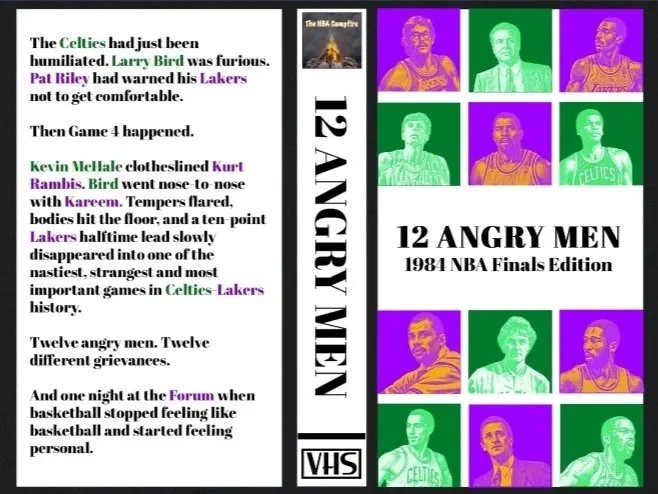
There are twelve men on the cover of this column.
Eleven of them are pissed off. The twelfth is Robert Parish.
That is more or less the organizing principle for what follows.
Because anger is a funny emotion to have on display in a basketball game. Sometimes it looks exactly like you’d expect. It looks like two guys going nose-to-nose after the whistle blows. It looks like somebody screaming obscenities at an official. It looks like Kevin McHale clotheslining Kurt Rambis out of midair, which is admittedly a fairly unambiguous example.
Other times, it looks different. It’s more subtle.
It looks like a coach watching the exact disaster he warned his team about beginning to materialize. It looks like a player missing the same shot twice and staring at the rim like it has betrayed him. It looks like one of the greatest scorers who ever lived playing brilliant basketball, only to get dragged into a street fight and whistled out before he can finish it. It looks like a player standing at the free-throw line about to inherit an unfortunate nickname.
And sometimes, apparently, it looks like K.C. Jones walking like a duck.
That’s Game 4 of the 1984 NBA Finals.
Not one story about twelve angry men, exactly. Rather, it’s a collection of twelve different reasons to be angry, all colliding inside the same basketball game.
So rather than tell this one possession by possession, we’re going to tell it through these twelve men: Larry. Cornbread. K.C. Cooper. McHale. Rambis. Riley. DJ. Parish. Kareem. Worthy. Magic.
Twelve men. Twelve grievances.
One night in Los Angeles where, by the time it was over, practically everybody had a reason to be pissed off.
Larry Bird - Angry at everybody, and also, the reason everybody else ends up angry
“We played like a bunch of sissies.”
Larry Bird had apparently decided that subtlety was not going to get the job done.
The Celtics had just lost Game 3 of the NBA Finals by 33 points, the worst Finals defeat in franchise history. Magic Johnson had dished out a Finals-record 21 assists. The Lakers had run Boston out of the Forum in such humiliating fashion that afterward Bird sounded less like the best player on the team and more like a guy who was going to war with eleven total strangers wearing Boston Celtics uniforms.
Years later, Bird admitted that his anger went considerably further than the quote suggested. He wanted to fight his teammates.
All of them.
And because fighting eleven coworkers individually would have been both time-consuming and generally frowned upon – even in a city as gritty and rebellious as Boston – Bird settled for the next best thing: he used the media to piss them off.
Asked what Boston needed before Game 4, Bird offered another diagnosis:
“Twelve heart transplants.”
This was not exactly the standard superstar response following a playoff loss. There was no We just have to execute better. No Credit to the Lakers. No We’ll watch the film and make adjustments.
Larry Bird went with: My teammates are cowards and all of their hearts need to be surgically replaced, ideally by the heart of someone who gives more of a shit about winning an NBA Championship than these guys do.
And then, importantly, Bird spent Game 4 behaving like a man who understood that if he was going to question everyone else’s courage publicly, he had better be willing to spend the next three hours proving his own.
In typical Larry Bird fashion, he was everywhere.
He fought for position inside. He threw his body into traffic. He pestered Michael Cooper seemingly whenever an opportunity presented itself. Eventually, he ended up nose-to-nose with Kareem Abdul-Jabbar, screaming at a 7-foot-2 man who had already spent most of the evening looking considerably angrier than he usually looked.
And Bird rebounded the basketball like he was pissed off that the shot dare come off the rim.
Twenty-one rebounds in total. Nine of them on the offensive glass.
This stat mattered more than any other because the Celtics weren’t going to beat the Lakers by playing the kind of game Los Angeles wanted to play. The Lakers were faster. They were devastating in transition. They had just spent Game 3 turning Celtics misses and turnovers into a Magic Johnson highlight reel.
So Bird helped drag Game 4 into the proverbial mud. Into traffic. Into second chances. Into loose balls. Into shoves and elbows and arguments and possessions where everybody had to earn six inches of floor space the hard way.
He had called his teammates soft. Then he spent Game 4 making sure the basketball game itself would be anything but.
And somewhere along the way, Bird’s anger became contagious.
Cedric Maxwell was already annoyed. K.C. Jones was about to start walking funny. Michael Cooper was going to spend much of the night wishing Bird would simply leave him the hell alone.
Kevin McHale was eventually going to clothesline somebody and Kurt Rambis was going to have some understandable thoughts about that.
By the end of the night, almost everybody inside the Forum had found something—or someone—to be pissed off about.
Larry Bird just got there first.
Cedric Maxwell - Angry because of what Jerry West said following Game 3
Cedric Maxwell did not need to be called a sissy, nor did he need a heart transplant. He did not need Larry Bird to make him angry.
He had Jerry West for that.
Sometime after Game 3, the Hall of Fame Lakers star turned Lakers general manager suggested that through the first three games of the Finals, second-year forward James Worthy had been the best player in the series.
Maxwell, the 1981 NBA Finals MVP, did not care for that assessment.
“It took me six games to earn that award,” Cornbread quipped after he heard Jerry West’s remark.
This is an objectively funny thing to be mad about in the middle of an NBA Finals series, but also exactly the kind of thing Cedric Maxwell would be mad about in the middle of an NBA Finals series.
There was pride involved. Territoriality. A little bit of who the hell do you think you are handing this thing out already?
And then, almost immediately after Game 4 began, Maxwell was given another reason to be annoyed.
Boston won the opening tip. Almost instantly, Maxwell found himself going up for a lay-in just seconds into the game, but Kurt Rambis fouled him hard enough to send him tumbling directly into the photographers.
One possession. That was all it took.
Before Boston had even settled into the game, Maxwell had already been publicly slighted, physically dumped into the baseline seats, and generally reminded that this was not going to be a calm evening in Hollywood.
The Lakers, meanwhile, picked up exactly where they had left off in Game 3. They ran. They attacked in transition. They got Boston chasing. They looked faster, hungrier, and better prepared.
By the middle of the first quarter, Los Angeles had already built a 29-21 lead and the game was starting to develop the same familiar shape as the 33-point beatdown two nights earlier.
Boston called timeout, which, considering the mood of the individuals involved, was probably for the best.
The Celtics responded with an 11-4 run to close the quarter, and for a few minutes, anyway, everybody appeared slightly less angry.
K.C. Jones - Angry enough for his toes to give him away
K.C. Jones was not an especially demonstrative man.
He rarely yelled. Rarely raised his voice. Rarely gave anyone watching from the outside much indication of what was happening inside his head.
Which meant that if you wanted to know whether K.C. Jones was angry, apparently you had to look at his feet.
Early in the second quarter, Bird scored inside through contact. No whistle, which in a game with 76 total free throw attempts, was noteworthy. Jones believed Kareem Abdul-Jabbar had gotten away with what would have been his third foul of the game, and for one of the few times all night, the Celtics coach lost his composure enough to earn a technical foul.
Dick Stockton pointed out how unusual the sight was. Jones rarely got mad, Stockton said. Rarely even spoke above a whisper.
But Tommy Heinsohn, former Celtics player turned CBS color commentator turned full-blown Celtics homer, knew better.
“Well, when he gets mad, he starts to duck walk. His toes start pointing out, you know he’s mad,” Heinsohn noted.
CBS immediately cut to K.C. Jones, and sure enough, his toes were pointing out.
There are plenty of ways for a basketball coach to express outrage. Bobby Knight threw chairs. Coaches have screamed themselves hoarse, ripped off jackets, loosened their ties, and chased referees down tunnels.
K.C. Jones apparently became a duck. And I can’t even begin to tell you how funny I find this to be.
Boston had briefly steadied itself after falling behind 29-21 in the first quarter, closing the period on an 11-4 run to pull within one. Then the second quarter started, and Los Angeles promptly went on a 14-1 run.
Every time the Celtics appeared to find their footing, the Lakers found a way to knock them off balance. The same transition attack that had humiliated Boston in Game 3 kept popping up, resulting in easy baskets. The same problems kept resurfacing. And now Jones was watching a possible third foul on Kareem disappear while Bird finished through contact.
So the toes went out. The duck walk arrived. And somewhere inside the Forum, the least visibly angry man on the Celtics bench had officially joined the party.
Michael Cooper - Angry because Larry Bird won’t leave him alone
Michael Cooper had a Larry Bird problem.
To be fair, so did most of the NBA in 1984. But Cooper’s was unusually literal.
Late in the second quarter, Cooper cut to the basket, took a beautiful feed from Kareem Abdul-Jabbar and finished at the rim. Perfectly normal basketball play. Nothing for anybody to be angry about, right?
Then as Larry Bird grabbed the ball and readied himself to throw an inbounds pass, Cooper found himself attached to Bird’s backside, and perhaps predictably, Bird did nothing to avoid the contact.
Bird backed into Cooper. And then he kept backing up and kept backing up until Cooper found himself getting walked directly into the photographers while trying to complete the fairly routine task of running back to the defensive end of the floor.
There was no real basketball reason for any of this. Larry Bird was simply being Larry Bird, which on this particular night meant turning every available dead ball into an opportunity to irritate somebody.
Cooper did not appear amused, but unlucky for the Lakers swingman, Bird wasn’t finished with him.
By the first timeout of the third quarter, the two were exchanging words again as their teams walked back toward their respective benches.
This was not especially surprising. Cooper was one of the league’s premier perimeter defenders, a player that Bird would eventually say was one of the best he ever faced. He was exactly the kind of long, irritating opponent Bird spent years battling. But don’t feel too bad for Larry Bird, because it’s entirely possible that The Hick From French Lick enjoyed making his Coop miserable.
Game 4 was apparently not going to be an exception.
The Lakers had taken a 68-58 lead into halftime, and Boston had already spent most of the night trying to figure out how to keep Los Angeles from turning every loose ball and long rebound into a track meet.
The answer, increasingly, was to make the game less comfortable.
Slower. More physical. More annoying. More like the kind of game you’d expect a team from Boston to want to play.
And nobody on the floor appeared more committed to the “annoying” portion of that strategy than Larry Bird. Michael Cooper just happened to be standing closest to him.
Unfortunately for the Lakers, Boston was about to move beyond annoying.
Kevin McHale - Angry enough to clothesline a grown man
Kevin McHale had missed the first five shots he attempted in Game 4. And probably even more irritatingly, the Celtics had spent most of the first half watching the same movie they had watched two nights earlier.
A Celtics possession ends with a missed shot or a turnover, and a Lakers possession began (and then end) with a stampede of players in purple and gold sprinting the other way.
By halftime of Game 4, the Lakers led 68-58, and Boston was once again losing the game on Los Angeles’ terms. So early in the third quarter, Kevin McHale went ahead and changed the terms.
James Worthy caught an outlet pass in on the left side of the court with Kurt Rambis streaking down the middle of the floor. Gerald Henderson was back. McHale was back. Worthy gave it up to Rambis, who gathered the ball and rose toward the rim, and rather than making a play on the ball, Kevin McHale made a play on Kurt Rambis.
One arm across the upper body. Full clothesline. John Bradshaw Layfield would be proud.
Rambis went horizontal and crashed to the floor. And just like that, Game 4 turned into an all-out fucking war.
There had already been pushing. Complaining. Jawing. Blatant attempts at aggravation.
But this was different.
This was Boston announcing that if the Lakers wanted to keep turning the game into a track meet, there were going to be some hurdles they needed to clear. And not like the hurdles runners jump over in a traditional track meet. We’re talking about the sorts of hurdles that pop up out of nowhere on Wipeout.
The Forum erupted. Rambis immediately got back to his feet looking for McHale. Both benches emptied. The crowd started chanting “Boston sucks.”
And Kevin McHale?
He received a common foul.
Yup, that’s it.
In 2026, a play like this one would result in an ejection, suspension, fine, and possibly even criminal charges. In 1984, everybody eventually went back to their benches and continued playing basketball. Very heated basketball, but still.
Bird had spent the previous two days trying to make the Celtics angrier. But Kevin McHale’s left arm had just made sure the Lakers were angry too.
Kurt Rambis - Take a wild fucking guess
Pat Riley - Angry because he fucking warned them
Pat Riley had already told his team this could happen.
After the Lakers dismantled Boston by 33 points in Game 3, Riley was asked about the possibility that his team might feel a little too good about itself. He did not sound particularly interested in celebrating.
“I’m concerned about us feeling too good about our game,” Riley answered. Then came the warning.
“To play the Boston Celtics, we have to be ready physically and emotionally. If you get caught half-stepping with them, you’re in trouble.”
Two days later, Kevin McHale clotheslined Kurt Rambis.
So, yeah. Pat Riley fucking warned them.
The frustrating part was that for most of Game 4, it looked like the warning might not matter.
The Lakers were still running. Still getting out in transition. Still making Boston look older and slower than them whenever the Celtics allowed LA to dictate the terms.
Los Angeles led by 10 at halftime.
Then in the third quarter, McHale and the Celtics started to change the terms.
The Celtics mucked everything up. They cut off the Lakers’ transition opportunities. They turned possessions into wrestling matches. They started winning the loose balls and second chances. And most importantly, they started forcing turnovers.
Los Angeles had committed just four turnovers in the first half. By the time Pat Riley was forced to burn a 20-second timeout after LA’s lead was cut to two, they had committed eight in the opening nine minutes of the second half.
This was the game Pat Riley had been worried about. The one he addressed as a possibility immediately following Game 3. Not necessarily because Boston was playing better basketball. Because Boston had succeeded in changing what this basketball looked like. What this basketball game felt like.
The Lakers wanted speed and open spaces. The Celtics wanted a total fucking grind in a phone booth.
Pat Riley had warned the Lakers not to get comfortable because Boston would certainly respond with physicality and resiliency. That’s the very definition of Celtic Pride, right?
Now Kurt Rambis was picking himself up off the floor, the Forum was chanting “Boston sucks,” and a ten-point halftime lead was down to just two.
There are few things more infuriating than watching a disaster unfold. Except, maybe, watching one unfold after you specifically told everybody it was going to happen.
Dennis Johnson - Angry at the rim
Dennis Johnson was not angry at another person.
He was angry at an 18-inch circle of orange metal.
By the fourth quarter, Boston had finally turned Game 4 into the kind of game it needed. The Lakers weren’t running as freely. Every possession felt heavier than the one before it. And thus, their lead was shrinking.
And twice, Dennis Johnson had a chance to make the Forum considerably more nervous.
Twice, Boston got out in transition with a chance to cut the Lakers’ lead to one.
Twice, DJ attacked the basket in transition.
And twice, the ball refused to cooperate.
Both of the shots had been contested, so neither immediately felt like a catastrophic mistake. Neither was the kind of shot you’d watch later and wonder what the hell Johnson had been thinking.
They were just two chances. Two layups. Two opportunities to get Boston within a single point after spending most of the night chasing Los Angeles around the Forum. And both of them rolled away.
There are more dramatic ways to become angry during an NBA Finals game. You can get clotheslined. You can get called a sissy by Larry Bird. You can watch your coach’s carefully articulated nightmare come true in front of him.
Or you can spend nearly two hours fighting your way back into a basketball game, finally see the door crack open, and have the rim slam it shut twice. And as a result, the Lakers took a five-point lead into the final minute of the fourth quarter.
Robert Parish - Somehow the only guy in the Forum who isn’t angry
Robert Parish was apparently doing just fine.
We know Robert Parish was capable of anger. Years later, Bill Laimbeer’s punchable face would receive fairly conclusive evidence of that.
But Game 4 of the 1984 NBA Finals?
Kevin McHale clotheslined Kurt Rambis. Larry Bird spent the evening antagonizing half of Los Angeles. Kareem Abdul-Jabbar was screaming at people. K.C. Jones was walking like a duck.
And Robert Parish looked approximately the same as Robert Parish always looked.
Which was fortunate, because while everyone else was busy getting pissed off, Parish had work to do.
Boston had finally taken the lead in the fourth quarter, but the Lakers refused to go away. With 39 seconds remaining, Los Angeles was back in front by five, and the Celtics were running out of time.
Parish caught the ball inside. Bucket. Foul. Free throw.
Five points became two just as quickly as you could say, “Typing out K.C. Jones was walking like a duck makes me laugh every single time.”
This was what Parish had been doing all night. Nothing especially theatrical. No screaming. No shoving match. No visible existential crisis. No meltdown because of the officiating. Just work.
Boston was dominating the offensive glass, piling up second chances in a game where almost every possession had become a fistfight. Parish was right in the middle of all of it.
Then, with the game tied and the Lakers trying to get a good shot to potentially win the game, Magic Johnson attempted an entry pass toward James Worthy.
Parish stepped in front. Steal. Overtime.
The Forum had spent the entire night slowly losing its mind. Robert Parish had spent it grabbing rebounds, scoring inside, making enormous defensive plays and handling this game like a rational, even-keeled adult in the building.
Maybe that was his version of angry. Or maybe Robert Parish was simply the one man in the building who understood that somebody still had to play basketball.
Kareem Abdul-Jabbar - Somehow the angriest man in the building
Kareem Abdul-Jabbar was thirty-seven years old when this game was played. For context, that’s older than me, and I’m practically a fifty-two year-old man.
He had played more than 1,000 NBA games. Won five MVP awards. Won three championships. Scored more points than anyone who had ever touched a basketball. He had presumably seen some shit. And somehow, Game 4 of the 1984 NBA Finals had Kareem Abdul-Jabbar acting like the angriest man in the Forum.
It started early.
Kareem picked up his second foul in the first quarter while trying to deflect an entry pass intended for Robert Parish. Later, he got tangled up with Gerald Henderson, didn't get the whistle he wanted and made his displeasure obvious.
Then James Worthy fouled Larry Bird in the paint. A perfectly reasonable foul. One that Worthy himself wouldn’t even argue against. But Kareem was furious anyway.
By this point, Dick Stockton had started noticing a pattern. Throughout the broadcast, he repeatedly remarked on just how animated Abdul-Jabbar had become.
This was not normal Kareem. And Larry Bird, being Larry Bird, eventually decided to investigate exactly how abnormal things could get.
During the second half, Bird and Kareem chased a loose ball into almost the exact same patch of floor where Kevin McHale had clotheslined Kurt Rambis earlier. Arms started swinging. Kareem threw an elbow that grazed the side of Bird's head. Bird didn't move, but he did start chirping, and a moment later, two of the ten greatest basketball players to ever live were nose-to-nose, screaming at each other.
Now I want you to think about this whole kerfuffle for a second.
Kareem Abdul-Jabbar—one of the most cerebral, dignified, outwardly controlled superstars in the history of professional sports—had reached the point where other grown men were physically preventing him from continuing an argument with Larry Bird.
It was verification that Larry Bird's plan was working beautifully.
The Celtics had wanted Game 4 to become uglier, slower, more physical and considerably less pleasant than the Lakers preferred it to be. By the second half, they had even managed to drag Kareem into the mud. And then with 16 seconds remaining in regulation, the mud swallowed him whole.
Kareem went over Bird’s back going for a rebound. The whistle blew and Kareem was charged with his sixth foul. Bird went to the line and made both free throws, a sequence that almost assured that this game would go to overtime and Kareem Abdul-Jabbar wouldn’t get to be part of it.
So one of the greatest scorers who ever lived spent the night carving Boston apart one skyhook at a time, got pulled into a street fight, and then was whistled out of it before he could see the ending.
For most players, that might have been enough to make them angry.
Kareem had apparently gotten there about two hours earlier.
James Worthy - Angry because his masterpiece is being wasted
James Worthy was having one of those nights where, had the Lakers won this game, we might remember his career slightly different because of it. Worthy made fourteen of his seventeen field goal attempts, scoring 30 points, trailing only Kareem Abdul-Jabbar, who had spent the last decade and a half proving he was the most automatic two points in the NBA.
But Worthy was only twenty-two years old and had fewer than 200 professional games under his belt. This wasn’t expected, but the fact that James Worthy was having a night where nearly everything was going right was a welcome sign for the Lakers.
Which made it especially irritating when Danny Ainge decided the easiest way to stop him was to simply grab him.
Late in the third quarter, Bob McAdoo blocked Robert Parish at one end and the Lakers were running again. Worthy took off in transition, exactly where Los Angeles wanted him, until Ainge committed one of those fouls that contained absolutely no pretense of being a basketball play.
Worthy immediately spun around, whipped his arms through the air and slammed the ball against the floor.
“If James Worthy didn’t have such a cool, calm, collected demeanor, I think he might’ve taken a shot at Danny there.”
That was about as close as Big Game James usually came to losing his shit. And honestly, Danny Ainge was the least of his problems. Because Worthy was playing damn near perfect basketball in a game the Lakers somehow could not put away. Boston had spent the second half dragging Los Angeles deeper and deeper into the mud. The transition opportunities disappeared. The turnovers piled up. Kareem fouled out. A ten-point halftime lead was gone and now the two teams were left to play an additional five minutes.
But even in overtime, with everything around him beginning to wobble, James Worthy kept finding answers.
With Los Angeles trailing 121-120, Worthy attacked the basket, finished through contact and converted the free throw.
Lakers 123, Celtics 121.
Stockton called him “a devastating offensive force,” and even if such a statement about a second-year player who averaged just 14.5 points per game in the regular season, on this night he was indeed devastating.
But sixteen seconds later, Larry Bird erased the lead, and now Worthy was watching one of the best games of his life turn into something considerably less memorable.
With ten seconds remaining and Boston ahead 125-123, Worthy went to the free-throw line with a chance to tie it.
First free throw: good.
Second free throw: not so good.
Thirty points. Fourteen-for-seventeen. Huge baskets when the Lakers desperately needed them. And still, somehow, not enough.
There are nights when you play badly and deserve to lose. There are nights when somebody else is simply better.
And then there are nights when you create something resembling a masterpiece and have to stand there helplessly while the people around you spill paint all over it.
Magic Johnson - Angry because everyone is about to start calling him ‘Tragic’
Earlier in the night, Magic Johnson had been angry at everybody else.
During the second quarter, he got tangled up with Cedric Maxwell chasing a loose ball. Magic wanted a whistle, but he didn’t get one. He complained to the officials, exchanged words with the Celtics bench, and had to be separated from the general nonsense as both teams headed toward their benches following a timeout. Nothing unusual by the standards of this game.
By the end of the night, Magic would be angry at someone else entirely… himself. His anger had nowhere else to go but inward.
This was supposed to be Magic’s series. Two nights earlier, he had carved Boston apart with 21 assists, an NBA Finals record. The Lakers had won by 33. Showtime looked faster, younger, better, and poised for a championship, which would’ve been the third in Magic’s young career. Every Boston miss seemed to lead to an outlet pass to Magic Johnson, and every outlet pass seemed to lead to another Lakers layup.
Even in Game 4, Magic was brilliant for long stretches. Twenty points, seventeen assists, eleven rebounds. A triple-double in the NBA Finals. That’s nothing to scoff at.
But absolutely nobody remembers it that way.
Because Game 4 joined Game 2 in becoming one of those basketball games where everything that happened for two and a half hours eventually got reduced to a handful of possessions at the end.
In Game 2, Magic had already been involved in the Lakers’ late-game collapse, dribbling out the clock and failing to get a shot when the Lakers had a chance to steal a second straight game in Boston to start the series. Now Boston had dragged Game 4 into overtime, Kareem Abdul-Jabbar had fouled out, James Worthy was playing one of the best games of his life, and Los Angeles still had another chance to escape.
The score was tied at 123 and Magic was going to the free throw line, where for his career he would end up an 85 percent shooter. So this was an awfully inopportune and totally unexpected time for him to back-rim back-to-back free throws and leave the game tied.
And to make matters worse, Boston came down the other way and did the cruelest — and smartest — thing possible: they gave the ball to Larry Bird, who posted up with Magic Johnson defending him, and he hit a turnaround fadeaway jumper right in Magic’s grill.
Celtics 125. Lakers 123.
Worthy would split the pair of free throws and Boston would go on to close it out by the final score of 129-125. The series was once again tied, and suddenly Magic Johnson’s triple-double felt like trivia.
That is the particularly vicious thing about basketball memory. It does not always care about the first 47 minutes. Or even the first 51 and change. Sometimes it takes an entire brilliant performance, folds it into a brain-fart or one missed pass or two missed free throws, and it stamps a different label over the whole thing.
Magic was about to learn that lesson in the least subtle way possible.
The late-game mistakes from Games 2 and 4 became ammunition. Boston fans and the basketball press found the obvious play on his nickname.
Magic became Tragic.
It is one of those nicknames that feels almost impossibly cruel in hindsight, because we already know what Magic Johnson would become. Shit, we know what he already was. We know about the championships still coming. We know about 1985, when the Lakers would finally beat Boston in the Finals. We know about the MVPs, the Finals MVPs, the smiles, the fast breaks, the mythology.
But in this moment, Magic did not know any of that yet. All he knew was that Los Angeles had just let another game against Boston slip away.
There had been twelve angry men scattered throughout the Forum that night.
Larry Bird was angry at his teammates.
Cedric Maxwell was angry at Jerry West.
K.C. Jones was angry enough to start walking like a duck.
Michael Cooper was angry at Bird.
Kevin McHale was angry enough to clothesline Kurt Rambis.
Kurt Rambis was—well, you saw the video.
Pat Riley was angry because he had warned everyone.
Dennis Johnson was angry at eighteen inches of orange metal.
Kareem Abdul-Jabbar was angry at damn near everything.
James Worthy had just watched a masterpiece get wasted.
Robert Parish remained Robert Parish.
And Magic Johnson?
Magic had to deal with the worst kind of anger of all. The kind where there’s nobody left to blame but yourself.
Larry Bird began this story angry at everyone. Magic Johnson ended it angry at himself.
Next Up on Throwback Tapes: ‘Best of 5’ (November 12)