The Throwback Tapes: Kings vs. Timberwolves, Game 7 of the 2004 2nd Round
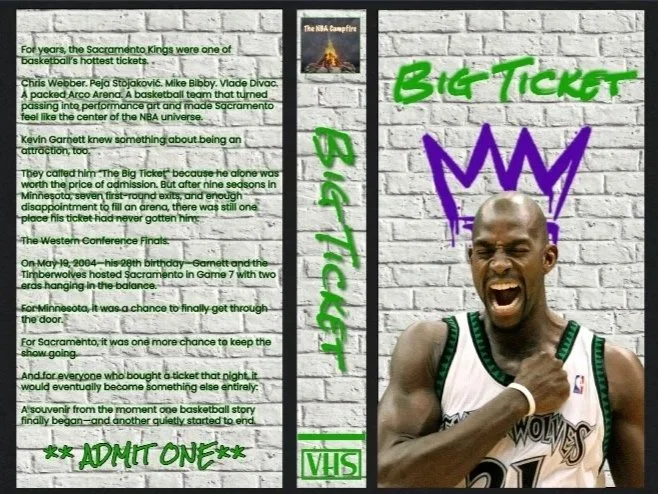
A ticket stub is one of the dumbest things a person can get sentimental about, which is of course why people get sentimental about them.
It is a tiny rectangle of paper that once had exactly one job — get you through a door — and then it almost immediately becomes useless. You were supposed to throw it away. Most people did. But sometimes one survives in a junk drawer or an old wallet or a box labeled IMPORTANT that also contains a few dead batteries, some paper clips, a $1 chip from an out of town casino you visited once, and a phone charger so old it can now legally obtain a driver’s license.
And then, twenty years later, you find it again and realize the ticket was not useless at all. It was proof. Proof of your presence. Proof that on one particular night, in one particular building, you sat in one particular seat and watched something happen that could never happen exactly that way again. The names may have changed teams. The building may have changed names. The people sitting around you may have become complete strangers in your memory. But the ticket remains, quietly insisting that you were there.
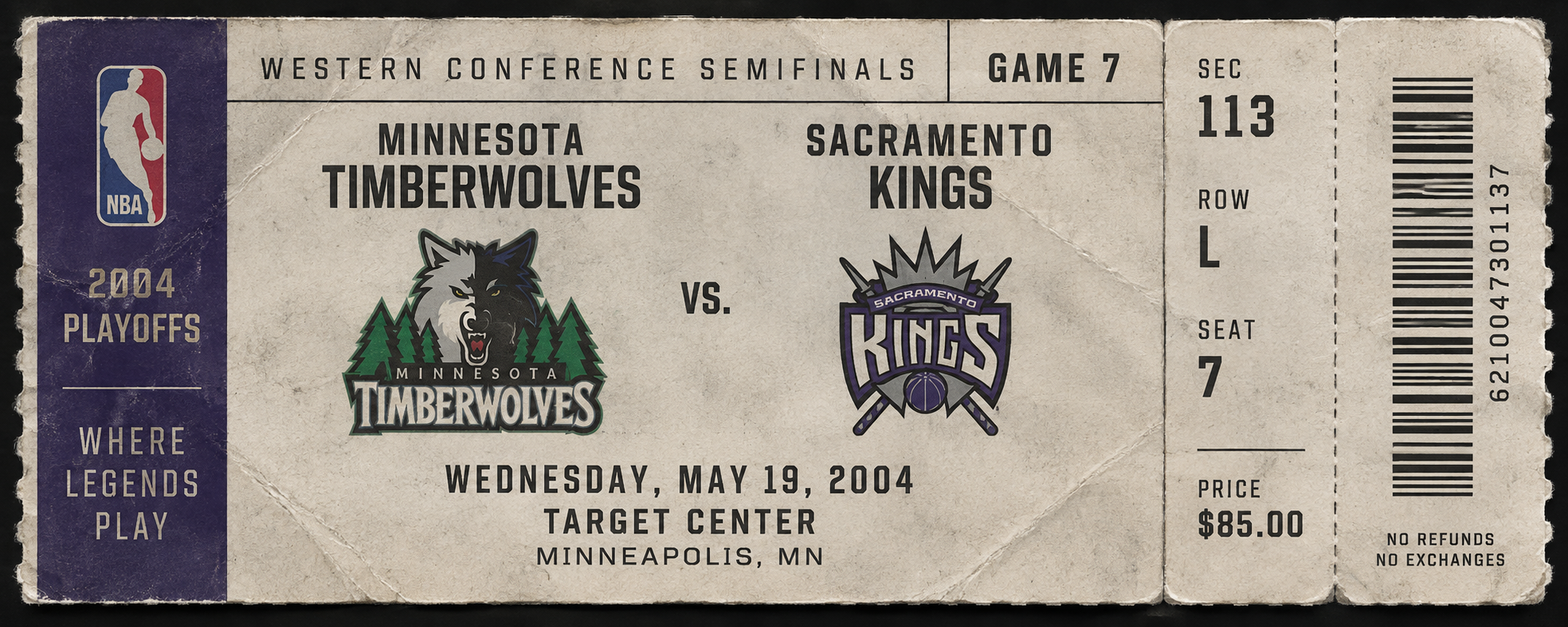
And if one of those little rectangles happened to read May 19, 2004 — Sacramento Kings at Minnesota Timberwolves — Western Conference Semifinals, Game 7, it would be carrying a hell of a lot more than a seat assignment.
At the time, it was simply admission to the biggest basketball game Minnesota had ever hosted. The Timberwolves had never played in a Game 7. Kevin Garnett had never reached a conference finals. Sacramento, meanwhile, was trying to wring one more postseason run out of the team that had spent the previous half-decade turning basketball into something closer to performance art.
The Kings were not merely good. Plenty of teams are good. Good teams win 50 games, exit the postseason in forgettable fashion and eventually disappear into Basketball Reference. The Kings were good in a way that makes people nostalgic for a team they didn’t even root for. They didn’t just win games; they altered the way people remembered that stretch of basketball — the passing, the pace, the noise in Arco, the feeling that something inventive and electrifying might happen on any possession.
They were so good that they’ve come to define a generation of basketball despite falling short of the NBA Finals every single season.
For a few years, Sacramento became one of the NBA’s hottest tickets because the Kings offered something beyond the possibility of winning. They offered a show. Arco Arena shook. Cowbells rang. Every extra pass seemed to lead to another, until all five players were moving as if they had all been let in on the same secret. And that’s because everybody in the production had a part.
Chris Webber was the headliner, a power forward with the hands of a point guard and enough athleticism, at his peak, to make offensive basketball sometimes seem unfair.
Vlade Divac was the old magician standing at the elbow, seeing cuts develop before the cutter seemed entirely sure he was going to make one, throwing passes a center of that era had no business throwing.
Peja Stojakovic spent possessions disappearing and reappearing around screens, dizzying poor defenders until they were mercifully put out of their misery with a smooth Stojakovic jumper from one of the wings.
Mike Bibby calmly arriving at whatever spot on the floor he needed to get to, giving Sacramento the kind of calm, dependable point-guard play that let everybody else indulge their more adventurous instincts.
Even the rest of the supporting cast seemed to fit the aesthetic. Doug Christie handled the dirty work, defending opposing stars and keeping the machinery from becoming too flashy for its own good. Bobby Jackson entered games off the bench with the energy of someone playing the game with the fast-forward button permanently pressed down. Brad Miller looked considerably more interested in partaking in a bar fight than a basketball game, but then he started slinging passes around and knocking down feathery jumpers like he had been raised in the same hoops laboratory as the rest of his teammates.
That was the trick of those Kings. The ball could find Webber, then Divac, then Christie, then Bibby, then Peja, and somehow none of them seemed particularly interested in being the person who kept it and took the shot. Sacramento made the extra pass feel less like an act of unselfishness than a dare: What if there’s an even better shot hiding one pass from now?
By May of 2004, though, you could still recognize the show. You just had to squint a little harder to see the production that had once earned such rave reviews.
The names were mostly the same. The sets were still standing. The choreography remained. But Webber’s surgically repaired knee had stolen some of the violence from his game, Divac was another year older, and the beautiful basketball machinery occasionally needed an extra beat to turn over. The Kings could still make a difficult game look easy. They just had to work a little harder to make it look that way.
And on the other side of the court stood a man whose entire career had been built around making the ordinary look exhausting.
Kevin Garnett had been worth the price of admission for years.
Now he was trying to find out where that admission could actually take him.
For most of Garnett’s career, the answer had been painfully simple: the opening round of the NBA Playoffs.
Seven straight trips to the postseason had ended without a single series victory, each one adding another layer to the strange tension surrounding his greatness. Nobody seriously questioned whether Garnett was one of the best players in basketball. The question was whether being one of the best players in basketball was enough to get Minnesota anywhere that mattered.
There are a few ways to answer that question, depending on how much responsibility you believe individual greatness carries for the circumstances surrounding it.
You could blame Garnett. That is probably the simplest explanation, and therefore the one we tend to reach for first. The best players are supposed to solve problems. They are supposed to turn mediocre teammates into good ones, good teams into great ones and playoff series into showcases. Once a player reaches Garnett’s altitude, context starts sounding suspiciously like an excuse.
Or you could look at Minnesota.
For years, Garnett was one of the guys in the NBA without ever being surrounded by the kind of roster normally afforded to players of that stature. Stephon Marbury left. The Joe Smith fiasco cost the franchise draft picks and flexibility. Supporting casts changed year by year. And the unforgiving Western Conference did not care about Minnesota’s struggles to build a championship roster.
And maybe that is the third, and likely correct answer: nobody failed.
Maybe Kevin Garnett simply spent the first half of his prime trapped in a conference that was manufacturing championship contenders like a factory line. Duncan’s Spurs. Shaq and Kobe’s Lakers. Dirk’s Mavericks. Portland, before they took on the Jail Blazers moniker. And yes, those aforementioned Sacramento Kings.
There were years when 50 wins in the West did not mean you were close. It only meant you had survived long enough to join the line. That distinction mattered because Garnett had already been inside the NBA’s VIP room for years, but the rest of the Minnesota Timberwolves had not yet been welcomed in.
The 2003–04 season was the first time the Timberwolves finally gave him the proper company, arriving in the form of two thirty-something guards who had already seen enough basketball to be unfazed by the expectations.
Sam Cassell had won championships, played in an NBA Finals and developed the peculiar confidence of a man who seemed to believe every important possession had been designed specifically for him to excel. Latrell Sprewell had been to the Finals too, and brought with him a different kind of assurance — harder, sharper, occasionally combustible, but no less useful when the stakes of a game started to rise.
Most importantly, neither man needed Kevin Garnett to convince him that he belonged there.
For most of Garnett’s career, his supporting casts had required him to be the best scorer, the best rebounder, the best defender, the emotional engine and, on particularly unfortunate nights, something resembling the point guard. Cassell and Sprewell did not eliminate those responsibilities. They simply gave Garnett two teammates capable of carrying some of the weight without asking for his permission first.
Cassell could take the ball late in a game and organize Minnesota’s sets. Sprewell could manufacture offense when the original plan had dissolved into static. Both had spent enough time in playoff basketball to understand that panic or a lack of confidence were both generally more dangerous than whatever the other team was doing.
For the first time, Garnett wasn't surrounded by players hoping he could take them somewhere. He was surrounded by a couple of guys who already knew the way.
The difference was evident almost immediately. Following a sluggish 9-8 start to the season, Minnesota would go 49-16 the rest of the way, finishing atop the Western Conference after spending the entire season looking less like a team borrowing Kevin Garnett’s greatness than one finally equipped to do something with it. Garnett responded with the best season of his career and an MVP trophy, the official recognition of something the league had understood for years: there were very few basketball players on Earth capable of doing more things well on the hardwood than KG.
More importantly, the Timberwolves finally made it through the first door.
Denver lasted five games in the opening round. Seven straight first-round exits became history. The thing that had followed Garnett around for the better part of a decade — that strange, increasingly unfair question of how one of the best players alive could keep disappearing before the playoffs really started — finally lost some of its oxygen.
Then Sacramento arrived, and if the 1st round had been about proving Minnesota could leave the lobby, the Kings were something closer to the velvet rope.
Game 1 offered an immediate reminder that having the right ticket did not guarantee entry. Garnett, freshly crowned MVP and carrying every bit of the emotion that came with that distinction on his shoulders, shot 6-for-21 and turned the ball over six times as Sacramento stole home court. The series spent the next two weeks refusing to settle into anything comfortable, the Kings trying to keep their old show on the road while Minnesota tried to push its way to a place the franchise had never been.
By the time Game 7 arrived, there was almost nothing left to abstract.
Minnesota had never played one, and Garnett had never reached a conference finals. On the other hand, Sacramento had been living in games like this for years.
The same ticket meant two different things: arrival for the Timberwolves, survival for the Kings.
After a panning shot of the Minneapolis skyline and a rundown of each team’s starting lineup, the first thing the TNT cameras found was Kevin Garnett. Already glistening with sweat, KG paced the sideline, tossed his chalk, peeled a fresh sheet from the courtside sticky mat, then sauntered toward the center circle for an opening tip he would control with ease.
Garnett scored on Minnesota’s second possession, turning over his right shoulder and dropping a baseline jumper over Chris Webber. On the next trip down, he switched onto Mike Bibby, picked his pocket under the basket and immediately pushed the ball the other way. The game was barely underway and Garnett already seemed determined to dominate every moment of it.
At the first timeout, Cheryl Miller offered the more complicated version of what everyone was watching. Garnett had been too wound up in Game 1, she explained, overwhelmed by the emotion surrounding his MVP presentation and unable to harness it as Sacramento stole home court away from the Timberwolves. Game 7 carried even more weight. May 19 was also his 28th birthday and the anniversary of the death of Malik Sealy, Garnett’s close friend and former teammate.
The question, Miller said, was whether Garnett could channel all of it.
That was always the strange thing about Kevin Garnett. His greatest strength and his greatest potential liability seemed to come from the same place. Nobody played with more visible feeling. Nobody expended more energy. He screamed, barked, brutalized the basket stanchion, talked to himself, talked to opponents, talked to teammates, talked to the basketball if necessary. The emotional volume was permanently set somewhere near eleven.
On this night, he needed all of it. He just needed to keep it pointed in the right direction. Doug Collins — on the call as the color man alongside the immortal Kevin Harlan — had a simpler way of describing what that control would look like.
“He doesn’t have to do it by scoring 30 plus points,” Collins commented after Cheryl Miller’s sideline spot. “Twenty plus points, twenty rebounds, assists, blocked shots, all the intangibles he brings. He’s a guy who can dominate the game in so many different ways, and his teammates feed off of him.”
Garnett’s gift was never that he could control a game in one obvious way. It was that he could make himself unavoidable in nearly every way at once. And if the first quarter was any indication, KG was well on his way to doing exactly that: 7 points, 6 rebounds, 2 assists, 3 steals, 0 turnovers, and a six-point Timberwolves lead.
As TNT returned for the second quarter, Collins spent an entire package marveling at Garnett’s “all-around brilliance.” Harlan followed by pointing out that Mike Bibby — “the other big name in this game” — was sitting on the Sacramento bench with no points, two fouls and a single assist.
For the Kings, the first quarter had looked less like a continuation of their greatest hits than a touring production beginning to show its mileage. The choreography was still there. The ideas were still recognizable. But everything seemed to require an extra beat.
Early in the game, Doug Christie tried one of those passes that once made Sacramento feel like it was playing a different and more exciting sport — a behind-the-back entry feed toward Vlade Divac. Instead, the ball bounced off Divac’s leg and out of bounds.
It was a tiny thing. Meaningless, really. Except it didn’t feel meaningless.
For years, those passes were why you bought a ticket to see the Kings. Now they reminded you of what Sacramento had once been.
No one made that passage of time more visible than Chris Webber. The instincts were still there. So were the footwork, the passing angles, the soft touch from eighteen feet. What was missing was the violence. The burst. The Holy Shit factor. The version of Webber who once detonated above the rim had been replaced by one who had to solve possessions with timing, angles and guile. He could still beat Garnett with an up-and-under. He could still punish a hard closeout. But every so often, he’d try to dust off one of those old moves only to discover that the old body wouldn’t allow him to.
Every so often, the old Kings would reappear, a treat for any basketball junkie who understood what this team had represented. More often, though, you were simply watching the Kings get old.
Then the second half started, and Sacramento stopped looking old for long enough to start to look familiar again.
On Sacramento’s first possession, Peja Stojakovic came curling around a pindown, found the sliver of daylight that had eluded him throughout a miserable first half, and buried a three. Suddenly the Kings had a little bounce. They chased down loose balls. The jumpers that had landed short began falling through. Passes started arriving a fraction sooner. For the first time all night, the game started moving at something resembling Sacramento’s preferred frequency.
This was the dangerous thing about an aging great team: the old version never disappears completely. It sits there somewhere in muscle memory, waiting for a familiar sequence or a made jumper or five good minutes to coax it back into the room.
And gradually, Sacramento erased Minnesota’s lead. With less than two minutes remaining in the third, Webber stepped into an eighteen-footer from straight away and knocked it down.
Kings 58. Timberwolves 57.
For the first time all night, Sacramento was ahead. The old show had managed to get itself through another act. And suddenly, Target Center remembered exactly what kind of night this was.
The building that had spent most of the evening roaring with anticipation of being taken to the Western Conference Finals began to tighten as Sacramento erased a 13-point deficit and took its first lead. Timberwolves fans had spent seven years learning how quickly a promising season could become a postseason obituary. Now, with twelve minutes separating the franchise from somewhere it had never been, all of that history felt close enough to touch.
Kevin Garnett responded by making sure nobody had to think about this sobering reality for too long.
The fourth quarter belonged to him, and by the final minute, Doug Collins had stopped analyzing and started testifying.
“If Minnesota goes on to win this game, it’s because this guy would not let his team lose.”
And somehow, even after this KG-induced avalanche, Sacramento was still there.
Garnett had spent the fourth quarter trying to slam the door shut, but the Kings kept wedging a foot into the frame. Bibby and Brad Miller worked a clean two-man game that produced a three. Christie kept making plays. Webber kept finding ways to compensate for everything his body could no longer give him.
With a little more than a minute remaining, Bibby drove into the paint and collapsed the Minnesota defense before dropping the ball off to Webber underneath.
Three years earlier, the possession ends violently. Webber rises. The rim shakes. Sacramento is within two. All of the pressure is on Minnesota.
But this was not three years earlier. Webber caught the pass, pump-faked, gathered himself and tried to manufacture the lift that once came naturally. He couldn’t. The layup rolled away.
The old move was still there, but the old body wouldn’t allow him to finish the play.
Sacramento still had one last chance with 2.2 seconds on the clock and no timeouts left. Doug Christie stood on the sideline searching for somewhere to put the ball. Garnett had just blocked Brad Miller at the rim, but the Kings were still alive, still clinging to one final possession, one final chance to keep the show running, trailing by just three points.
Christie threw the pass across the court. It barely cleared Garnett’s outstretched hand. Webber caught it near the left wing, gathered and rose. Garnett recovered just quickly enough to contest, flying past as Webber released a hurried but remarkably clean look.
For a moment, the entire night hung there with the ball.
Minnesota’s first conference finals.
Garnett’s first trip beyond the second round.
Sacramento’s last chance to extend a run that had defined half a decade of basketball.
And for a shot that missed, it came awfully fucking close to going down and potentially re-writing history.
Webber folded to the floor, sinking into something close to Child’s Pose as the Target Center went ballistic around him. Garnett celebrated briefly with Sprewell and Wally Szczerbiak, then turned back toward the man who had just missed the shot.
Garnett walked over and embraced Webber. One man had finally gotten through the door. The other had just watched it close.
“Seven years I been knocked out and now we’re going to the Western Conference Finals,” Garnett said. “I feel pretty good.”
Pretty good was one way of putting it, and maybe, given what we know now, it’s the proper summation of the moment.
The Western Conference Finals appearance was not the beginning of a dynasty in Minnesota. It was the summit.
Minnesota would lose that series to the Los Angeles Lakers in six games in the Western Conference Finals, and there was something fitting about who was waiting for them there. Los Angeles had spent the previous five years owning the Western Conference, turning the month of June into something close to a standing reservation. Beating Minnesota would become the last shining moment of that run — one final trip through the West before the Detroit Pistons — and an increasingly tumultuous rivalry between Shaquille O’Neal and Kobe Bryant — ended the dynasty for good in the NBA Finals.
For the Timberwolves, there would be no return trip.
They would not make the playoffs again for the remainder of Garnett’s first tenure in Minnesota. What felt in the moment like a breakthrough turned out to be a brief clearing, one season in which the roster, the timing and Garnett’s own brilliance aligned just long enough to show everyone what the franchise might have been capable of.
So even at Minnesota’s highest point, it was surrounded by endings.
Sacramento was fading. The Lakers were making one last march through the conference they had ruled for years. Minnesota had finally arrived, only to discover that arrival did not guarantee permanence.
Maybe that is why the ticket matters.
The teams changed. The players got older. The dynasties ended. The window Minnesota had spent years trying to pry open slammed shut almost as quickly as it was left ajar. Even the building itself eventually became home to different uniforms, different stars, different dreams.
But somewhere, maybe, that little rectangle of paper survived all of it.
The Big Ticket had finally gotten Minnesota through the door. And the ticket that got somebody into the building that night had become something else entirely.
Before the game, it was admission. Afterward, it was a souvenir. Twenty-two years later, it is proof.
Next Up on Throwback Tapes: ‘Linsanity Running Wild’ (September 30)